
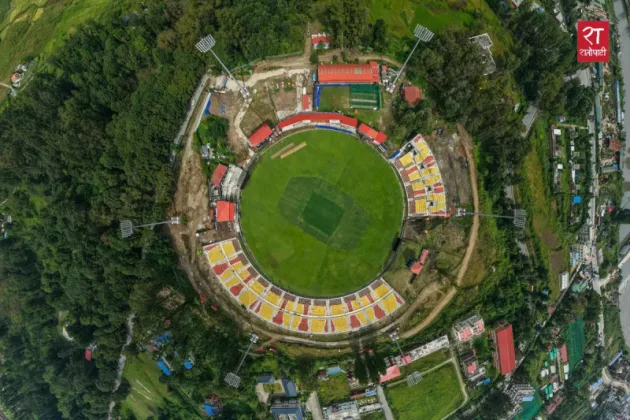
The floodlights at the Tribhuvan University (TU) International Cricket Ground in Kirtipur were switched on during the daytime on Thursday after weather over the Kathmandu Valley turned overcast and natural light began to fade. According to reports, the artificial lights came on from around 3 pm, allowing the Nepal Premier League (NPL) match under way at the ground to continue in adequate visibility. Janakpur Bolts were among the teams in action as the lighting towers glowed against a darkening afternoon sky, producing one of the more unusual scenes seen at the Kirtipur venue in recent days.
Floodlights glow in mid-afternoon as valley skies turn grey
The sequence of events was straightforward but striking. As the afternoon progressed on Thursday, cloud cover over the Kathmandu Valley thickened and daylight over the stadium dimmed noticeably. Rather than suspend play, those managing the match had the floodlights switched on, with RatoPati reporting that the lights at the TU International Cricket Stadium were lit up during the day after the weather turned overcast.
Thaha Khabar similarly noted that the lights were turned on from around 3 pm as daylight faded in the afternoon, while Aja ko Artha also covered the daytime use of the stadium's lighting system. For a ground where the floodlight towers are ordinarily associated with evening and day-night fixtures, seeing them fully illuminated while the sun had not yet set was an unfamiliar sight, and one that immediately signalled how heavily the overcast conditions had cut visibility over Kirtipur.
Floodlights at cricket stadiums exist for exactly this kind of situation, though usually at a later hour. They are designed to keep matches playable when natural light drops below the level needed for batters, bowlers and fielders to see the ball clearly. On Thursday, that technology was called into action in the middle of the afternoon, a reflection of just how gloomy the skies above the Kathmandu Valley had become.
NPL fixture continues under artificial light
The artificial lighting was used for the Nepal Premier League match being played at the TU ground, with Janakpur Bolts among the sides on the field when the lights came on. The switch ensured that the fixture could carry on under proper illumination instead of being halted because of the poor light, and the reports published on Thursday confirmed that the match proceeded with the help of the floodlights after conditions dimmed.
The available reports did not specify Janakpur Bolts' opponent in the fixture, nor did they indicate whether the overcast weather ultimately forced any interruption or shortening of play beyond the daytime use of the lights. What was clear from all three accounts was that the lighting infrastructure at the Kirtipur stadium played a direct role in keeping the NPL game going while the weather over the valley deteriorated.
For players on the field, the transition from fading natural light to full floodlights can be a notable one, as the ball is viewed against a different backdrop and shadow patterns around the ground change. Teams that play regularly under lights are generally well accustomed to such shifts, and the NPL sides taking the field at Kirtipur on Thursday were able to continue their match under a lighting setup built precisely for such moments.
Cricket's dependence on the sky, and Kirtipur's answer to it
Cricket remains among the most weather-sensitive of major sports, with light, rain and cloud cover all capable of affecting play. Overcast conditions in particular can make it difficult for batters to pick the ball out of the sky and for fielders to track high catches, which is why matches at well-equipped venues are moved under lights when visibility drops. Thursday's events at Kirtipur followed that familiar logic, only hours earlier in the day than usual.
The episode also underlined the value of the floodlight infrastructure installed at the TU International Cricket Ground. Because the stadium is equipped with a full lighting system, officials had the option of illuminating the field when the sky darkened, rather than seeing the NPL fixture stall in gloomy conditions. In effect, the daytime switch-on demonstrated that the facility can respond to poor light at any hour, not only after sunset.
With NPL matches continuing at the Kirtipur ground, weather over the Kathmandu Valley will remain a factor of close interest to teams, organizers and fans alike. For now, Thursday's image of floodlights burning against a grey mid-afternoon sky stands as the clearest illustration of how quickly conditions can change, and how the stadium's lights were pressed into service hours ahead of their usual schedule to keep Nepal Premier League cricket on track.


