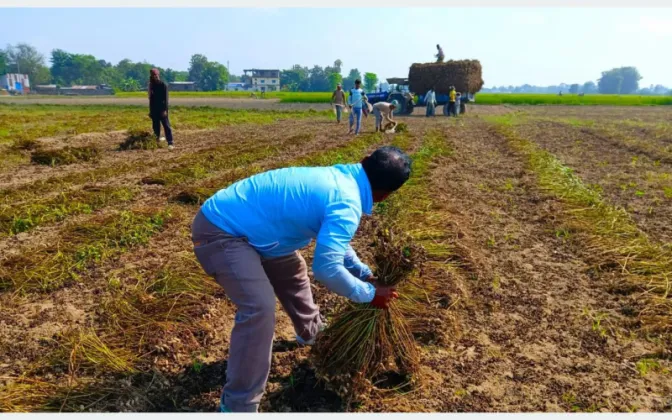
Sixty-five-year-old Raju Agrawal, a farmer from Jhapa Rural Municipality-1 in eastern Nepal, has harvested 20 quintals of peanuts from two bighas of farmland that last year's flood in the Mai Khola river buried under sand. The flood swept away the fertile paddy fields Agrawal had depended on, leaving behind a barren sandbank where his crops once stood. Rather than abandon the land, he decided to experiment with peanut cultivation on the sandy deposits, and the successful harvest has transformed a season of loss into one of renewed hope, according to reports in Ratopati, Khabarhub and Pradesh Khabar.
A sandbank where paddy fields once stood
The Mai Khola, a small river flowing through the area, burst its banks during last year's flood and eroded a large chunk of Agrawal's holdings. In a single event, two bighas of his most productive paddy land were washed away, and what the water did not carry off was buried under thick layers of sand and silt. For a farmer in his mid-sixties, the loss was not merely financial. It struck at the foundation of a lifetime of agricultural work on the same fields.
Sand deposition is among the most damaging legacies of river flooding in the Terai. When floodwater recedes, the sand it leaves behind drains quickly, holds almost no organic matter and is generally unsuitable for water-hungry staples such as paddy. Many affected farmers are left with land they consider written off, sometimes for years, while the cost of removing the sand by machine is often beyond what a smallholder can bear.
Agrawal faced exactly that situation on his land in Jhapa Rural Municipality-1. But instead of letting the sandbank sit idle, he looked for a crop that could survive, and even thrive, in the conditions the flood had created.
A calculated gamble on peanuts
The crop he chose was the peanut, also known as groundnut. Agronomically, the choice made sense. Peanuts prefer loose, well-drained, sandy soils, the very conditions that make land useless for paddy. The nut develops underground in the light, friable soil that heavy monsoon deposits can provide, and the crop generally demands less water than rice. As a legume, it can also play a role in improving soil fertility over time.
The gamble has paid off. Agrawal's peanut crop on the former sandbank has yielded 20 quintals, a harvest that demonstrates the land can still generate income despite the damage it suffered. The key facts of the story are stark in their simplicity:
- Farmer: Raju Agrawal, 65, of Jhapa Rural Municipality-1
- Damage: Last year's flood in the Mai Khola washed away two bighas of fertile paddy land
- Response: Peanut cultivation started on the resulting sandbank
- Outcome: A harvest of 20 quintals of peanuts
For a farmer who had every reason to walk away from the land, the decision to replant the sandbank represents a quiet but significant act of adaptation. The 20-quintal yield does not erase the loss of the paddy fields, but it proves that the flood-damaged plot can still feed a household and generate income.
A lesson for flood-hit farmers across the Terai
Agrawal's experience carries a wider relevance beyond one farm in Jhapa. Every year during the monsoon, rivers across Nepal's southern plains erode farmland and dump sand on fields that took generations to build. Farmers in flood-prone settlements routinely face the same dilemma Agrawal confronted: wait for the land to recover, sell it at a distressed price, or find a crop suited to the changed soil.
His case suggests a fourth path, one grounded in working with the new conditions rather than against them. Crops that tolerate sandy, fast-draining soils can convert a sandbank from a write-off back into productive land. Peanuts, with their preference for exactly such soils, are a natural candidate, and Agrawal's 20-quintal harvest now stands as local proof of the concept.
There are caveats. A single successful harvest on a single farm does not guarantee that peanut farming will suit every sandbank, and questions of market access, pricing and input costs would shape whether other farmers follow his lead. What his story does establish is that the damage inflicted by a flood need not be the final word on a piece of land.
At 65, Agrawal has shown a flexibility that many younger farmers might envy, reading the new character of his soil and choosing a crop to match it. Where the Mai Khola took away his paddy, the sand it left behind has now given him a peanut crop, and with it, a measure of the hope the flood had swept away.