
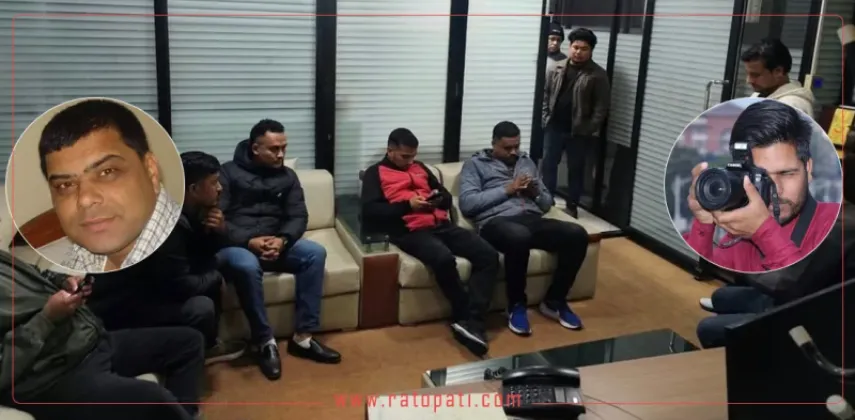
Former officials of the Nepal Federation of Journalists (FNJ) are set to hold a one-hour silent sit-in at Maitighar Mandala in Kathmandu on Saturday to protest police entering media houses to arrest journalists and the deployment of police to detain other members of the press. The programme will run from 8 am to 9 am, according to a statement issued by the former office-bearers on Friday.
The announcement, reported by Ratopati and Nepal Press, places the former FNJ officials among the prominent voices publicly objecting to police action involving journalists. In their statement, they characterize both the arrests and the presence of police inside media houses as an attack on press freedom, and they have chosen a quiet, disciplined demonstration in the heart of the capital to register that objection.
The sit-in reflects concern among the former officials over the manner in which journalists are being detained, and over what they see as the intrusion of security forces into spaces where the media carries out its work. By announcing the programme a day in advance, the organizers have also made the protest a public date in Kathmandu's calendar for anyone following press-freedom issues.
Key details of the Saturday sit-in
The essentials of the programme, as set out in the statement issued on Friday, are as follows:
- Event: Silent sit-in
- Organizers: Former officials of the Nepal Federation of Journalists (FNJ)
- Venue: Maitighar Mandala, Kathmandu
- Time: Saturday, 8 am to 9 am
- Duration: One hour
- Central grievance: Police entry into media houses to arrest journalists, and the deployment of police to detain other journalists
- Stated position: The actions constitute an attack on press freedom
Why Maitighar Mandala
Maitighar Mandala is one of Kathmandu's most frequently used sites for public demonstrations. Located at a major intersection in the capital, it has long served as a default venue for sit-in protests by professional groups, civil society organizations and rights activists. Its visibility makes it a natural choice for organizers who want their message seen by commuters and passers-by without needing a large rally.
The choice of format is equally deliberate. Unlike the slogan-chanting rallies common in Kathmandu, a silent sit-in relies on the presence of participants rather than speeches or loudspeakers. The one-hour time frame keeps the protest compact and focused. For a community whose work is built on words, a protest built on silence is a pointed gesture, and the former officials appear to be using that contrast to underline the seriousness of their concerns.
The grievances behind the protest
At the heart of Saturday's programme are two specific objections. The first is the entry of police into media houses to arrest journalists. The second is the deployment of police to detain other journalists. The former officials argue that both actions cross a line that a democratic society should not cross, and they describe them plainly in their statement as an attack on press freedom.
The concern about police entering media premises carries particular weight for journalists' groups. Media houses are not ordinary offices; they are working newsrooms where reporters gather, verify and publish information. When security personnel enter such spaces to make arrests, journalists' organizations typically warn of a chilling effect, arguing that the presence of police inside newsrooms can be experienced as intimidation and can hinder the media's ability to report independently.
Press freedom and the right to information are guaranteed under Nepal's constitution, and objections to police conduct toward journalists are generally framed in those terms. By staging their protest at a public landmark rather than issuing only a written statement, the former FNJ officials are seeking to move their complaint from paper to the street, where it can be seen as well as read.
The weight of former FNJ leadership
The FNJ is the umbrella organization of Nepali journalists, with a long history of advocating for journalists' rights and for press freedom. That its former officials, rather than a serving committee, have announced this programme underscores how seriously the issue of journalist detentions is being taken within the country's media community.
Their involvement also brings experience to the protest. Former office-bearers of the federation have spent years working on questions of journalist safety, working conditions and press freedom, and their decision to gather at Maitighar signals that the concerns raised in Friday's statement are shared by veteran figures in the profession, not only by those currently in the headlines.
What to expect on Saturday
The programme is scheduled to begin at 8 am and conclude at 9 am. As a silent sit-in, it will center on the participants' presence at Maitighar Mandala rather than on speeches or demonstrations of force. The organizers' public explanation for the protest is contained in the Friday statement: that police entering media houses to arrest journalists, and police being deployed to detain other journalists, amount to an attack on press freedom that they are not willing to let pass unremarked.
For Nepal's media community and for observers of press freedom in the country, the sit-in will be a visible expression of the unease surrounding the arrest of journalists. The one-hour duration and the silent format make it a restrained form of protest, but the venue, the timing and the statement behind it are all designed to ensure the message carries beyond the intersection where it will be delivered.


