
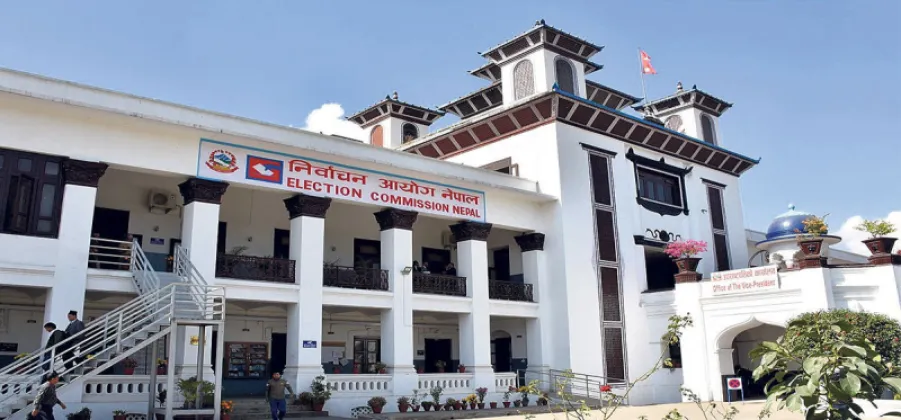
Kathmandu - The Election Commission is preparing to update and verify Nepal's voter roll using data from the Department of National ID and Civil Registration, under an agreement signed between the two institutions. As part of the arrangement, the poll body will draw on records maintained in the Personal Event Registration and Social Security Management information system, one of the government's central repositories of personal data, to carry out the update. Election Commission spokesperson Narayan Prasad Bhattarai said the details available in the system will be used for the task, marking a step toward closer coordination between the country's electoral administration and its civil registration infrastructure.
Agreement signed between the two institutions
The Department of National ID and Civil Registration signed a memorandum of understanding (MoU) with the Election Commission to put the data-sharing arrangement into effect. The pact links the Commission, the constitutional body responsible for maintaining the voter roll, with the department that administers the national identity card programme and civil registration nationwide.
Under the agreement, the Commission will draw on the Personal Event Registration and Social Security Management information system. The system is the platform through which key life events, including births, deaths, marriages and changes of residence, are recorded with local authorities, and through which matters connected to social security are managed. Because the records are updated as events take place, they provide a continuously refreshed picture of the population that election officials can now use to cross-check the voter list.
For the Commission, the arrangement means the voter roll update can be anchored in records already held by the government rather than relying solely on field-level registration and correction campaigns of its own. The development was reported by My Republica and carried by Khabarhub, both citing the Commission's announcement that national ID and civil registration data will feed into the voter roll update.
What the update and verification will involve
Spokesperson Bhattarai said the details held in the Personal Event Registration and Social Security Management information system will be used to update the voter roll. The exercise covers both updating and verifying the list, which means entries will not only be refreshed with new information but also checked against official records for accuracy.
Roll update and verification exercises are the principal tools through which the Commission keeps the voter list current. Such exercises typically serve to:
- Add the names of citizens who have become eligible but are not yet on the roll.
- Identify and remove duplicated, outdated or ineligible entries.
- Account for changes such as deaths or migration that affect where a voter is registered.
By benchmarking the list against data held by the Department of National ID and Civil Registration, the update is intended to rely on official records rather than on declarations made at the time of registration alone.
Why the linkage matters
The Election Commission is the constitutional body entrusted with preparing and maintaining the voter roll, a document that ultimately determines who can vote, where they can vote and in which constituency their ballot is counted. The Department of National ID and Civil Registration, meanwhile, holds the administrative records that capture a person's identity, age and place of residence, the same attributes that underpin voter eligibility and registration.
Bringing the two datasets together under a formal agreement gives election authorities a mechanism to reconcile the voter list with the state's civil records. Entries on the roll that no longer match the underlying records, whether because a voter has died, moved or been registered more than once, can in principle be flagged during verification. The move also aligns the voter roll with the wider use of the national identity card system as a backbone for how personal records are held and shared across government bodies.
What happens next
For voters, the practical implication is that the accuracy of their registration will increasingly depend on whether their personal records are up to date in the civil registration system. Life events that have not been formally registered with local authorities, such as a change of residence or the death of a family member, could surface as discrepancies when the roll is checked against official data.
The announcement did not set out a timeline for completing the update or the technical details of how the records will be matched, with further information yet to be made public. What the signing of the MoU makes clear is the direction of the exercise: the Commission intends to ground the voter roll in the Personal Event Registration and Social Security Management information system, using data from the Department of National ID and Civil Registration to keep the list accurate, verified and current.
If the linkage functions as planned, it would place the voter roll on the same administrative footing as other state records that depend on the civil registration database, reducing the room for entries that cannot be substantiated. For now, the MoU marks the formal start of that effort, with the two departments and the Election Commission expected to work from the shared data as the update proceeds.


