
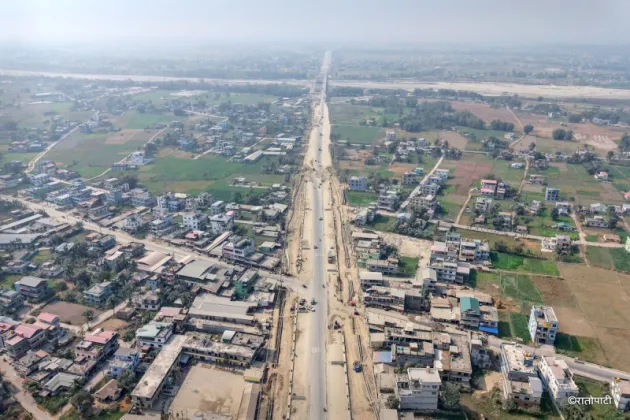
The 95-kilometre Kakarbhitta-Laukahi road section, which is being upgraded to Asian Highway standards along the East-West Highway with financial support from the Asian Development Bank, has turned into a daily ordeal for passengers and residents of the eastern Terai. According to local media reports, the construction has been carried out in a disorganised manner, with poorly managed diversions, potholes, mud and dust combining to make journeys slow, uncomfortable and dangerous. The deteriorating situation has prompted lawmakers, political parties and local residents to demand that the upgrade work be made organised and traveller-friendly without further delay.
Daily travel reduced to a struggle
For the people who use the section every day, whether to commute to work, reach hospitals, attend schools or move goods, the road has become a test of patience. Reports describe a surface broken by potholes and interrupted by diversions that have not been managed in a way that keeps traffic moving safely. Where the road has been dug up or narrowed for the upgrade, vehicles are left to pick their way through uneven stretches, and the resulting congestion affects not only long-distance passengers but also the residents of settlements along the corridor.
The hardship changes shape with the weather, but it does not ease. Mud makes the diversions slippery and difficult for vehicles to cross after rain, while dust blankets the surroundings when the surface dries out, affecting pedestrians, motorbike riders, shops and homes beside the road. The reports note that this combination of dust, mud and broken surfaces has made the section particularly punishing for travellers, who must budget far more time than the distance would normally require.
Accident risk mounting along the corridor
Beyond the inconvenience, the disorganised state of the construction has raised the risk of accidents, according to the reports. Potholes and abrupt, poorly signposted changes in the driving surface leave drivers with little room to react, and the mix of heavy vehicles, motorcycles, pedestrians and livestock on a corridor under construction only increases the danger. The concern is not limited to a single spot but runs along much of the 95-kilometre stretch, wherever diversions have been laid out without adequate management.
-
Poorly managed diversions along the section have disrupted the normal flow of traffic.
-
Potholes, mud and dust have made the surface hazardous for vehicles and pedestrians alike.
-
The conditions have raised the likelihood of road accidents, according to the reports.
-
Travellers and local residents have both borne the brunt of the disruption.
Lawmakers, parties and locals demand order
The growing trouble on the highway has not gone unanswered. Jhapa Constituency No. 2 lawmaker and former Deputy Speaker Indira Ranamagar is among those who have raised the issue, pressing for the construction to be brought under control so that the travelling public is spared unnecessary suffering. As reported by Rato Pati, the disorder in the Asian Highway upgrade has left both travellers and locals suffering, and voices from across the political spectrum have begun calling for corrective action.
Lawmakers, political parties and local residents have converged on a common demand: that the work on the Kakarbhitta-Laukahi section be made organised and traveller-friendly. The argument put forward is that a project of this scale, which is meant to deliver a modern regional highway, should not leave the people it is intended to serve navigating dust, mud and dangerous diversions for the duration of the construction. Pradesh Khabar has similarly reported on the disruption in the Asian Highway construction and the hardship it has caused.
The project behind the disruption
The Kakarbhitta-Laukahi section forms part of the East-West Highway, Nepal's principal transport artery across the southern plains, and is being upgraded as part of the Asian Highway network. The Asian Highway is a regional road system intended to improve connectivity between countries across the continent, and the upgrade of this eastern corridor is a step toward bringing Nepal's highway network up to those international standards. The work is being carried out with financial support from the Asian Development Bank, a multilateral institution that has funded a number of Nepal's road improvement projects.
Because the section links Kakarbhitta in the east with Laukahi along the East-West alignment, it carries a heavy share of passenger and freight traffic in the eastern Terai. That importance is precisely why the current disorder matters so much to those who depend on the road: when the corridor is disrupted, the effects ripple out to trade, transport services and everyday life across the districts it serves. The reports underline that the suffering of travellers and locals stems directly from the way the upgrade is being managed, rather than from the goal of the project itself.
Calls for a traveller-friendly approach
What the critics are seeking is not a halt to the upgrade but a change in how it is executed. Their demand, as reflected in the reports, is for construction that is organised, with diversions managed in a way that allows people to travel with dignity and safety while the work proceeds. Until those corrections are made, the passengers, residents and businesses along the Kakarbhitta-Laukahi section are left to bear the consequences of a project that has, for now, prioritised neither order nor the traveller.


