
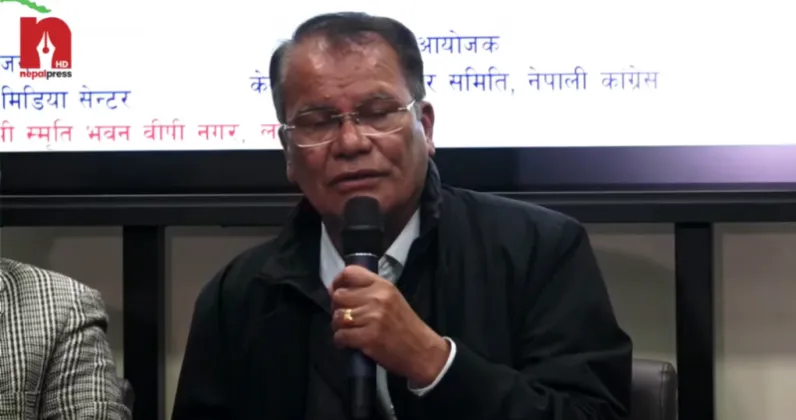
Nepali Congress leader Devaraj Chalise has declared that the party does not need any patron, pawn or proxy created by the ruling power to prove its legitimacy, insisting that the party's standing rests on its own statute, the constitution of Nepal and the country's prevailing laws. In remarks published on Tuesday, November 3, Chalise also objected to attempts to question the party's legitimacy and its internal decision-making process, and asserted that the Nepali Congress is fully capable of resolving its internal problems on its own. He added a pointed warning for the party's critics and opponents: anti-democratic forces, he said, need not celebrate the Nepali Congress's internal disagreements.
No favour needed from the government
The core of Chalise's message, as reported by NepalPress and Nagarik News, was direct and unambiguous. The Nepali Congress, he said, does not require the favour or endorsement of the government, or of any patron generated by the ruling side, to establish that it is a legitimate political force. Any suggestion that the party depends on such approval, in his view, misreads both the character of the organisation and the source of its authority.
Chalise paired that message with a plea for proportion. According to the NepalPress headline, he urged that no one should exaggerate the party's situation, signalling his discomfort with the way the Nepali Congress's internal affairs were being discussed and portrayed in public. The remarks position the party as an institution confident in its own rules and processes, rather than one seeking external validation from those who currently hold state power.
The statement also carried a defensive edge. By rejecting the idea of a ruling-party patron, pawn or proxy, Chalise appeared to be pushing back against any attempt to position individuals or factions within the party as though they operate with the blessing of the government, or to treat such an arrangement as a condition for the party's acceptance in national politics.
Every activity guided by the statute
Central to Chalise's argument was the claim that the party's internal life is governed by a clear and binding legal framework. Every organisational activity of the Nepali Congress, he said, is guided by the party's own statute. That statute, he added, is implemented and regulated under the constitution of Nepal and the prevailing laws of the country.
The point appeared intended to answer those who have questioned how the party takes its decisions and whether its internal processes stand up to scrutiny. By anchoring the party's functioning in its statute, the constitution and existing law, Chalise framed the Nepali Congress as an organisation that already operates within the country's democratic and legal order, and therefore does not need a ruling power to certify or regularise its conduct.
In effect, his argument rests on a simple proposition: the legitimacy of the Nepali Congress flows from its own democratic statute and from the constitutional framework of the state, not from the goodwill of whoever happens to be in government. On that reading, external attempts to arbitrate the party's internal affairs are not only unnecessary but objectionable.
Objection to questions over legitimacy and decision-making
According to the reports, Chalise specifically objected to attempts to question both the party's legitimacy and its internal decision-making process. He framed such questioning as unwarranted, and insisted that the Nepali Congress is itself capable of resolving whatever problems arise within its ranks.
His statement can be summarised in five key points:
- The Nepali Congress needs no patron, pawn or proxy created by the ruling power to prove its legitimacy.
- The party's organisational activities are guided by its own statute, which is implemented and regulated under the country's constitution and prevailing laws.
- Attempts to question the party's legitimacy and its internal decision-making process are objectionable.
- The party is itself capable of resolving its internal problems without outside intervention.
- Anti-democratic forces need not celebrate the party's internal disagreements.
A warning to anti-democratic forces
The most pointed element of Chalise's remarks was his message to opponents of democracy. The Nepali Congress's internal disagreements, he indicated, should not be treated as an occasion for celebration by forces hostile to democratic politics. The remark acknowledged that differences exist within the party, while firmly rejecting any suggestion that such differences amount to a crisis that weakens the organisation or invites outside adjudication.
The framing matters. Chalise did not present the party's internal debates as a source of shame or as evidence of dysfunction. Instead, he drew a clear line between disagreements that are a normal feature of a democratic party's life and attempts to weaponise those disagreements against the party or against democracy itself. His message was that the resolution of internal matters belongs to the party's own mechanisms, and that gloating by anti-democratic forces over the Nepali Congress's internal differences is misplaced.
Context
The Nepali Congress is Nepal's oldest political party, with roots stretching back to the 1940s, and it has historically stood at the centre of the country's struggles for democracy and constitutional rule. That history is part of the backdrop to Chalise's assertion that the party's legitimacy is self-standing and long established, rather than something granted or withheld by a sitting government.
His remarks, published on November 3 by NepalPress and Nagarik News, add a prominent voice to the ongoing conversation around the party's internal affairs and its relationship with the ruling establishment. The statement leaves little room for ambiguity about where he stands: the Nepali Congress, in his telling, answers to its statute, its constitution and its own members, and it will settle its internal questions through its own processes, with or without the approval of those in power.


