
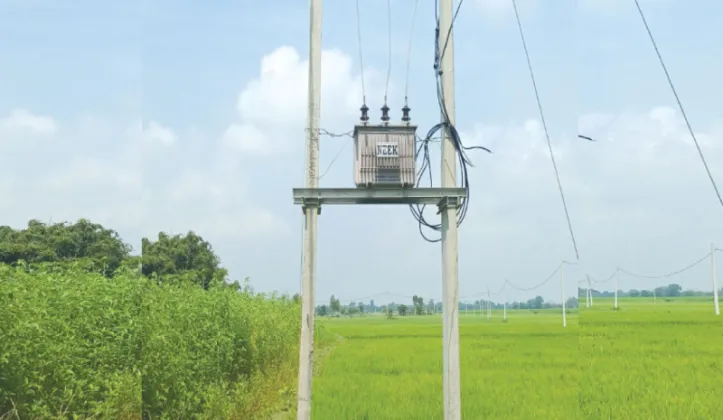
Devanganj Rural Municipality in Sunsari district has pushed its campaign to deliver electricity directly to farmers' fields into the final stage, with the Nepal Electricity Authority and the rural municipality jointly carrying out a project worth about Rs 30 crore. The initiative is designed to give farmers easier access to irrigation and to bring down the cost of agricultural production, two goals that the local unit hopes will translate into more secure and profitable farming across the municipality.
Power Lines Reaching the Last Fields
The work of extending electricity to individual farm plots in Devanganj has advanced through successive phases and now stands at its final stage, as reported by Gorkhapatra Online and RatoPati. The project is being implemented as a partnership between the Nepal Electricity Authority, the country's national power utility, and the rural municipality itself, with both institutions combining resources to take distribution lines beyond the settlements and into the agricultural areas where water has to be lifted onto the fields.
The scale of the undertaking, with an estimated investment of around Rs 30 crore, underlines how significant the scheme is for a rural local unit. Distribution infrastructure at this level involves poles, transformers and service connections reaching plots that were previously beyond the grid, allowing farmers who once depended on manual or fuel-based methods to run electric pumps at the edge of their own land.
The Project in Brief
- Where: Devanganj Rural Municipality, Sunsari district, Koshi Province
- Who is building it: The Nepal Electricity Authority in partnership with Devanganj Rural Municipality
- How much: An investment of about Rs 30 crore
- Status: Extension work has reached the final stage
- Purpose: To make irrigation easier for farmers and cut the cost of production
Why Irrigation Power Matters for Farmers
Reliable irrigation is one of the most decisive factors in farm productivity, and access to it has long shaped how much a farmer in Sunsari can grow and earn. Where fields are not connected to a dependable water source, cultivation often remains tied to the rhythm of the monsoon, leaving farmers exposed to delayed rains and dry spells. Extending electricity to the fields removes a practical barrier for farmers who need to pump water onto their land, because a power connection makes it possible to irrigate when crops need water rather than when the weather happens to cooperate.
The cost dimension is equally important. Running pumps on costlier sources of energy drains a farmer's budget over every cropping season, eating into the margin earned from vegetables, paddy or other produce. By bringing the grid to the fields, the municipality and the Nepal Electricity Authority intend to lower this recurring cost of production. Cheaper irrigation means the money a farmer spends to grow a crop shrinks, and any reduction at that end flows directly into better returns from the same plot.
There is also a wider logic behind projects of this kind. When irrigation becomes easier and more affordable, farmers are in a better position to invest in their land, cultivate in seasons they might otherwise leave fallow and move toward higher-value crops. While the immediate aim in Devanganj is straightforward, easier water access at lower cost, the longer-term expectation is that electrified fields will support a broader strengthening of agriculture across the municipality.
A Model of Joint Investment
The Devanganj project stands out as an example of a local government and the national utility working together on infrastructure that serves agriculture directly. Rather than treating electrification purely as a matter of household lighting and consumer supply, the rural municipality has directed a substantial share of resources toward lines that terminate at farm fields, where the power will be put to productive agricultural use.
For the Nepal Electricity Authority, such partnerships extend the distribution network into areas that might otherwise wait longer for connections, while for the local unit the investment channels public money into a service that touches nearly every farming household. The arrangement reflects a growing recognition among local governments that agricultural infrastructure, including field-level power, sits at the heart of rural livelihoods, and it places Devanganj among the local units investing seriously in that direction.
What Happens Next
With construction at its final stage, the immediate task is to complete the remaining extension work so that the lines can be energized and service connections handed over to farmers. Once electricity reaches the fields, attention will turn to how farmers put it to use, with electric pumps expected to become a routine part of irrigation across the municipality.
If the project delivers on its promise, the effects are likely to be felt first in the cost of growing crops and in the ease with which farmers can water their fields during critical stages of cultivation. For the farming households of Devanganj, a Rs 30 crore investment in wires and transformers is ultimately an investment in whether their fields can be farmed with fewer constraints and at lower cost, and the final stage of the work signals that this change is now close at hand.


