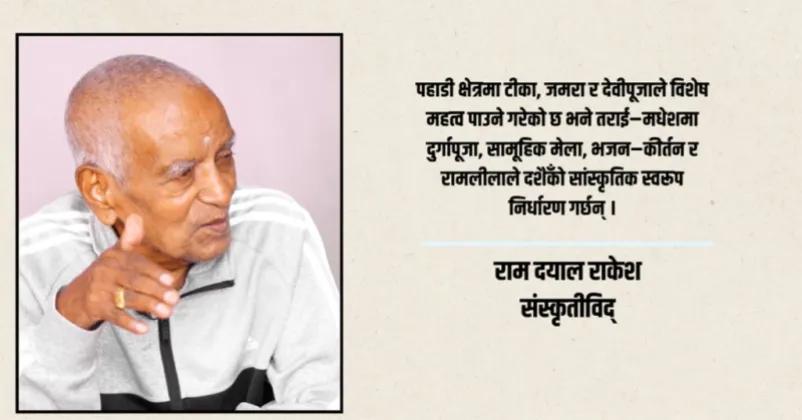
Cultural expert Ramdayal Rakesh says Dashain is marked by different customs in Nepal’s hill regions and the Tarai-Madhesh, but its religious, familial and social significance remains the same across both regions. In explainers published by Nepal Press and Pradesh Khabar on 15 October 2026, the contrast is described as one of tradition and practice rather than meaning: hill communities give particular importance to tika, jamara and worship of the goddess, while Madhesh observes its own distinct customs. Across the regions, the festival carries a similar sense of closeness among people and families.
Different customs, a shared festival
The ways people observe Dashain are not identical from one part of the country to another. Rakesh’s account highlights a distinction between the hill regions and Madhesh, where communities follow different customary practices. In the hills, tika, jamara and worship of the goddess hold special importance. The explainers describe Madhesh as having its own distinct customs, without suggesting that one region’s observance is more authentic or meaningful than the other’s. The regional differences are part of how Dashain is experienced across Nepal, while the festival’s broader significance remains shared.
The distinction matters because a national festival can be familiar across regions without being celebrated in precisely the same way. Dashain’s common identity does not depend on every community following one uniform set of customs. In Rakesh’s view, different forms of observance coexist with a similar religious, familial and social meaning. That perspective places local traditions alongside a shared festival, rather than treating them as opposing versions of it. The descriptions in the two explainers therefore draw attention both to what varies and to what people across the regions hold in common.
Religious, family and social significance
The religious dimension is reflected in the importance given to goddess worship in the hill regions, as well as in the wider significance Rakesh attributes to Dashain. The summary of the explainers does not set out the specific religious customs followed in Madhesh, but it does emphasize that the festival’s religious meaning is shared. This allows the regional comparison to recognize distinct practices without making unsupported assumptions about how those practices are carried out. The central point is that differences in observance do not diminish the place of Dashain in the religious life of either region.
Family and social ties are also central to the account. The reports characterize Dashain as carrying an equal sense of closeness across the hills and Madhesh. That shared feeling is presented alongside the region-specific customs, not as a replacement for them. In this framing, the festival brings familial and social meaning that extends across differing ways of celebration. The explainers do not detail particular gatherings or activities, but they underline that the sense of connection associated with Dashain is not limited to one region’s traditions.
Regional identity and common ground
The comparison by Rakesh offers a way to understand Dashain as both locally rooted and widely shared. Tika, jamara and goddess worship are identified as especially important in the hill regions, while Madhesh is described as following its own customs. The reports do not provide a list of those Madhesh practices, so the distinction is best understood at the level stated: the forms differ, while the festival’s religious, familial and social importance remains common. Recognizing that difference avoids reducing Dashain to a single regional pattern.
The two explainers, published by Nepal Press and Pradesh Khabar on 15 October 2026, focus on this balance between variation and commonality. Their central message, as summarized by Rakesh’s comments, is that regional traditions shape how Dashain is celebrated, but do not divide its underlying significance. Across the hills and Tarai-Madhesh, the festival retains a sense of closeness. The account presents that shared intimacy as a defining feature of Dashain, even as communities observe it in different ways. Read more from Nepal Press and Pradesh Khabar.