
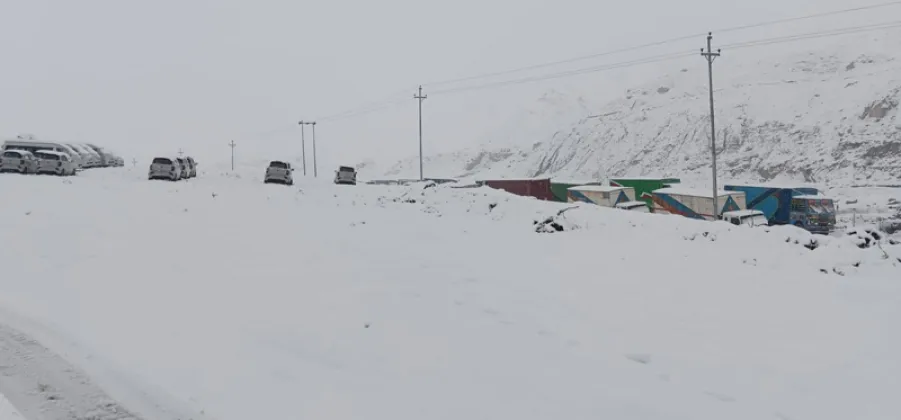
Heavy snowfall triggered by Cyclone Arnab, the weather system that formed in the Bay of Bengal, has left tourists stranded in Manang, with trekkers heading for destinations in Upper Manang unable to proceed, local officials said. Dhak Bahadur Bhujel, chief of the Annapurna Conservation Area Project (ACAP) in Manang, said the tourists have been unable to continue toward the upper part of the district, and an advisory has been issued against trekking in the upper region after thick snow accumulated there. The disruption is not limited to the trails: according to reports published by Nagarik News, Nepal Press and Khabarhub, daily life in the affected area has also been disturbed by the snow.
Thick snow strands trekkers bound for Upper Manang
The trekkers caught out by the weather were on their way to destinations in Upper Manang when the heavy snowfall set in. According to Bhujel, they have been unable to proceed any further, leaving them held up on the approach to the upper region while thick snow piled up ahead of them. Upper Manang lies deep within the Annapurna region along trekking routes that draw visitors from around the world, and its high elevation means that the moisture carried in by such weather systems falls as snow rather than rain.
The stranding underlines how quickly conditions on Himalayan trails can change when a cyclonic system pushes moisture toward the mountains. The reports available so far do not specify how many tourists have been affected or exactly where they have been held up, but the picture emerging from the district is consistent: movement toward the upper region has come to a standstill, and the snow is thick enough that officials have advised against pressing on.
Advisory issued as snow accumulates in the upper region
In response to the accumulation, ACAP's Manang office has issued an advisory against trekking in the upper region. Bhujel, who heads the office in the district, said the advisory was put out after thick snow accumulated across the upper area. For trekkers already en route, the advisory effectively means the journey into Upper Manang is on hold until conditions improve and the trails become passable again.
The key points from the reports so far are:
- Heavy snowfall triggered by Cyclone Arnab has left tourists stranded in Manang.
- Tourists heading to destinations in Upper Manang have been unable to proceed, according to ACAP Manang chief Dhak Bahadur Bhujel.
- An advisory has been issued against trekking in the upper region after thick snow accumulated there.
- Local daily life has also been affected by the snowfall.
Cyclone Arnab: from the Bay of Bengal to Himalayan snow
Cyclone Arnab formed in the Bay of Bengal, and the snowfall in Manang has been attributed to that system. Weather systems that develop over the Bay of Bengal typically carry enormous moisture when they drift toward the Himalayas, and as that moist air is pushed up against the high range, it releases heavy precipitation. At the altitudes found in districts like Manang, that precipitation falls as snow, which is what has blanketed the upper part of the area.
The result on the ground has been significant enough for ACAP's field office to step in with a formal advisory. Authorities in high mountain districts routinely watch such systems closely because of their potential to strand trekkers and disrupt movement, and the developments in Manang fit that familiar pattern: a cyclone-driven weather system, heavy snow at altitude, and travel into the upper region brought to a halt.
Impact reaches beyond the trekking trails
The effects of the snowfall are not confined to tourists. According to the reports from Manang, local daily life has also been affected by the heavy snow. In high-altitude settlements, significant snowfall typically makes everyday movement difficult, from travel along the paths that connect villages to routine outdoor activity, and the situation in Manang has followed that pattern.
ACAP, the Annapurna Conservation Area Project, works in the region on conservation and on matters affecting both trekkers and resident communities, and its Manang office has been the source of the key details emerging about the current situation. With Bhujel confirming both the stranding of tourists and the advisory against trekking in the upper region, attention now turns to the weather itself: the stranded trekkers and the communities around them will be waiting for the snowfall to ease and for conditions to allow travel and daily life in the upper region to return to normal.


