
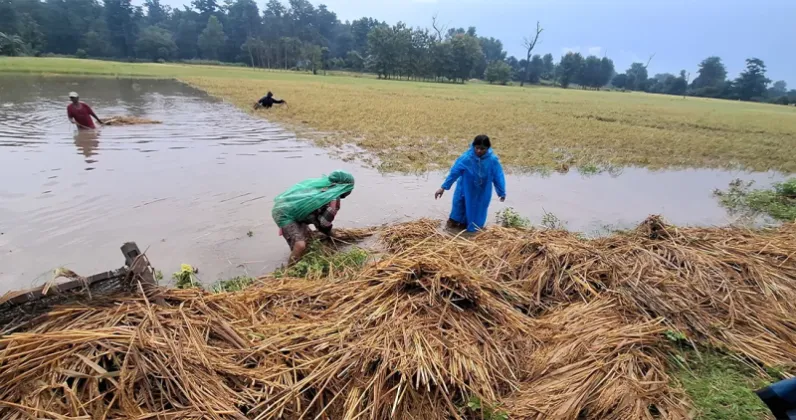
Farmers across Bhojpur district are watching the skies with mounting anxiety as days of continuous rain have fallen precisely when the paddy crop has ripened and should be heading for harvest. Local media reports say the paddy has turned yellow in the fields across the eastern hill district, signalling that it is ready to be cut, but the unbroken rain and the growing threat of hail have made it difficult for farmers to harvest the crop and store it safely in time. The untimely spell of bad weather during the harvest season has left farming families worried about the fate of the produce they have tended through the entire year, with fears that ripe grain may fall in the fields before it can be brought home.
Rain arrives at the worst possible time
For farmers, few moments in the cropping calendar are as decisive as the harvest window, and in Bhojpur the rain has arrived at exactly the wrong one. The paddy, having turned yellow in the fields, is at the stage when it must be cut, dried and threshed without delay. Instead, persistent wet weather has kept families out of their fields and left the ripe crop standing.
Reports published by RatoPati described ripe rice falling in the fields as the continuous rains persisted, meaning that some of the crop is already being lost where it stands. When mature paddy is battered by rain, the heavy, wet panicles can bend the stalks and drop grain to the ground, and once grain has fallen into the mud it can rarely be recovered.
The situation is made worse by the threat of hail, which farmers in the hills know can flatten a field within minutes during the harvest season. According to Pradeshkhabar, the growing risk of rain and hail has left farmers unable to cut and safely store their crop in time. Together, the two hazards have turned what should be the most rewarding weeks of the farming year into a period of watchfulness and dread.
A narrow window to cut, dry and store
Harvesting paddy is a race against the clock even in a good year. Farmers cut the stalks, leave them to dry in the field, thresh them and then winnow and dry the grain before it goes into storage. Each of those steps depends on dry weather, and each can be disrupted by rain. In the hills, where most of the work is done by hand, the process can stretch over days or even weeks for a single farm.
- Cut crop left lying in a wet field can heat up, discolour and lose quality before it is threshed.
- Damp grain is difficult to thresh and, if stored without proper drying, can sprout or spoil.
- Muddy, sodden fields make it harder for farmers to move through their terraces and carry the harvest home.
That is the dilemma now facing growers in Bhojpur. If they harvest while the rain continues, they risk bringing in wet grain that cannot be dried properly. If they wait for clearer skies, they must gamble that the standing crop, already yellow and ripe, will not be knocked down by more rain or struck by hail.
A season's work hanging in the balance
For most households in Nepal's hill districts, paddy is the crop on which the year's food supply depends, and a harvest spoiled at this stage is not easily replaced. That is why the anxiety described in local reports runs deeper than a simple inconvenience: the unfavourable weather during the harvest season has left farmers worried about their produce itself, the grain that should feed their families and generate cash for the months ahead.
Farmers who planted, weeded and nursed their paddy through the growing season now face the possibility of losing a share of it not to pests or drought, but to weather at the very last step. The sight of yellow, ready paddy that cannot be cut is a particularly frustrating one, because by every other measure the crop is complete. In a district like Bhojpur, where farming is carried out on terraced hillsides largely by family labour, there is little buffer between a damaged harvest and the household kitchen.
Waiting for the skies to clear
With the rain still falling, there is little that farmers in Bhojpur can do beyond keeping their sickles and threshing gear ready, watching the weather and hoping for a stretch of dry days long enough to bring in the harvest. Once the skies clear, families across the district are expected to move into their fields in force, working quickly to cut, dry and store whatever the rain has spared.
Until then, the yellow paddy stands in the terraced fields of Bhojpur, ripe and ready but out of reach, and the farmers who depend on it can only wait and hope that the damage done so far does not deepen into a lasting loss.


