
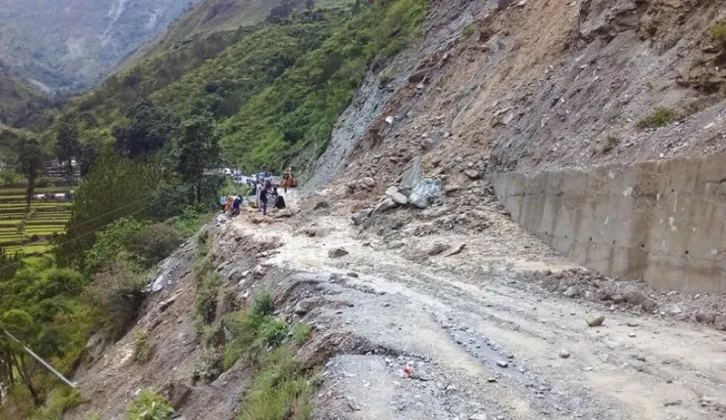
Continuous rainfall since the previous night has blocked several national highways across Nepal, halting traffic on key corridors including the BP, Prithvi, Karnali, Madhyapahadi and Kanti highways. Floods and landslides triggered by the downpour have left mud, debris and washed-out sections across the carriageways, bringing passenger and freight movement to a standstill. The Department of Roads under the Ministry of Physical Infrastructure and Transport, through its subordinate division offices, has deployed personnel and equipment to clear the landslides and reopen the blocked routes, according to a report by Global Aawaj.
Highways buried under mud and debris
The uninterrupted rain set off floods and landslides across multiple districts, and the debris landed squarely on the country's main road network. Traffic on the affected highways stopped as earth, rock and mud covered the road surface, while in places floodwater washed out sections of the road altogether. For travellers and transport operators, the blockades mean journeys have been interrupted mid-route, with reopening dependent on the pace of clearance work.
The five reported blockades sit on some of Nepal's most important road links:
- BP Highway: the Sindhuli corridor that connects the capital's road network with the eastern Terai, widely used as an alternative southbound route.
- Prithvi Highway: the principal road between the Kathmandu valley and Pokhara, the gateway to the western hills and a major tourism hub.
- Karnali Highway: a lifeline for the hill districts of Karnali Province, a route long known for its vulnerability to monsoon landslides.
- Madhyapahadi Highway: a mid-hill route serving communities away from the main Terai corridors.
- Kanti Highway: the road link in Makawanpur connecting Hetauda with the Kulekhani area.
Together, these highways carry daily buses, supply trucks and private vehicles between the capital, the Terai plains and the mid- and far-western hills. That is why a single night of continuous rain can disrupt travel across large parts of the country at once.
Crews mobilised to reopen the routes
In response, the Department of Roads and its subordinate division road offices have deployed personnel and equipment to the blocked sites. Their task is twofold: to clear the mud and debris deposited by the landslides, and to restore the sections of road that floodwater has washed out. The division offices, which maintain the national and strategic road network at the local level, act as the first line of response whenever monsoon disasters cut the highways.
The scale of the work varies from site to site. Debris left on the carriageway by landslides must be excavated and hauled away before vehicles can pass, while washed-out sections require more substantial repairs. With the rain described as continuous since the previous night, teams are working to clear the blockades and get the routes open to traffic again.
A familiar monsoon pattern
The blockades underline a recurring seasonal challenge. Nepal's monsoon brings heavy rain that repeatedly triggers floods and landslides on roads carved into steep and fragile hillsides. National highways that cross the Chure hills and the Mahabharat range are particularly exposed, and the routes affected this time, from the Prithvi Highway in the central hills to the Karnali Highway in the west, follow exactly such terrain.
Each closure on a corridor such as the Prithvi or BP Highway affects far more than passenger travel. These roads also carry food, fuel and other essentials to districts that depend almost entirely on road transport, so a blockade can quickly be felt in local markets and supply chains. Restoring access promptly is therefore treated as a priority by the road authorities every monsoon season.
For now, the Department of Roads' immediate focus is to get crews and machinery to each blocked site and reopen the routes to two-way traffic. Travellers planning to use the BP, Prithvi, Karnali, Madhyapahadi or Kanti highways face halted or delayed journeys while clearance work is under way, and normal movement will resume only once the mud, debris and damaged sections are cleared and the roads are declared safe.


