
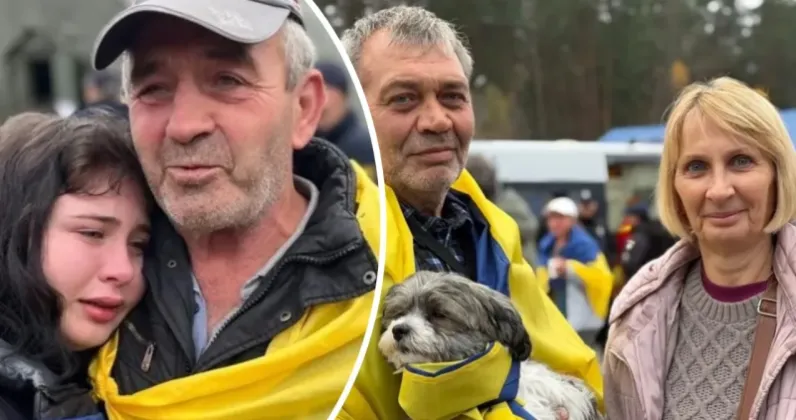
Hundreds of Ukrainian civilians have been rescued from Oleshki, a front-line city that has lived under Russian occupation, arriving in Ukraine's northern Chernihiv region on Saturday after a journey that took most of them through Belarus. The evacuees had endured four years of war in the occupied city, surviving shelling, drone attacks and severe food shortages. Among them were Olha and her husband Vyacheslav, who, like many of their fellow evacuees, described life in Oleshki as terrifying and summed up their escape with a single, haunting phrase: they had "returned from hell."
'We came back from hell'
Among the hundreds who reached Ukrainian soil on Saturday were Olha and Vyacheslav, a married couple who had spent the war years in occupied Oleshki. Speaking after their rescue, they described the city they had left behind as a place of constant fear, where shelling and drone attacks shaped everyday life and where finding enough to eat was a struggle in itself. Their verdict on those years was brief and devastating. They had, they said, come back from hell.
That sense of having passed through something almost unendurable ran through the accounts of the rescued residents. For four years, the people of Oleshki had lived with the sound of shelling and the ever-present threat of drones, rationing scarce food and waiting for a chance to get out. When that chance finally came, hundreds of them took it, leaving behind the lives they had known and setting out on a journey into the unknown. What waited on the other side was safety, and the first days of a life without fear.
Four years under Russian occupation
Oleshki has spent the war under Russian occupation, and for its residents the front line ran directly through their daily lives. Those rescued described a city where shelling was routine and where drone attacks added a constant, unpredictable danger. Civilian life continued in the shadow of the guns, but only barely.
The rescued residents pointed to three hardships that defined their years under occupation:
- Relentless shelling across the front-line city
- Constant drone attacks overhead
- Severe food shortages that made even basic survival a daily challenge
Together, those conditions reduced ordinary life in Oleshki to a matter of endurance. The evacuees described their existence in the occupied city as terrifying, and the food shortages compounded the danger posed by the shells and drones. For many, the rescue operation offered the first real opportunity in years to escape.
The road to safety: through Belarus to Chernihiv
Getting out of Oleshki was only the first stage of the ordeal. Most of the evacuees left the occupied city via Belarus, passing through the neighboring country before crossing back into Ukraine. On Saturday they arrived in the Chernihiv region in the country's north, where the hundreds rescued from occupation could finally begin to recover.
The route underscores the extraordinary lengths civilians must go to in order to escape occupied territory. Rather than crossing the front line directly, most of those rescued traveled through Belarus before completing their journey into Ukrainian-controlled territory. The trip carried them far from the front-line city to the comparative quiet of the north, a distance measured not only in kilometers but in the gulf between a place where shelling is a daily reality and a region where it is not.
Reunions after years apart
For many of the evacuees, Saturday's arrival ended in tears and embraces. Many of the rescued residents were reunited with relatives they had not seen for years, families separated by the front line and by four years of occupation that kept the people of Oleshki from leaving.
These reunions gave the rescue its most human moments. Relatives who had spent years able only to wonder what was happening to their loved ones in the occupied city could finally hold them again. The evacuees arrived not simply as people fleeing an occupied city, but as sons, daughters, parents and siblings coming home after a separation that had lasted far too long.
The rescue of hundreds of civilians from Oleshki stands out as an operation that brought people out of occupied Ukrainian territory after four years of war, and the words of those who escaped carry the full weight of that time. "We came back from hell," the rescued residents said, and in that single phrase lies the reality of everyday life in a city that has lived under Russian occupation, under shelling and under drones, through four years of fighting. For Olha, Vyacheslav and the hundreds who traveled out with them, that life is now behind them. What lies ahead is the slower work of rebuilding, in safety, among family.


