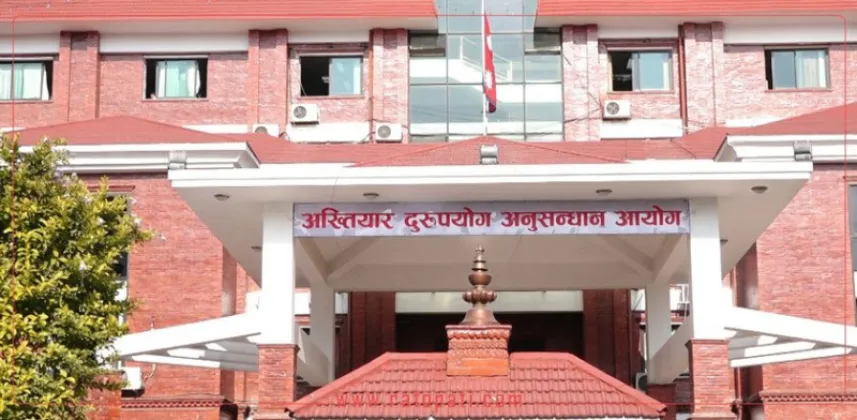
The Commission for the Investigation of Abuse of Authority (CIAA) on Wednesday filed a corruption case at the Special Court in Kathmandu against Hirababu Bhattara, the chief investigation officer of the National Investigation Department, the country's central intelligence agency also known as Guptachar. The anti-corruption watchdog has accused Bhattara of submitting fake academic certificates to gain entry into government service and to obtain promotion, and the registration of the case has triggered his automatic suspension from the post, according to reports by RatoPati and Nepal Press.
Case registered under the former anti-corruption law
According to the details of the case, the CIAA filed the charge sheet under Section 12 of the former Corruption Prevention Act, 2017. The case stems from the allegation that Bhattara, both at the point of his entry into the service and in the course of his subsequent promotion, relied on forged academic credentials rather than genuine qualifications.
The Special Court, based in Kathmandu, is the venue where corruption cases filed by the CIAA are formally heard. With the registration of the case, the matter has now moved from the commission's internal investigation to judicial proceedings, in which the accused will have the opportunity to present his defense before the court delivers its verdict.
The allegations at the heart of the case
At the center of the case is the accusation that Bhattara submitted fake academic certificates. The CIAA's position is that the use of fraudulent credentials, first to enter the service and later to secure a promotion, constitutes corruption because it allowed him to obtain and hold a public office, along with its rank and benefits, on the basis of documents he was not legitimately entitled to use.
The charge is therefore treated not as a minor administrative irregularity but as a corruption offense under the former law. The fact that the accused served as the chief investigation officer of the National Investigation Department gives the case added weight, as it concerns the authenticity of the academic records that underpinned the career of a senior officer within the state's intelligence structure.
Automatic suspension takes effect
A key consequence of the case filing is that Bhattara has been automatically suspended. Under the prevailing legal provisions, a public officeholder against whom the CIAA files a corruption case stands suspended from the moment the case is registered at the Special Court, and that suspension remains in place until the court reaches a final decision.
For the National Investigation Department, this means that one of its senior officers is now formally off duty pending the outcome of the trial. The suspension, however, is not in itself a finding of guilt. It is a statutory consequence that applies upon the filing of a corruption case, and it will be up to the Special Court to determine whether the allegations against Bhattara are actually proven.
The process ahead at the Special Court
The CIAA, Nepal's apex anti-corruption body, is empowered to investigate and prosecute cases involving the abuse of authority and corruption by public officials, and the filing of a case at the Special Court represents the final step of its investigative process. The court will now examine the evidence submitted by the commission and hear the arguments from both sides before ruling on the charge.
Since the case has been filed under the former Corruption Prevention Act, 2017, the proceedings will be governed by that statute. The eventual verdict will determine Bhattara's fate in the service, including whether the allegations that he entered the department and obtained promotion through fake academic certificates are upheld by the court.
A case touching the intelligence apparatus
The case is notable for the institution involved. The National Investigation Department functions as the country's primary intelligence agency, and the work of its officers typically remains far from public scrutiny. A corruption case against its chief investigation officer, filed openly at the Special Court, places the internal affairs of that sensitive institution under the lens of the judicial process.
It also demonstrates the reach of the CIAA's mandate, which extends across the civil service and other organs of the state regardless of the nature of the institution concerned. For now, the immediate facts are straightforward: a corruption case has been filed, a senior intelligence officer stands accused of building his career on forged academic documents, and the automatic suspension that follows such a filing has already come into effect. The next word on the matter rests with the Special Court, which will weigh the charges against Bhattara in the days and months ahead.