
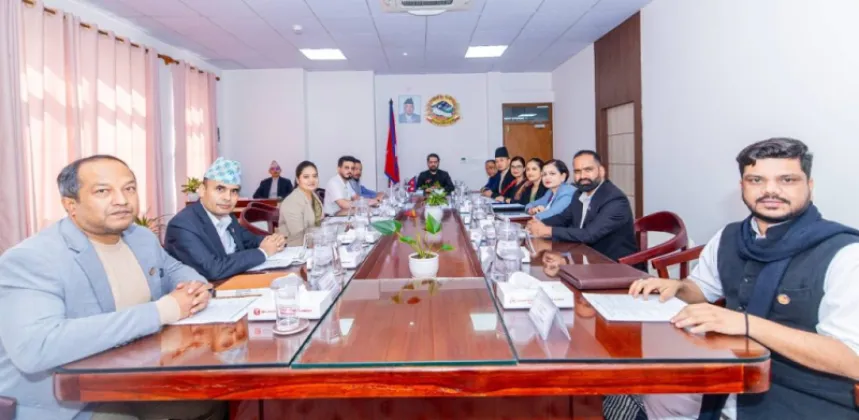
Nepal's federal Cabinet on Tuesday decided to recommend two ordinances to President Ram Chandra Paudel for issuance, government spokesperson and Minister for Education and Sports Sasmit Pokharel said, setting in motion legal amendments that touch the country's press regulator as well as laws governing culture, tourism and civil aviation. Alongside the two ordinances, the meeting also approved the acceptance of a concessional loan. Of all the decisions announced, the ordinance concerning the Press Council Nepal is already being flagged as the most contentious, with criticism from the media fraternity expected.
Cabinet clears two ordinances for presidential issuance
The meeting of the Council of Ministers held on Tuesday decided to send the two draft ordinances to the President for issuance, as reported by Online Khabar.
The decisions announced by Pokharel include:
- An ordinance to amend the Press Council Nepal Act, 1992, the law that governs the statutory body overseeing Nepal's press.
- An ordinance to amend several Nepal Acts related to Culture, Tourism and Civil Aviation, laws that fall under the ministry of the same name.
- Approval to accept a concessional loan, for which the amount, the lender and the intended purpose were not disclosed in the announcement.
Of the measures cleared on Tuesday, the Press Council ordinance is the one expected to generate the most debate. The government has not made public the specific provisions the amendment seeks to change, but the expectation of criticism from the media fraternity underscores the sensitivity surrounding any revision of the country's press law.
How the ordinance route works
Under Nepal's constitution, the President may issue an ordinance on the recommendation of the government when the federal parliament is not in session. Once issued, an ordinance carries the same force as a law passed by the legislature, but its authority is temporary: the measure must be tabled before the federal parliament when it reconvenes, and it ceases to remain in force unless endorsed by lawmakers.
Nepali governments have repeatedly turned to ordinances to push through legal changes quickly, a practice that has long divided opinion. Supporters of the mechanism argue that it allows the executive to respond when urgent legal changes cannot wait for a parliamentary session. Critics, including lawmakers and civil society observers, contend that frequent recourse to ordinances sidelines parliamentary scrutiny and narrows the space for public debate on laws that affect citizens.
That critique carries particular weight when the measures concern the media, since press legislation is conventionally shaped through consultation with journalists' bodies, editors and media houses, a process that the ordinance route effectively bypasses. The government's decision to amend the Press Council law through an ordinance rather than a bill is therefore likely to feature prominently in the reaction that follows.
Press Council amendment set to draw scrutiny
The proposed amendment to the Press Council Nepal Act, 1992, stands out because the law it seeks to change is the very foundation of the country's press regulation. Press Council Nepal is the statutory body responsible for monitoring the country's newspapers and periodicals, classifying them, promoting professional and ethical standards in journalism, and addressing complaints related to media conduct.
The Act itself dates back to 1992, the early years of Nepal's multiparty democracy, and has remained the governing legislation for the press regulator for more than three decades, surviving successive political transitions, including the end of the monarchy and the adoption of the 2015 constitution. Amendments to such an entrenched law are closely watched by the media industry, which has a direct stake in the powers and composition of its regulator.
Media stakeholders in Nepal have historically been vigilant about changes to press laws, particularly those introduced without parliamentary debate or advance consultation. The expectation of criticism from the media fraternity, noted at the time of the announcement, suggests that resistance is anticipated. As of Tuesday's briefing, however, the substance of the proposed amendments had not been shared publicly, leaving editors, publishers and journalists' associations with little to assess beyond the fact that the three-decade-old law is in line for revision.
Culture, tourism and aviation laws, and the loan decision
The second ordinance would amend several Nepal Acts related to Culture, Tourism and Civil Aviation, an area that covers some of the country's most economically significant sectors, including heritage management, tourism promotion and air transport. As with the Press Council measure, the announcement did not specify which acts are targeted or what changes the amendment would introduce, and further detail is expected to emerge once the ordinance is issued.
The Cabinet's decision to accept a concessional loan rounds out the package of announcements from Tuesday's meeting. Concessional loans, typically extended on soft terms such as below-market interest rates and long repayment periods, are a regular feature of Nepal's development financing and are commonly channelled into infrastructure and social sector projects. Details of the loan accepted on Tuesday, including its size, source and purpose, were not included in the spokesperson's briefing.
With the Cabinet's recommendation in place, the two ordinances now move to President Paudel for issuance. Once issued, they take effect immediately and remain in force until parliament gets the opportunity to consider them. Attention in the coming days is likely to focus less on the procedural steps and more on whether the government releases the texts of the ordinances, particularly the Press Council amendment, whose reception among media houses and journalists' groups is expected to be critical.


