
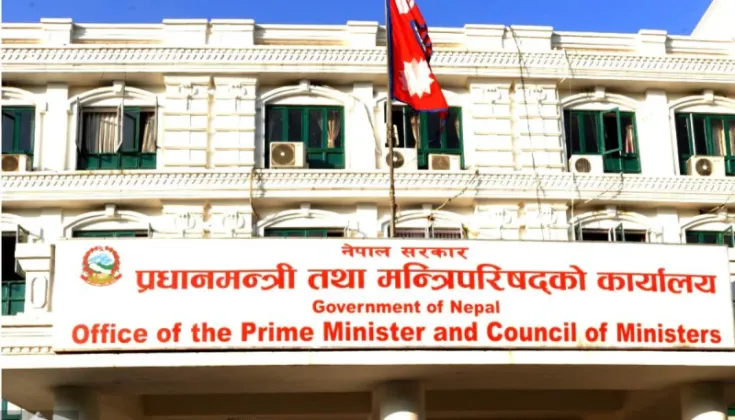
A decision by the federal Council of Ministers to provide land belonging to Purnamrit Bhawani Secondary School in Waling, Syangja, to the Armed Police Force has run into controversy, with the school objecting that the land acquisition process was advanced without its consent. The decision, approved at the Cabinet meeting of Ashoj 19 (early October), concerns 29 ropani 5 aana of land at plot number 482 in Waling Municipality-8. The Armed Police Force has maintained a presence in the area since 2060 BS, when it was established in Waling to provide security to the town and its surrounding areas, as reported by Prades Khabar.
A decision sealed at the Cabinet table
The parcel at the center of the dispute was allocated through a decision of the Cabinet, Nepal's highest executive body, at its meeting on Ashoj 19. According to the details of the decision, the land provided to the Armed Police Force measures 29 ropani 5 aana and carries plot number 482 in Waling Municipality-8.
The key facts of the decision are as follows:
- Landowner: Purnamrit Bhawani Secondary School, Waling, Syangja
- Recipient agency: Armed Police Force
- Area: 29 ropani 5 aana, roughly equivalent to about 1.5 hectares
- Plot number: 482
- Location: Waling Municipality-8, Syangja district
- Approval: Cabinet meeting of Ashoj 19
For readers unfamiliar with Nepal's traditional land measurement, ropani and aana are the units most commonly used in the country's hill districts, including Syangja. One ropani equals 16 aana, and a holding of 29 ropani 5 aana translates to a substantial parcel of land, one large enough that its transfer is of tangible significance to whichever institution holds it. In this case, the land belongs to the school, which is what has placed the Cabinet's decision at the center of a growing dispute.
Decisions of this nature, involving the provision of land to a security agency, are taken at the level of the Council of Ministers, and the Ashoj 19 meeting did exactly that. What has followed, however, is an objection from the very institution whose land was on the table.
The school pushes back
Purnamrit Bhawani Secondary School has objected to the decision, saying the land acquisition process was advanced without its consent. That objection is the crux of the controversy: the school is not disputing the arithmetic of the plot or the identity of the recipient agency, but the process itself. In its view, the acquisition moved forward without the institution being consulted.
The objection carries weight in a context where land is among the most critical assets an educational institution possesses. School grounds in Nepal typically house classrooms and administrative buildings, and they also serve as playgrounds and open spaces for students, while remaining the most obvious reserve for any future expansion of teaching infrastructure. A transfer of school land, decided without the school's agreement, therefore strikes directly at the institution's operational foundation.
It is also worth noting what the school's objection does not say. The statement attributed to the institution centers on consent and consultation rather than on the Armed Police Force's presence in Waling, which dates back decades. The dispute, as it stands, is fundamentally about whether a decision of this consequence can be advanced over the head of the institution that owns the land.
Two decades of the Armed Police Force in Waling
The recipient of the land is no newcomer to the area. The Armed Police Force was established in Waling in 2060 BS, meaning the force has now been present in the municipality for roughly two decades. Its mandate in the area, as recorded at the time of its establishment, was to provide security to Waling and the surrounding areas.
The Armed Police Force is Nepal's paramilitary security wing, operating alongside the Nepal Police with responsibilities that extend to internal security duties across the country. A permanent presence in a municipality like Waling, one of the significant towns of Syangja district in Gandaki Province, has been part of that security arrangement since the force first deployed there in 2060 BS.
The Cabinet decision of Ashoj 19 now provides the force with the 29 ropani 5 aana plot at Waling Municipality-8, formalizing the land provision for the agency in the very area where it has long been stationed. It is precisely this provision, made on land belonging to the school, that has brought the two sides into conflict.
Where the dispute stands
As things stand, the Ashoj 19 Cabinet decision remains in place, and so does the school's objection to it. The disagreement therefore hangs on a single question: whether the consent of Purnamrit Bhawani Secondary School was sought, as the school insists it should have been, before the Cabinet endorsed handing its land to the Armed Police Force.
No resolution of the dispute has been reported so far. What the episode makes clear is the sensitivity that attaches to land decisions involving educational institutions and security agencies alike. The school maintains it was never consulted; the government has approved the provision; and the 29 ropani 5 aana plot at Waling Municipality-8 now sits at the center of an unresolved argument between the two.


