
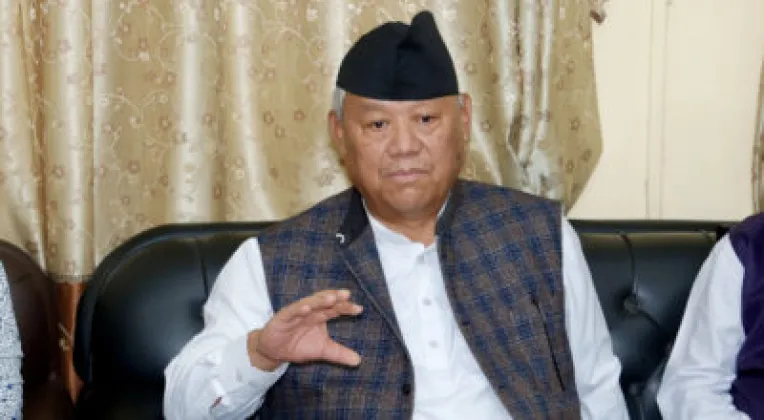
Kathmandu - Nepali Congress parliamentary party leader Bhishmaraj Angdembe on Sunday accused the government of treating his party's goodwill as a sign of weakness, in a pointed critique of the administration's approach to governance. Speaking at the party office in Sanepa, Angdembe said the government does not appear serious about basic democratic values such as parliamentary dignity, the rule of law, transparency and accountability. He further alleged that state bodies have repeatedly disregarded parliamentary dignity and established procedures, remarks that signal mounting friction between the party's parliamentary wing and the government.
Goodwill Mistaken for Weakness
At the heart of Angdembe's complaint was the way the ruling side has interpreted the Nepali Congress's conduct. According to the parliamentary party leader, the goodwill his party has shown toward the government has been taken not as a democratic courtesy but as an admission of frailty. In his telling, this misreading has shaped the government's behaviour, encouraging a posture that pays little heed to the opposition or to the institutions that mediate between the state and its citizens.
The choice of words carried weight. By stating that the party's goodwill is being taken as weakness, Angdembe suggested that the Nepali Congress's cooperative approach, which he framed as an expression of democratic commitment, has been taken for granted. His remarks implied that a party that has invested political capital in stability and constructive engagement now finds its restraint unreciprocated.
The comments carry particular force coming from the leader of the Nepali Congress's lawmakers in parliament, a role that places him at the frontline of the party's engagement with the government on legislative and oversight matters. They indicate that discontent with the government's conduct is no longer confined to routine criticism but is being voiced directly by the party's parliamentary leadership.
"Not Serious" About Democratic Values
Angdembe said the government does not appear serious about the basic values on which democracy rests. He identified them as:
- Parliamentary dignity, the respect owed to the legislature as the country's supreme elected body
- The rule of law, the principle that all state organs and officials remain bound by law
- Transparency, openness in the decisions and actions of government
- Accountability, the obligation of those in power to answer to parliament and to the public
In his assessment, these are not abstract ideals but the working machinery of a democratic state. A government that is serious about them, his argument suggested, would conduct itself in a manner that strengthens parliament, respects legal processes, keeps its workings open to scrutiny and accepts responsibility for its decisions. Failing to take these values seriously, as he put it, strikes at the foundation of the system itself.
His remarks positioned the Nepali Congress as a defender of democratic norms at a moment when, in the party's view, those norms are being eroded. The party, which has long associated itself with Nepal's democratic movement, has traditionally claimed the role of custodian of constitutional values, and Angdembe's speech placed that self-image at the centre of his critique of the government.
State Bodies Disregarding Parliament
Perhaps the most concrete of Angdembe's charges concerned the conduct of state bodies. He said these institutions have repeatedly disregarded parliamentary dignity and the procedures that have been established for the functioning of the state. The word "repeatedly" was key: rather than describing a single lapse, the parliamentary party leader alleged a pattern of behaviour in which the dignity of the legislature and settled procedures are brushed aside.
The significance of the allegation lies in the place parliament occupies in a democratic system. As the body directly elected by citizens, the legislature is meant to be the principal forum for accountability, where the government answers questions, defends its record and seeks legitimacy for its actions. When state bodies show disregard for parliamentary dignity, they weaken the very mechanism through which the public holds power to check. Established procedures exist precisely to prevent the arbitrary exercise of authority, and to bypass them is to invite governance by convenience.
Angdembe did not, in the remarks reported, detail specific incidents, but his characterization of the problem as repeated and systemic pointed to a deeper concern: that the norms of parliamentary democracy are being treated as dispensable by the very institutions charged with upholding them.
A Signal of Strained Relations
Delivered at the party office in Sanepa and reported by Khabarhub, Angdembe's comments underscore a hardening tone in the relationship between the Nepali Congress parliamentary wing and the government. An accusation that goodwill is being read as weakness is rarely a neutral observation; it typically signals that the party issuing it is reassessing how far its cooperation should extend.
For the government, the criticism adds to the pressure of being seen as dismissive of democratic values. Questions of parliamentary dignity, the rule of law, transparency and accountability are not peripheral matters; they are the standards by which any administration in a democracy is measured. A governing side that allows the opposition to frame it as careless of these standards risks a reputational cost that extends well beyond the floor of the house.
Whether the government responds to Angdembe's charge, or adjusts its conduct toward parliament and state institutions, remains to be seen. What the statement makes clear is that the Nepali Congress parliamentary leadership has placed the government on notice: the party's goodwill, it insists, flows from democratic conviction, not from an invitation to be taken lightly.


