
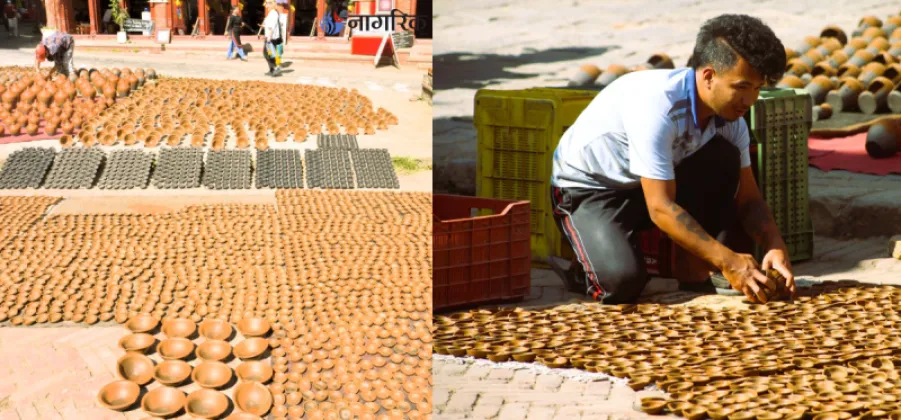
The pottery quarters of Bhaktapur are at their busiest of the year. With Tihar just around the corner, members of the Prajapati community, the traditional potters of the historic Newar town, are working long days to shape, dry and fire the small clay vessels known as pala that will light homes, shops and courtyards during the festival of lights. A photo feature published by Nagarik News captures the rush, showing community members absorbed in their work with little time to spare. The clay pala made in Bhaktapur are well known among residents of the Kathmandu Valley and beyond, and with the festival days away, the work is in full swing.
Why pala matter at Tihar
Tihar, the five-day festival celebrated with lamps, flowers, music and the worship of the goddess Laxmi, is inseparable from clay. In nearly every household that observes the festival, the season's glow comes from small oil lamps set in shallow earthen vessels. The pala, saucer-shaped pieces finished by hand, hold the wicks whose flames line windowsills, doorways and courtyards during Laxmi Puja, when devotees welcome the goddess of wealth into their homes, and during Bhai Tika, the final day dedicated to the bond between sisters and brothers.
Their role does not end with light. The same modest vessels are used to hold flowers, offerings and ritual items through the festival's five days, which makes them among the most sought-after festive goods of the season. As families across the valley prepare for the celebrations, demand for pala rises sharply, and much of that demand turns toward Bhaktapur, whose potters have supplied the valley's earthenware for generations.
A community built on clay
The Prajapati community has been identified with the potter's wheel for as long as living memory reaches. In Bhaktapur, whose old pottery square remains one of the most recognizable craft landmarks in the Kathmandu Valley, the trade has been handed down within families, with children learning at the wheel beside their parents and grandparents. Through the year, the community produces a wide range of earthenware, from cooking and storage pots to ritual vessels, but the weeks before Tihar are unlike any other stretch of the calendar.
For these households, the festival season is the busiest time of the year, when every spare hour goes into production. Most of the season's sales must be completed before the lamps of Laxmi Puja are lit, and potters have to balance shaping new pieces with drying, firing and dispatching finished stock. It is a demanding rhythm, one that leaves little room for rest until the last consignment has left for the market.
From wet clay to festive light
The making of pala follows a rhythm that has changed little over the years. While each potter works in his or her own way, the broad stages of the craft are familiar to anyone who has walked through Bhaktapur's pottery quarters:
- Clay is collected, soaked and kneaded until it reaches the right consistency for shaping.
- The pala are formed by hand and on the wheel, then set out to dry in the open air.
- Once dry, the pieces are stacked and fired so they gain the strength to hold oil and flame.
- The finished pala are sorted, packed and sent out to traders and markets ahead of the festival.
The photographs from Bhaktapur show the rush at its height, with members of the community bent over their wheels and work areas, racing the calendar. Each completed batch moves one step closer to a doorstep in Kathmandu, Lalitpur or beyond, where it will be filled with oil and lit at dusk.
A craft that lights the valley
The reputation of Bhaktapur's pala extends well beyond the town's old quarters. Familiar to residents of the Kathmandu Valley and far beyond it, the pieces reach shops and roadside stalls across the region in the run-up to Tihar, where they are sold alongside marigold garlands, flowers and other festival goods. For buyers, a pala is a small purchase. For the Prajapati families who make it, it represents weeks of labour compressed into the festival's unforgiving deadline.
The annual rush is also a reminder of the community's place in the valley's living heritage. At a time when many traditional trades are shrinking under pressure from mass-produced goods, the sight of Bhaktapur's potters at work before Tihar shows a craft that still holds a firm place in the festival life of the city and its neighbours. Long after the last lamp burns down at the end of the five days, the wheels of Bhaktapur will keep turning, as they have for generations. For now, though, the community's attention is fixed on the festival, and on making sure that when the moment comes to light the lamps, there is a pala ready for every home that needs one.


