
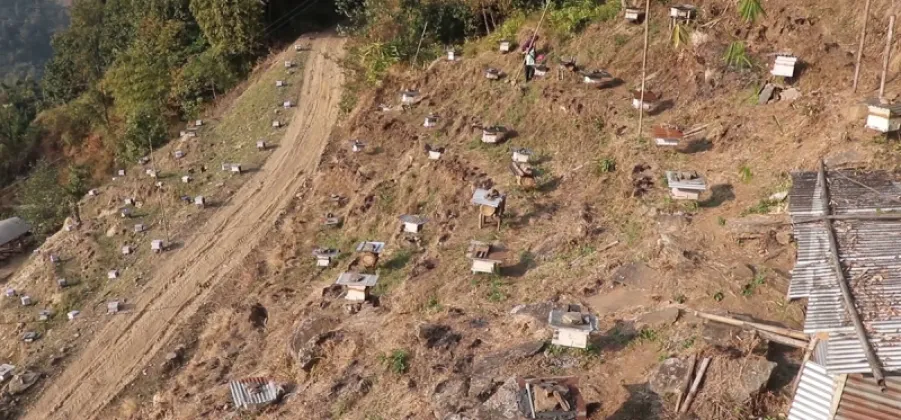
Beekeeping is fast emerging as a new source of income for farmers in Dhankuta, with growers across the hilly eastern district turning rocky patches of forest land that once lay unused into productive apiaries. According to recent reports published by Nagarik News and Rato Pati, the venture requires relatively little effort while yielding earnings in the lakhs of rupees, a combination that is drawing growing numbers of hill farmers towards the trade. The attraction towards beekeeping in Dhankuta is particularly visible in areas where the potential for grain crop production is low, giving farmers a practical way to earn from land that conventional farming has long bypassed.
From rocky forest land to buzzing apiaries
For years, the rocky patches of forest land scattered across the district served little purpose in agricultural terms. Too stony and uneven to plough or terrace, such parcels were typically left unused by farm households whose attention remained fixed on crops that demanded cultivable soil.
That picture is now changing. Local media reports say these once-neglected areas are being put to use for beekeeping, an enterprise that does not depend on tilling the earth. Because bees draw their sustenance from the flowering plants and wild flora found in and around forest areas, land that produces no grain can still sustain honey production. In effect, terrain that was previously written off as farm waste is being converted into a productive asset.
The shift reflects a broader reality of hill agriculture in districts like Dhankuta, where steep slopes and limited flat land constrain what can be grown. Rather than forcing crops onto unsuitable ground, farmers are matching the enterprise to the terrain, and beekeeping has emerged as one of the clearest examples of that adjustment.
Little effort, lakhs in income
What is drawing farmers to the trade is the unusually favourable balance between the work involved and the money it returns. The reports describe beekeeping as an activity that demands comparatively little effort, yet one that delivers earnings running into the lakhs of rupees, with the returns characterised as reaching into the millions.
For farm households accustomed to the modest and often unpredictable returns of hill cultivation, that arithmetic carries obvious appeal. An income of lakhs of rupees, earned without the heavy labour inputs that staple crops require, stands out sharply against the constraints of traditional farming in the district.
The advantages highlighted in the reports can be summed up as follows:
- Minimal effort: beekeeping is described as demanding far less labour than other farming activities.
- Use of idle land: rocky forest patches once left unused for farming are now being put to productive purpose.
- High earnings: income in the lakhs of rupees, with returns described as reaching into the millions.
- Fit with the terrain: the enterprise thrives precisely where grain crop potential is low.
Where grain crops struggle, bees deliver
A striking feature of the trend is where it is taking root. The growing attraction towards beekeeping is concentrated in areas where the potential for grain crop production is low, meaning pockets of the district where cereals have never delivered dependable returns.
In such locations, beekeeping fills a gap that conventional agriculture cannot. It generates cash income without competing for scarce cultivable land, and it draws on the wild flora of the surrounding forests, a resource that already exists and requires no investment to establish. For farmers in these areas, bees are effectively converting an environmental constraint into a commercial opportunity.
The development also points to a quiet diversification of the farm economy in the district's hills. Rather than relying solely on crops suited to limited parcels of land, some farmers are layering beekeeping on top of, or in place of, grain cultivation, spreading their livelihoods across more than one source of income.
A growing attraction
The tone of the local coverage, headlined as a "growing attraction towards beekeeping in Dhankuta", suggests the trend is gathering pace rather than plateauing. What began for some farmers as an experiment on unused land is now being reported as a source of earnings in the lakhs of rupees, a level of income that naturally draws attention in a hill district where farming options are narrow.
For now, the reports portray beekeeping in Dhankuta as a rare alignment of circumstances: land that was useless for crops, a trade that demands little effort, and returns that reach into the lakhs and even millions of rupees. As more farmers in the district's low-grain-potential areas weigh that combination, the beehive appears set to claim a firmer place beside traditional agriculture in the hills of eastern Nepal.


