
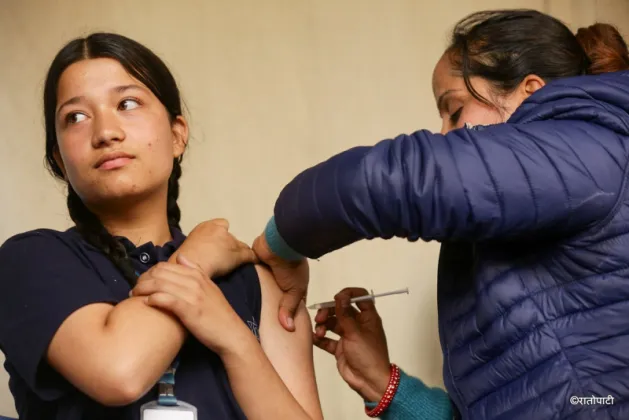
The human papillomavirus (HPV) vaccination campaign against cervical cancer in Baglung district has reached 99.36 percent of its target for the current fiscal year. According to Raju Khatri, a vaccination supervisor at the Provincial Public Health Office, Baglung, 2,182 of the 2,196 adolescent girls targeted across the district's 10 local levels received the vaccine. The campaign, conducted in two phases, focused on 10-year-old girls, covering both students reading in class 6 and girls who are out of school. With a shortfall of just 14 vaccinations against the district's goal, the drive has effectively fulfilled the target set for the year.
Two-phase drive across all 10 local levels
The campaign was carried out in two phases and extended to every one of Baglung's 10 local levels, meaning the vaccination effort was spread across the district rather than concentrated in a few areas. Health authorities set a target of 2,196 adolescent girls for the fiscal year, a benchmark the drive has now all but achieved. Health offices set annual immunization targets and report achievement rates against them, making the 99.36 percent figure the district's official result for this year's HPV campaign.
Phased implementation is a common feature of immunization campaigns of this scale, allowing health offices to organize vaccination teams, coordinate with local institutions and track coverage as the drive moves from one stage to the next. In Baglung's case, the two-phase structure culminated in near-total coverage, with 2,182 girls vaccinated under the campaign by its close.
Officials confirm the target has been met
The achievement figures were confirmed by Raju Khatri of the Provincial Public Health Office, Baglung, who put the campaign's coverage at 99.36 percent of the fiscal year's target. The numbers mean that of every 1,000 girls targeted in the district, more than 993 received the vaccine, leaving only 14 girls across the entire district outside the vaccinated total.
The key figures from the campaign:
- Target: 2,196 adolescent girls
- Vaccinated: 2,182 girls
- Achievement: 99.36 percent
- Coverage area: all 10 local levels of Baglung district
- Target group: 10-year-old girls, including class 6 students and out-of-school girls
- Structure: two phases
An achievement rate this close to the target is a notable outcome for a district-wide campaign involving children of a specific age group spread across multiple administrative units. Such a rate indicates that the identification of eligible girls and the delivery of doses across the district's local levels came together to leave very few girls uncovered by the time the campaign ended.
School and out-of-school girls alike
A defining feature of the Baglung campaign was the composition of its target group. The drive counted 10-year-old girls among its beneficiaries, taking in those studying in class 6 as well as girls of the same age who are not enrolled in school. By placing both categories in the same target list, the campaign was designed to ensure that a girl's schooling status would not decide whether she was vaccinated.
Reaching children outside the classroom is widely regarded as one of the harder tasks in immunization drives, since school-linked vaccination naturally covers only those attending classes. The explicit inclusion of out-of-school girls in Baglung's target reflected an effort to make the district's coverage representative of all eligible girls, not only those easiest to reach through schools. The overall achievement of 99.36 percent was recorded across the campaign as a whole, covering both groups.
Protection against cervical cancer
The vaccine administered during the campaign protects against HPV, the viral infection identified as the principal cause of cervical cancer. Vaccinating girls at around the age of 10, before they are likely to be exposed to the virus, is the approach favoured in international health guidance, as protection is strongest when the vaccine is given early in adolescence. The age focus of the Baglung drive is consistent with this principle, and vaccination, combined with later screening, remains central to reducing the incidence of a cancer that is largely preventable.
For the district, the completion of nearly the entire target within the fiscal year marks a measurable step toward reducing the future risk of cervical cancer among its young female population. Each of the 2,182 girls vaccinated under the campaign now carries protection against a disease that remains a serious threat to women's health. The campaign's design, which combined its focus on classroom students with the inclusion of out-of-school girls, also offers an approach that can inform future rounds of HPV immunization in the district.
The figures released by the Provincial Public Health Office, Baglung, and reported by Ratopati, close this year's campaign with the district just 14 vaccinations short of its full target.


