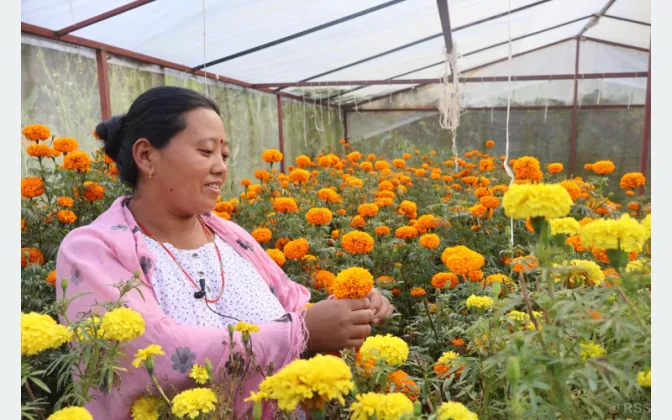
Kamala Thapa, a farmer from Maindanda in Ramrekha, Baglung Municipality-1, has moved out of commercial vegetable farming and into floriculture, completing the transition over the past three years. The change of crop has changed her standing as well: residents of her area now describe her as a successful farmer, and she is known locally above all for her flowers. The switch has brought her both recognition and income, a story highlighted by RatoPati, Khabarhub and Pradesh Khabar.
At a glance
- Who: Kamala Thapa, a farmer from Maindanda in Ramrekha, Baglung Municipality-1
- What: A shift from commercial vegetable farming to floriculture
- Timeline: Carried out over the past three years
- Outcome: Both income and recognition as a successful flower farmer
From plastic tunnels to flower farming
Thapa's earlier work was rooted in one of the most familiar forms of commercial agriculture in Nepal's hills. She grew vegetables in plastic tunnels, the arched poly-sheet structures that let farmers manage heat, moisture and pests while producing crops outside their normal season. Tunnel farming has been widely promoted across the country as a way for smallholders to earn more from limited plots, and it gave Thapa a commercial footing long before flowers entered the picture.
Over the past three years, that footing shifted. She gradually moved away from vegetables and toward flower farming, a transition that reports describe as complete. The change involves far more than swapping one crop for another. Vegetables grown in tunnels follow fast, repetitive cycles of planting, care and harvest, while flowers demand a different rhythm: longer growing periods, closer attention to individual plants and careful timing so that blooms are ready when the market wants them.
For Thapa, the adjustment appears to have paid off. Rather than remaining a side experiment, floriculture has become the activity that now defines her farm, and the results are visible in the way her neighbors talk about her.
Income and a new reputation
The most immediate effect of the switch has been financial. Reports note that flower farming has brought Thapa both income and recognition, pairing a livelihood with a reputation. In rural Nepal, where earnings from farming are often modest and unpredictable, a transition that delivers both money and standing is rare enough to draw attention from the wider community and from news outlets across the district.
Just as significant is the recognition itself. Local residents now describe her as a successful farmer known for floriculture, a phrase that captures how completely her identity has changed. Three years ago she was, in the eyes of her community, a vegetable grower with plastic tunnels. Today she is the flower farmer of Maindanda.
That kind of local reputation carries weight in farming villages. At a time when many Nepali households measure success by remittances from abroad or jobs in the cities, a farmer who builds a name at home offers a different model. Thapa's experience points to the possibility that changing what a farm produces, rather than leaving the farm, can be a route to both earnings and esteem.
A wider shift taking root in the hills
Thapa's story also fits a broader pattern. Baglung, a hilly district in Gandaki Province, has long depended on agriculture, with farmers traditionally growing cereals and, increasingly in recent decades, vegetables for nearby markets. As road access and market links improve, growers in such districts face a choice between sticking with familiar crops and moving into higher-value products. Floriculture, with demand driven by festivals, weddings and urban events, is one of the options more farmers are weighing.
Across Nepal, flower farming has grown from a niche activity into a recognized commercial sector, supplying everything from garlands for religious ceremonies to bouquets for celebrations. The economics differ sharply from vegetable production: volumes are smaller, but well-grown flowers can command strong prices, particularly around peak festive seasons. Farmers who make the switch successfully, as Thapa has, often become reference points for neighbors considering the same move.
Nothing in the reports suggests that the transition was easy or instant; the three-year timeline itself points to a gradual, learned process rather than a sudden leap. But the outcome, income combined with recognition, is exactly what agricultural diversification is meant to deliver for smallholder families in the hills.
For now, her story remains a local one, rooted in a single settlement in Baglung Municipality-1. Yet it is precisely such local examples that other farmers tend to watch closely. A neighbor seeing Kamala Thapa earn both money and respect from flowers may well ask whether a tunnel full of vegetables is still the best use of the same land. In that sense, her shift from vegetables to floriculture is more than a personal business decision; it is a quiet demonstration, in the middle of the hills, that change on the farm can change a farmer's life.