
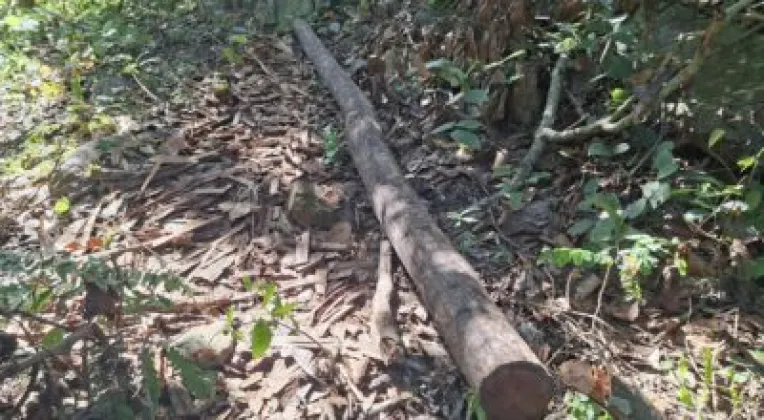
Around 100 sal (sakhua) trees have been found illegally felled inside two community forests in Khotang district, in an incident that has raised fresh concerns about the protection of valuable hardwood in Nepal's community-managed forests. The felled trees were discovered in the Chandraman Community Forest at Khalle, in ward 4 of Diktel Rupakot Majhuwagadhi Municipality, and in the Deule forest at Lafyang, in ward 5 of the same municipality. According to a Khabarhub report, the timber was reportedly being prepared for extraction when the felling was detected, suggesting that those behind the cutting had not yet managed to remove the wood from the forest when it came to light.
Felling Detected in Two Community Forests
The illegal cutting was not confined to a single site, but was spread across two separate forest areas within Diktel Rupakot Majhuwagadhi Municipality, the municipality that serves as the headquarters of the hilly Khotang district in eastern Nepal. The larger of the two discoveries was made in the Chandraman Community Forest at Khalle, which falls under ward 4 of the municipality. The second site was the Deule forest at Lafyang, located in the adjoining ward 5.
Together, the two locations accounted for roughly 100 felled sal trees, a significant loss for forests that are formally placed under the stewardship of local community forest user groups. The fact that the timber was found stacked or otherwise readied for extraction indicates that the felling was not an isolated act of casual cutting, but part of a deliberate effort to harvest and transport valuable wood out of the forests. The report did not identify those responsible for the felling, and details on how the trees were discovered remained limited at the time of reporting.
Valuable Sal Timber at the Centre of the Incident
The choice of target is significant. Sal, known locally as sakhua, is one of Nepal's most prized hardwood species. Its dense, durable timber is in steady demand for construction beams, furniture, doors, windows and other high-value uses, which makes sal-bearing forests a recurring target for illegal loggers wherever enforcement is weak. Because the species is slow-growing and ecologically important, the loss of around 100 mature trees in a single operation represents a substantial blow to the affected forests.
That the timber was detected while still being prepared for extraction may limit the immediate loss, as the wood had reportedly not yet been smuggled out of the two forest areas. Even so, the felling itself has already damaged the forest stands, and the discovery points to the scale of organization that illegal timber operations can reach in remote hill districts, where forests are far from roads and monitoring is difficult. Incidents of this kind typically involve considerable labour to fell, trim and move heavy hardwood logs, underscoring how determined such operations can be.
A Setback for Community Forest Management
The incident is particularly troubling because both affected areas are community forests. Nepal's community forestry programme, one of the country's most widely cited conservation successes, hands day-to-day management of forests to local user groups, which in turn are entitled to harvest and sell forest products in a regulated manner and to use the proceeds for community development. Illegal felling of this scale undermines that arrangement in two ways at once: it strips the user groups of timber that would otherwise be managed and sold under their own plans, and it erodes the resource base and biodiversity that the communities are mandated to protect.
For the residents of Khalle and Lafyang, the loss is therefore not merely ecological. The felled sal trees represent revenue and resources that would have accrued to the community forests under lawful management, and their removal through illegal means shifts the benefits of the forests away from the very users entrusted with their care. The case also highlights the pressure that community forest user groups in hill districts like Khotang face in guarding large forest areas with limited staff and resources.
Growing Concern Over Illegal Logging
The discovery of around 100 felled sal trees in Khotang adds to ongoing concerns about illegal timber harvesting across Nepal's forests, particularly in areas where valuable hardwood species grow. The fact that the timber was found before it could be extracted is likely to renew attention on the need for stronger patrols, better coordination between community forest user groups and local authorities, and closer monitoring of forest areas that are distant from settlements.
For now, the two sites at Khalle and Lafyang stand as the most tangible evidence of the operation, and the fate of the seized timber, the identification of those responsible, and any action by forestry or law enforcement authorities remain to be seen. What is already clear is that the forests of Diktel Rupakot Majhuwagadhi Municipality have suffered a serious loss, and that the protection of community forests in the district will require renewed vigilance in the period ahead.


