
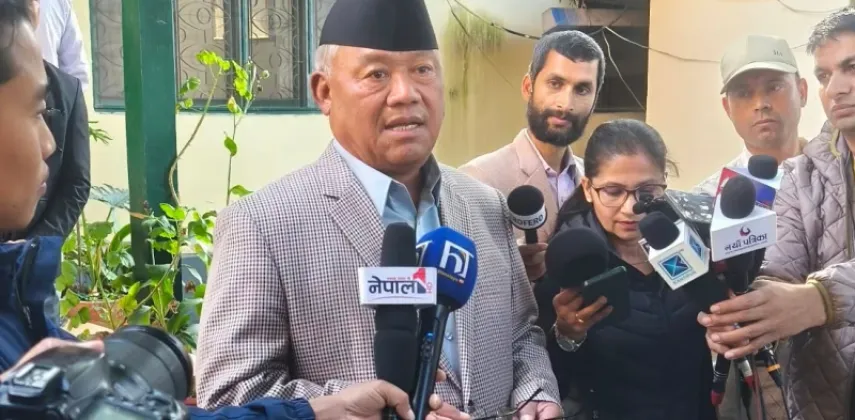
Bhishmaraj Angdembe, the parliamentary party leader of the Nepali Congress, met Speaker Dol Prasad Aryal at the Speaker's office in Singha Durbar on Tuesday afternoon to formally convey the decisions taken by Nepal's opposition parties, including their demand for the convening of a parliamentary session. According to Angdembe's personal secretary, Yam Dhungana, the meeting had been scheduled for Tuesday afternoon and came a day after a meeting of opposition parties on Monday at which the bloc took its decisions.
Opposition's Decisions Taken to the Chair
Angdembe's visit was effectively a formal handover of the opposition's collective position rather than a routine courtesy call. As reported by RatoPati and Nepal Press, the Nepali Congress parliamentary party leader briefed the Speaker on the outcome of Monday's meeting of opposition parties, with the demand for a parliamentary session standing out as the principal point communicated to the chair.
Singha Durbar, the historic complex in the heart of Kathmandu that houses the country's key institutions of government, has long been the setting for such exchanges between the House leadership and political leaders. The Speaker's office, located within the complex, is where the presiding officer of the Federal Parliament receives party leaders and formal communications from the forces represented in the House.
Why the Demand for a Session Carries Weight
A parliamentary session is the principal arena in which elected representatives question the government, debate issues of public concern and place their positions on the official record. For an opposition bloc, pressing for the House to convene is among the most visible instruments at its disposal, particularly when it wants to force discussion of matters it believes are not receiving adequate attention.
Under Nepal's constitutional framework, sessions of the Federal Parliament are formally summoned on the government's recommendation, while the Speaker presides over the House and manages its proceedings. That division of roles means opposition parties typically route their pressure through several offices at once, and a meeting with the Speaker, as the custodian of the House, is among the most standard first steps. By calling on Speaker Aryal in person, Angdembe has placed the opposition's demand directly before the officer who presides over parliamentary business.
A Coordinated Sequence of Opposition Moves
The sequence of events, an opposition meeting on Monday followed by the delivery of its decisions to the Speaker on Tuesday, points to a coordinated effort to keep the demand for a session firmly in public view. The Nepali Congress, one of the oldest political forces in Nepal, has in Angdembe a parliamentary party leader whose position makes him a natural conduit for communication between the opposition and the House leadership.
Neither the full text of the decisions adopted at Monday's meeting nor the specific issues the opposition intends to raise in a prospective session have been detailed in the reports available so far. What has been confirmed, through Dhungana's account, is the fact and timing of the meeting with the Speaker and its central purpose: informing him of the opposition's decisions, foremost among them the demand that parliament be convened.
The key points of Tuesday's development can be summarised as follows:
- Who: Bhishmaraj Angdembe, parliamentary party leader of the Nepali Congress, and Speaker Dol Prasad Aryal
- What: A meeting at which Angdembe conveyed the decisions of Monday's opposition party meeting, including the demand for a parliamentary session
- Where: The Speaker's office at Singha Durbar, Kathmandu
- When: Tuesday afternoon, one day after the opposition parties met on Monday
- Confirmation: Yam Dhungana, Angdembe's personal secretary, confirmed that the meeting was scheduled for Tuesday afternoon
What Comes Next
No immediate response from the Speaker's office or the government was reported following the meeting, and it remains to be seen whether the opposition's demand will translate into a date for the House to convene. As is typical in such situations, the coming days are likely to show whether further opposition mobilisation follows and whether the chair responds with any timetable for parliamentary business.
The meeting underscores the routine but consequential choreography of Nepal's parliamentary politics, in which procedural steps such as personally informing the Speaker often serve as the first public markers of a broader political push. For now, the opposition's message has been delivered to the chair, and attention turns to whether the demand for a session is acted upon in the days ahead.


