
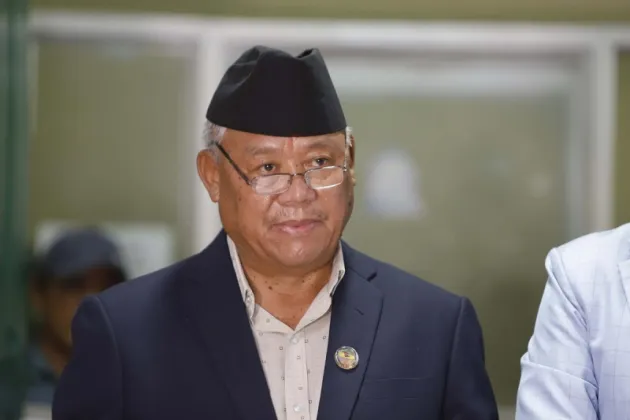
Nepali Congress parliamentary party leader Bhishmaraj Angdembe on Saturday condemned the arrest of journalists over their reporting and police interference at media outlets, declaring that such actions "cannot be the conduct of any democratic government." In a press statement issued on Saturday, Angdembe said the parking of police vehicles at the doors of media houses and the sending of police into newsrooms amount to a naked abuse of state power and a direct attack on press freedom. The senior Congress leader also asserted that arresting journalists cannot suppress the truth of the news, underlining that detention does nothing to change the substance of published reporting. His remarks, as reported by RatoPati, represent one of the sharpest political responses to the police measures targeting the press.
'Cannot Be the Conduct of Any Democratic Government'
Angdembe's statement concentrated on a series of police actions involving media organisations, and he reserved his strongest language for the visible presence of security personnel at the doors of media houses. According to the Congress leader, such displays place the machinery of the state directly against institutions whose purpose is to inform the public.
He singled out the following measures for condemnation:
- The arrest of journalists in connection with their reporting
- Police vehicles being parked at the doors of media organisations
- Police personnel being sent into newsrooms
In Angdembe's assessment, each of these actions crosses a line that no democratic government should cross. He argued that treating newsrooms as sites for police intervention inverts the proper role of the state: instead of protecting institutions that perform a public function, the government appears to be directing its authority at them. The image of police vehicles stationed at the entrances of media outlets, he indicated, is fundamentally incompatible with democratic norms in which the press operates independently of those in power.
'A Naked Abuse of State Power and a Direct Attack on Press Freedom'
The Nepali Congress leader framed the measures not as an administrative matter but as a question of democratic principle, describing them as a "naked abuse of state power" and "a direct attack on press freedom." In his statement, the abuse lies in the use of state power against the press rather than in its service to the public.
Angdembe's argument rests on the idea that press freedom is not merely a professional concern for journalists but a safeguard for the public's ability to receive information. When police enter newsrooms or park their vehicles at media doors, the state's coercive instruments are being deployed in a manner that intimidates the media and, by extension, the citizens the media serve. His characterisation of the actions as an abuse of state power places the burden on the government to explain why police resources are being used against media houses at all.
The statement makes clear that, in Angdembe's view, the conduct he described cannot be reconciled with the responsibilities of a democratic government, whatever justification may be offered for it.
'Arresting Journalists Cannot Suppress the Truth of the News'
A central element of Angdembe's Saturday statement was his assertion that the arrest of journalists cannot suppress the truth of the news. In his view, detaining reporters does not alter the accuracy or the substance of what they have published; it merely substitutes state action for any engagement with the content of the reporting itself.
He linked this point directly to his broader criticism of the police measures. Rather than addressing the substance of journalists' work, the actions he condemned target the people who produce that work. For Angdembe, this is both ineffective and wrong: the truth of published reporting remains unchanged whether or not its authors are at liberty, and the decision to arrest journalists therefore does nothing to diminish the significance of their stories.
In this formulation, press freedom and truth-telling are inseparable. An attack on journalists, as the Congress leader presented it, is not simply an attack on individuals but on the flow of information to the public. Arrests may remove reporters from their desks, but they do not remove the facts that have already been put before the people.
A Political Test for Democratic Governance
Angdembe's statement places the issue before the government in blunt terms. By insisting that parking police vehicles at media doors and sending police into newsrooms "cannot be the conduct of any democratic government," he has set out a standard against which the actions of the state apparatus can be measured.
The remarks also underscore the position of a senior Nepali Congress leader that the press must be allowed to work free of police interference and that journalists should not face arrest for their reporting. For Angdembe, the measure of a democratic government lies partly in how it treats the media, and the actions he condemned fall short of that measure. His statement concludes, in effect, that a government confident in its democratic credentials has no business deploying the police against newsrooms or detaining journalists over what they publish.
Further details of his remarks are available in the original report on RatoPati.


