
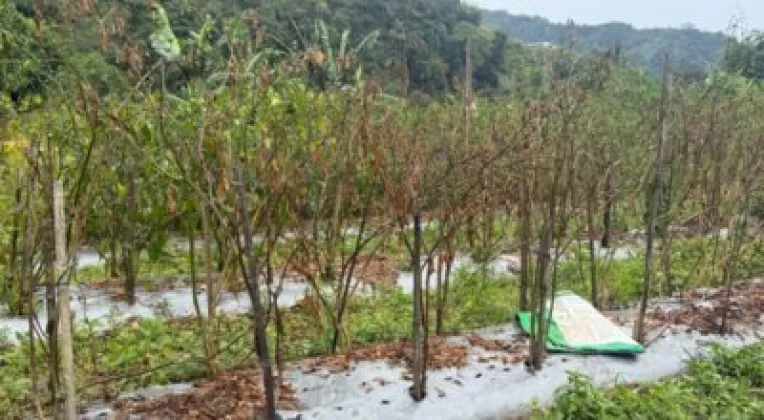
Farmers across Ilam district are watching their Akabare chili crop fail at the worst possible moment, as plants begin dying during the main production season. Pradeep Rai, a grower from Mangsebung Rural Municipality-6, said the plants suddenly turn yellow and die, with leaves yellowing, branches drying out and entire plants perishing just as fruiting begins. The wave of deaths has left commercial Akabare growers throughout the district worried about the income they had been expecting from this season, as reported by Khabarhub and Thaha Khabar.
Sudden yellowing, then a swift decline
The account from Rai describes a condition that gives farmers little warning and little room to react. Plants that should be entering their most productive weeks instead begin to fail, and the transition from a healthy field to a dying one can happen suddenly. According to his description, the first visible sign is in the foliage: the leaves turn yellow, draining the plants of the green color that marks a thriving crop.
From there, the damage moves through the rest of the plant. The symptoms farmers are seeing follow a clear and grim progression:
- Yellowing leaves, the first sign that something is wrong
- Drying branches, as the plant's structure begins to fail
- Entire plants perishing, dying off completely as fruiting begins
What makes the pattern especially unsettling is where it strikes in the crop cycle. The plants are not failing as seedlings or in their early growth, but at the fruiting stage, the point at which a season of cultivation is supposed to pay off. Rai's account makes clear that the decline is comprehensive: leaves yellow, branches dry, and the whole plant dies, leaving nothing to harvest from it.
Losses landing at the peak of the season
For commercial growers, the timing could hardly be more damaging. A chili plant that dies before fruiting takes away future output, but a plant that dies as fruiting begins takes away the harvest itself, the very thing the market pays for. Unlike a partial reduction in yield, the death of entire plants removes both the current fruit and any prospect of further pickings from those plants. The disease is therefore hitting Ilam's Akabare growers at the exact point when their expected income is supposed to be realized, turning a promising season into an uncertain one.
Akabare, a pungent chili variety grown in Nepal's eastern hills, is cultivated commercially in Ilam, and the growers involved have invested a full season of labor and care in their fields. That investment, from planting through tending, is meant to be recovered when the fruit is picked and sold. With plants yellowing and perishing as fruiting begins, that recovery is now in doubt. Each plant lost represents a portion of the season's earnings that will not arrive, and the worry among growers is that the losses will be large enough to matter for household finances across the district's chili-growing areas.
The concern is not abstract. Commercial Akabare growers in the district are worried specifically about the effect on the money they had planned around when the season began. The phrase "main production season" carries real weight here: this is the period when the crop delivers its output, and a disease that strikes now does not merely delay income but can erase it outright for the affected fields.
Questions without answers in the hills
The reports from Ilam describe the symptoms and the worry, but they do not identify what is causing the plants to die. That gap leaves growers in an uncomfortable position. Without a confirmed cause, farmers are left to judge for themselves how far the yellowing might spread, whether neighboring fields are at risk, and whether anything can be done to protect plants that have not yet shown signs of trouble. For a district where chili farming forms part of the agricultural calendar, an unexplained disease during peak production is a worry that extends beyond any single farm to the many commercial growers who depend on the same crop.
For now, the picture in Mangsebung and across the wider district is one of anxiety rather than answers. Rai's description of plants that suddenly turn yellow and die captures the experience of growers watching a valuable crop fail in its most important weeks. As the season continues, attention across Ilam's Akabare-growing areas will remain fixed on the fields, where yellowing leaves and drying branches have turned a season of expectation into one of concern.


