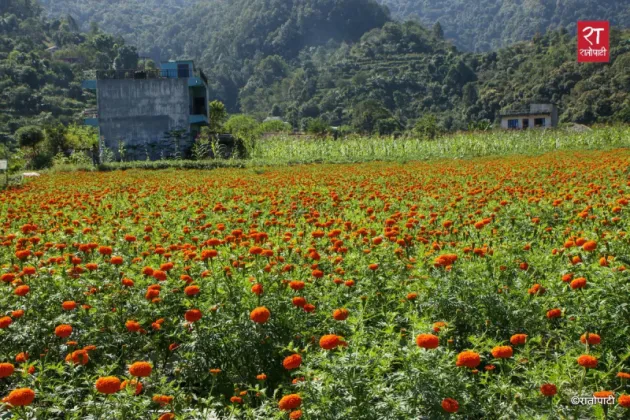
Three students who are completing their bachelor's degrees in agriculture have taken up flower farming in Futaha, Nepalgunj Sub-Metropolitan City-19 of Banke district, turning 10 kattha of land into an experimental flower farm that is already earning them an income. Bedraj Archaya, Asim Sigdel and Chetan Kesi, all local youths of Nepalgunj, began the venture while still finishing their studies, and their experience has convinced them that flower farming is a field where a small investment can bring large returns. According to a report by RatoPati, the trio's decision underlines a growing argument among educated young Nepalis: that agriculture, practiced with training and intent, can be a career choice rather than a last resort.
From Classroom to Flower Field
The three friends have spent years studying the theory of agriculture, and they have now put that learning to the test on the ground in their own city. Instead of waiting until after graduation to look for work, they prepared 10 kattha of land in Futaha and cultivated flowers on it experimentally. The holding is a substantial one: a kattha, the traditional land unit used across the Tarai, is equal to 20 dhur and measures roughly 3,645 square feet, which places their plot at close to 36,500 square feet, or a little over a third of a hectare.
The word experimentally is central to the story. The young farmers did not take over an established flower business; they treated the plot as a trial of what their education had taught them. That trial has paid off in the most basic way, because the flowers they planted have produced income, giving the three students both a return on their effort and practical evidence for the claim they now make about the economics of floriculture.
Why Flower Farming Appeals to Educated Youth
Flower farming has been gradually gaining ground in Nepal as an option that suits farmers with limited land and capital. Compared with staple crops that occupy a field for an entire season and often fetch modest prices at harvest, flowers can offer a faster cycle and higher returns per unit of land. Demand is reinforced by the rhythms of everyday life: flowers are used for worship at temples and in homes, for garlands at weddings and festivals such as Tihar, and for decoration at offices, hotels and public events. For Nepalgunj, one of the largest commercial centres of the Tarai, those represent steady and close-at-hand sources of demand.
The choice made by Archaya, Sigdel and Kesi also speaks to a larger conversation in Nepal about who will farm the country's land. As young people continue to leave villages for jobs at home and abroad, planners and agricultural experts have repeatedly argued that the future of Nepali farming depends on trained, energetic youth willing to treat agriculture as an enterprise. Three agriculture students choosing to grow flowers before their degrees are even complete is a small but telling answer to that debate.
Small Investment, Large Returns
The core of the trio's message, as reported, is economic. They believe that a small investment in flower farming can yield large returns, and their own experience stands as the proof they point to. The plot in Futaha began as an experiment, but it has already moved beyond the experimental stage in one important respect: it is generating income for the three students even as they complete their academic requirements.
Their venture so far can be summed up in a few points:
- Educated hands: All three farmers are completing bachelor's-level study in agriculture, bringing formal training to their fieldwork.
- Local roots: The three are youths of Nepalgunj itself, farming within their own sub-metropolitan city.
- A defined plot: The trial covers 10 kattha of land in Futaha, an area of roughly a third of a hectare.
- Early returns: The experimental cultivation has already earned the group an income.
- A guiding belief: The farmers maintain that small investments in flowers can bring large returns.
A Signal for Banke and Beyond
What comes next for the three students is not detailed in the report, but the significance of their start is not difficult to read. Banke lies in the fertile plains of the Tarai, where agriculture remains a mainstay of household incomes, and Nepalgunj's markets give local farmers relatively quick access to consumers. Flowers, which are perishable and lose value over long transport routes, benefit precisely from such proximity, an advantage that the Futaha farm enjoys by location.
For other students now completing agriculture degrees across the country, the message from Nepalgunj is straightforward. The knowledge gained in lecture halls and practical classes can be applied on land near home, sometimes with modest capital, and the results can be measured in income rather than only in grades. Whether flower farming in Futaha grows from a 10-kattha experiment into a larger enterprise will depend on the farmers themselves, but as a demonstration of what trained young people can achieve with land, initiative and a small investment, the trial has already succeeded.