
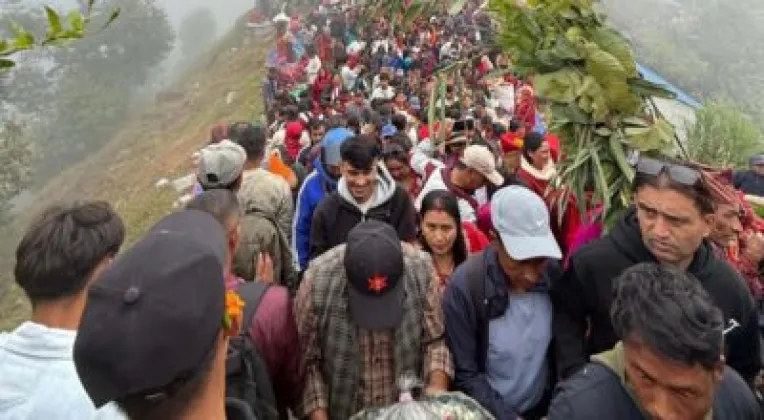
Devotees offered 91 flower palanquins at the Thanimai Temple in Basantapur, Bhanu Municipality-7 of Tanahun district, all within a single day, in a striking display of collective faith at the long-revered shrine. The decorated palanquins were brought to the temple by devotees from various villages and places, who travelled to Basantapur in keeping with religious tradition. According to Jeevan Thapa, chair of the temple management committee, devotional singing, worship and other religious activities were held in the temple premises during the offering. Local residents say worship at the Thanimai Temple began in 1825 BS, a timeline stretching back roughly two and a half centuries, making the day's mass offering the continuation of a practice passed down through generations.
Ninety-One Palanquins in a Single Day
The sheer number of offerings made the occasion remarkable. Ninety-one flower palanquins, each one decorated and prepared by devotees, were presented at the temple over the course of just one day. For a single shrine serving the villages around Basantapur, such a volume of offerings within a matter of hours reflects the depth of attachment local communities feel toward the temple and its traditions.
The devotees did not come from a single settlement. They arrived from various villages and places to make their offerings, turning the temple grounds into a meeting point for worshippers from across the wider area. Each palanquin represented an individual or family act of devotion; together, they formed a collective expression of faith on a scale that few ordinary days of worship can match.
The key facts of the day can be summarized as follows:
- Offerings: 91 flower palanquins presented in a single day
- Site: Thanimai Temple, Basantapur, Bhanu Municipality-7, Tanahun district
- Participants: Devotees from various villages and places
- Activities: Devotional singing, worship and other religious rituals on the temple premises
- Heritage: Worship at the temple is said by local residents to date back to 1825 BS
Hymns and Rituals Fill the Temple Premises
Jeevan Thapa, who chairs the temple management committee, said the offering of palanquins was accompanied by a full program of religious observance. Devotional singing echoed through the temple premises as worshippers performed rituals and took part in other religious activities organized for the occasion.
The involvement of the management committee points to the organized character of the event. Committees such as the one Thapa leads typically oversee the day-to-day affairs of temples across Nepal, and their role becomes especially visible on days of heavy footfall, when offerings, rituals and gatherings must be coordinated so that devotees can complete their worship in an orderly manner.
For the devotees themselves, the day combined solemn ritual with communal celebration. Devotional singing, in particular, is the feature of such gatherings that turns individual worship into a shared experience, with voices raised in hymns while flower-decked palanquins wait to be offered. The combination of worship, song and ritual described by Thapa suggests the temple grounds remained at the heart of the community's religious life throughout the day.
A Tradition That Began in 1825 BS
For residents of Basantapur and the settlements around it, the Thanimai Temple's significance is rooted in a very long history. Local residents say worship at the temple began in 1825 BS. On the Gregorian calendar, that places the start of worship around the late 1760s, meaning the shrine has drawn devotees for close to two and a half centuries.
Continuity of this kind carries weight in Nepal's religious landscape, where temples often serve as anchors of identity for the villages that surround them. A shrine whose worship is traced back to 1825 BS has outlived generational change, migration and the transformation of daily life in the hills, yet it still commands the kind of devotion on display on this occasion: ninety-one palanquins, brought by devotees from surrounding villages and offered at the temple in a single day.
Devotion Carried from Villages Near and Far
Perhaps the most telling detail of the day was the geography of devotion. The palanquins came not from Basantapur alone but from various villages and places, evidence that the Thanimai Temple functions as a centre of faith for a broad area rather than a single community. For the families involved, preparing and offering a decorated flower palanquin is an act of reverence performed in accordance with religious tradition, one that links present-day worshippers to the generations who have made the same journey since worship began at the site in 1825 BS.
The day's events, as described by the temple management committee and local residents, offer a portrait of a living tradition: a centuries-old shrine, a committee that organizes its rituals, and a steady stream of devotees willing to carry their offerings to the temple door.
Reports on the day's offerings were published by Khabarhub, Nagarik News and Thahakhabar.


