
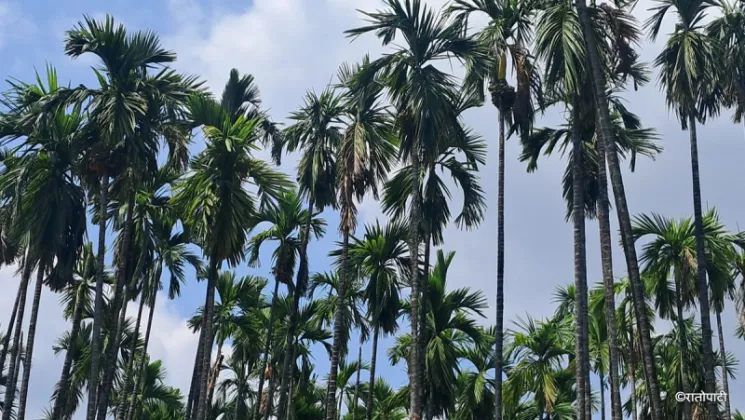
At 80, Govinda Bahadur Karki remains actively engaged in betel nut farming at Mahendra Chowk in Inaruwa Municipality-4, Sunsari, spending his days caring for a well-maintained orchard spread across one and a half bighas. The clean, orderly plantation has become an attraction for visitors, while the farming continues to provide Karki with a dependable source of income.
An orchard kept in order
Karki’s plantation stands out for its neat arrangement and cleanliness. Rather than leaving the orchard untended, he continues to spend his days looking after it, maintaining a place that is both productive and welcoming to people who come to see it. The care visible across the one-and-a-half-bigha plot has helped make the farm notable in the neighbourhood.
The orchard’s appeal is not limited to its role in Karki’s livelihood. Visitors are drawn to the plantation, where the orderly layout and clean surroundings make it an attraction in its own right. Its condition reflects the attention Karki gives to the farm and has made his betel nut cultivation a point of interest for people in the area.
Farming remains a dependable livelihood
For Karki, the plantation is also a continuing source of income. The available details do not specify how much the farm earns, how much betel nut it produces or how its harvest is sold. They do, however, identify farming as a dependable means of support for him, making the orchard more than simply a well-kept property.
That combination of regular work and income gives the farm an important place in Karki’s daily life. At an age when many people may step back from active work, he remains involved in tending the orchard. The reported account describes him as actively engaged in the cultivation, with the farm providing a practical livelihood as well as a daily responsibility.
A local example of continued engagement
Karki’s experience is notable for the way it brings together age, work and a long-term connection to farming. The central facts are straightforward: he is 80, lives in Mahendra Chowk, and continues to care for a betel nut orchard in Inaruwa. The plantation covers one and a half bighas, is kept clean and orderly, attracts visitors and serves as a reliable income source.
The details also show why the orchard has attracted attention. Its appeal rests not on a reported expansion or a claim about production, but on its visible upkeep and Karki’s continued involvement. Visitors can see a carefully maintained plantation, while Karki remains closely engaged with the work that sustains it.
No figures on output, earnings or the size of the visitor turnout have been provided. Still, Karki’s farm offers a clear portrait of an older farmer continuing to work his land and rely on its cultivation. In Inaruwa, his neat betel nut orchard is both a source of income and a place that people are drawn to see.


