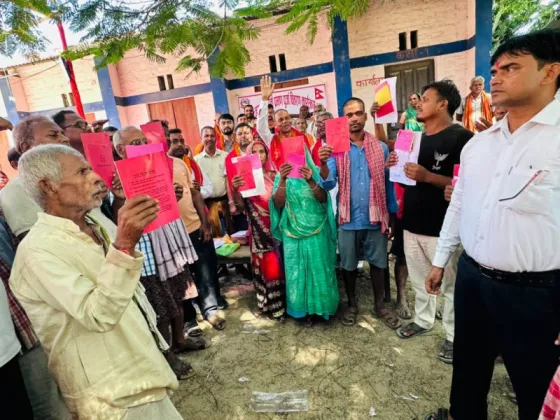
A total of 233 long-term resident families in Dhanauji Rural Municipality-3 of Dhanusha district have received land ownership certificates, around 11 years after their land survey was completed. The families, known as swavasi residents, had been living in the area covered by wards 1 through 9 of the former Jhojhi Kataiya Village Development Committee. The Dhanauji survey office completed the required legal process and distributed the certificates, formally establishing the families’ ownership of their land.
Certificates follow a long wait after survey
The certificates were issued about 11 years after the land survey was completed. The interval marks a significant gap between surveying the land and providing the families with documents confirming ownership. The survey had established the land details, but the families received formal ownership certificates only after the necessary legal process was completed.
The 233 households are described as swavasi, or long-term residents. They had been living in the former Jhojhi Kataiya VDC’s wards 1 to 9, an area now within Dhanauji Rural Municipality-3. The certificates therefore cover families in a defined part of the rural municipality, rather than residents across the entire municipality.
The Dhanauji survey office handled the required legal steps before distributing the lalpurja, the land ownership certificate. The completion of that process enabled the office to issue documents formally recognizing the families’ ownership. The reports do not specify the individual plots or the number of certificates received by each household.
Formal ownership for 233 families
For the recipient families, the certificates provide formal legal ownership of the land where they have been living. Their distribution is the outcome of the survey and subsequent legal process, and turns the land survey into a documented ownership record for the households concerned.
The reported figures establish the scale of the distribution: 233 families received certificates, and the process followed a survey completed about 11 years earlier. The information available does not give a reason for the time taken between the survey and the issuance of the documents. It also does not detail any additional measures or services linked to the certificate distribution.
The families’ former location is identified through the wards of Jhojhi Kataiya VDC, while their current location is given as Dhanauji Rural Municipality-3. The distribution thus concerns long-term residents in that area who were awaiting completion of the formal steps needed for land ownership documentation.
The issuance of the lalpurja completes a key stage for the 233 families: after the survey and legal processing, they now hold certificates that formally establish ownership of their land. The Dhanauji survey office’s distribution brings the 11-year process to this point, providing the households with legal documentation for the land they have occupied as long-term residents.