
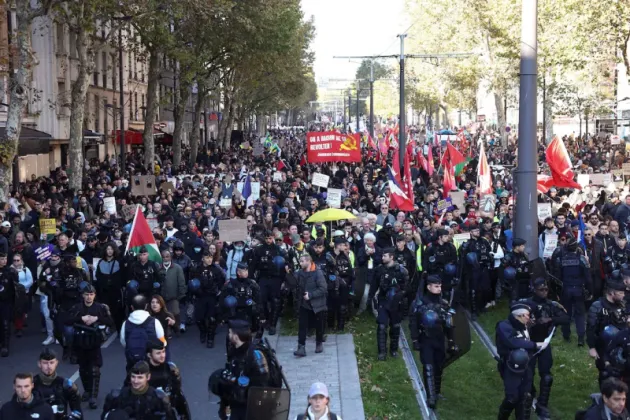
Youth-led protests have intensified across France, Italy and Germany, as anger over rising living costs, weak public services and mounting economic hardship pushed demonstrators in all three countries into the streets. Reports published on October 31, 2026 describe the unrest as spreading across Europe's three major economies, with inflation and dissatisfaction with national governments emerging as the common grievances uniting the movements.
The protests, framed in coverage as an expression of "youth anger," signal a broad wave of discontent among young Europeans who say that high prices and deteriorating public services have made daily life increasingly difficult, according to reports published by Ratopati.
High Prices and Poor Services at the Heart of the Anger
At the center of the demonstrations in France, Italy and Germany is a shared complaint: the cost of living has risen to a point where many people, and young people in particular, can no longer keep up. In each of the three countries, protesters have directed their anger at high prices that continue to squeeze household budgets, and at public services that many say have grown weaker even as the pressures on citizens have grown heavier.
The convergence of grievances across the three national movements is one of the defining features of the unrest. The reports identify a consistent set of complaints voiced by demonstrators in all three countries:
- Rising living costs, with inflation repeatedly cited as a driving force behind the anger spilling onto the streets.
- Weak public services, which protesters say have failed to keep pace with the needs of the population.
- Economic hardship among young people, who have found themselves at the sharp end of the squeeze on household finances.
- Dissatisfaction with government, with demonstrators directing their frustration at political leadership in each country.
Individually, each of these grievances has fueled protest movements before. What makes the current wave notable, the reports suggest, is that all of them have surfaced at once, across three of Europe's largest economies, and that young people have placed themselves at the front of the mobilization.
Young People at the Forefront
The unrest has been defined by the prominence of youth in the streets. In France, Italy and Germany alike, the demonstrations have drawn young people who say the combination of high prices and poor services has narrowed their prospects and deepened their daily struggles. The reporting frames the protests explicitly as an outpouring of youth anger, with the economic hardships faced by young people identified as a central experience binding the generation together across borders.
For the young demonstrators, the frustrations are layered. Inflation raises the price of essentials, weak public services erode the support systems households rely on, and dissatisfaction with government reflects a belief that those in power have not adequately addressed the problems. That combination, present in all three countries, has produced a protest movement that crosses national boundaries even as it responds to national conditions.
The fact that the anger has taken the form of street protests in three separate countries at the same time underscores how widely the grievances are shared. Rather than isolated outbursts tied to a single national issue, the demonstrations in France, Italy and Germany are described as part of a broader wave of discontent moving through the continent's major economies.
Discontent Across Europe's Three Largest Economies
The scale of the unrest carries added significance because of where it is unfolding. France, Italy and Germany are the three largest economies in Europe, and the reports, also carried in Nepali-language coverage, describe the protests as spreading across all three simultaneously. That breadth suggests the frustration is not confined to any single political system or policy debate, but reflects a regional moment of economic strain in which young people in different countries are responding to similar pressures with similar methods.
Dissatisfaction with government, identified in the reports as a common grievance in all three countries, points to the political stakes of the moment. In each country, the protests represent a direct challenge to national leadership, with demonstrators blaming governments for failing to contain cost-of-living pressures and to repair the public services on which citizens depend.
As of the reports published on October 31, 2026, the protests were described as intensifying rather than subsiding. With inflation, weak public services and youth hardship all cited as continuing sources of anger, the unrest across Europe's three major economies showed no clear sign of abating.
For now, the message from the streets of France, Italy and Germany is unified: high prices and poor services have brought young people out in protest, and their dissatisfaction with the governments presiding over those conditions shows no sign of easing.


