
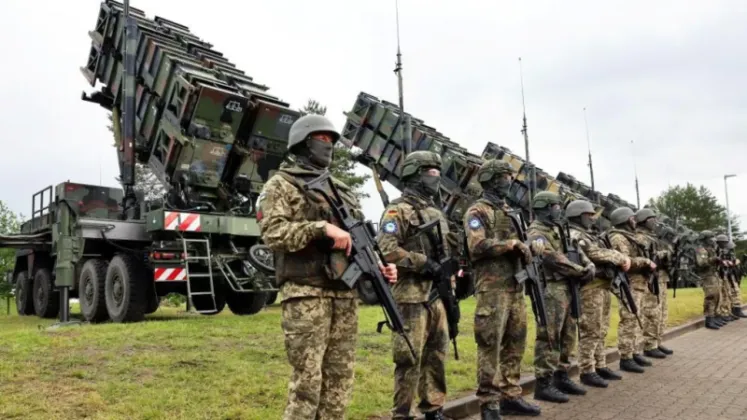
The United States has approved the sale of 500 Patriot air-defence missiles to Ukraine, a transaction valued at 2.1 billion US dollars that will be financed by European countries and Canada, according to the US State Department. The approval covers 500 PAC-3 interceptor missiles, the advanced munitions used by Patriot batteries to shoot down incoming missiles and aircraft. The decision comes as Ukraine makes renewed appeals to its Western partners for air-defence ammunition, with the missiles seen as urgently needed to counter intensifying Russian air attacks on Ukrainian cities and infrastructure.
A Major Air-Defence Package
The State Department's approval clears the way for Ukraine to receive 500 PAC-3 interceptor missiles, providing a substantial boost to the country's air-defence stockpile. The package is valued at approximately 2.1 billion dollars, a figure that underlines the scale of investment required to sustain modern air-defence operations. Crucially, the purchase will not be bankrolled by Washington alone: European countries and Canada are funding the acquisition, as reported, reflecting the increasingly shared financial burden of supporting Ukraine's defence.
The PAC-3 is the latest generation of interceptor used with the Patriot air-defence system, widely regarded as one of the most capable platforms in the Western arsenal. Patriot batteries are designed to detect, track and destroy a broad range of aerial threats, including ballistic missiles, cruise missiles, aircraft and drones. Ukraine first began receiving Patriot systems from its allies in 2023, and the batteries have since become a central pillar of the country's layered air defences, shielding Kyiv and other major population centres from Russian strikes.
Key Facts of the Deal
- Missiles approved: 500 PAC-3 interceptor missiles
- Estimated value: 2.1 billion US dollars
- Funding: European countries and Canada
- Purpose: Replenishing Ukraine's air-defence capacity amid intensifying Russian air attacks
Meeting an Urgent Requirement
The missiles are seen as urgently needed by Ukraine as it works to blunt escalating Russian air attacks. Since Russia launched its full-scale invasion in February 2022, Ukrainian cities, energy facilities and other critical infrastructure have come under repeated missile and drone barrages. The pressure on Ukraine's air-defence network has grown steadily, and Kyiv has repeatedly warned that its stock of interceptors is being depleted faster than it can be replaced.
Patriot batteries have been credited with intercepting some of the most sophisticated weapons in Russia's arsenal, including ballistic missiles that many other systems struggle to stop. Because defenders often need to fire more than one interceptor to reliably bring down an incoming threat, sustaining operations requires a continuous flow of replacement missiles. A transfer of 500 PAC-3 rounds therefore represents far more than a symbolic gesture: it directly replenishes the ammunition that keeps Ukraine's most valuable air-defence systems in action.
Air defence has consistently sat at the top of Ukraine's military requests to its partners. While Western nations have supplied a range of systems, from short-range launchers to longer-range platforms, Ukrainian officials have long argued that no amount of other weaponry can compensate for gaps in protection against missiles falling on cities. The latest approval addresses precisely that gap.
Allies Sharing the Cost
The financing arrangement is a notable feature of the deal. Rather than relying on direct American funding, the purchase will be paid for by European countries and Canada, continuing a broader pattern in which Ukraine's partners finance the acquisition of US-made weapons for Kyiv. The approach allows Ukraine to draw on American military sales channels while spreading the cost among a coalition of backers committed to sustaining its air defences.
For the United States, the approval signals that American involvement in arming Ukraine's air defences is continuing, even as the financial responsibility is shouldered largely by partners across Europe and in Canada. For European capitals, the investment reflects a recognition that the security of the continent is tied to Ukraine's ability to withstand Russian strikes, and that Patriot interceptors remain among the most effective tools available for that purpose.
The delivery of the missiles is expected to strengthen Ukraine's capacity to protect its cities, troops and critical infrastructure at a time when Russian air attacks show no sign of easing. For a country that has made air defence its most persistent request to Western partners, the approval of 500 Patriot interceptors amounts to a significant reinforcement of Ukraine's ability to keep its skies defended.
Military watchers will now turn to how quickly the interceptors can be produced, financed and delivered to the front lines, and whether further allied-funded packages follow. With Ukraine's air war showing no sign of slowing, the demand for PAC-3 missiles is likely to remain among the most pressing items on Kyiv's list of requirements from its partners.


