
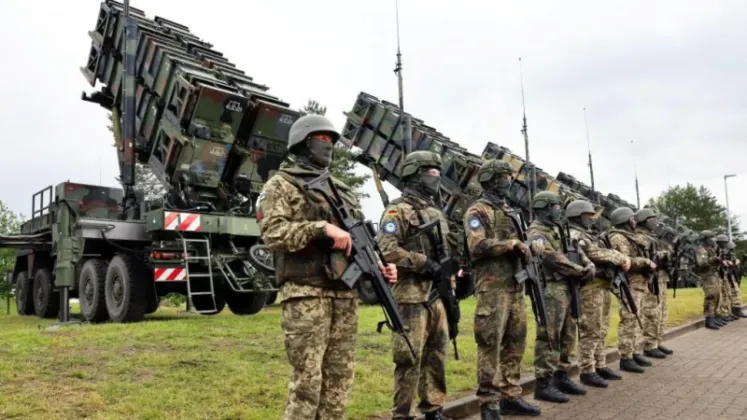
The United States has approved the possible sale of 500 Patriot air defence missiles to Ukraine in a deal valued at $2.1 billion, according to the US Department of State. The proposed package, details of which were carried by Ratopati, centres on 500 Patriot Advanced Capability-3 (PAC-3) Missile Segment Enhancement (MSE) missiles, together with spare parts and technical support. Washington has framed the sale as a measure to strengthen Ukraine's ability to defend itself against missile and aircraft threats. Notably, the cost of the transaction is to be covered through allied funding, placing the financial weight of the deal on partner nations rather than on Kyiv alone.
Inside the $2.1 Billion Package
The approval announced by the State Department covers a comprehensive support package rather than a simple missile purchase. At its core sit the 500 PAC-3 MSE interceptors, the rounds on which any Patriot-based defensive effort ultimately depends. Around them, the deal includes:
- 500 Patriot Advanced Capability-3 (PAC-3) Missile Segment Enhancement (MSE) missiles, the interceptors that will form the cutting edge of the sale
- Spare parts, intended to keep the missiles and their supporting equipment serviceable over an extended period
- Technical support, the expertise and assistance required to maintain, operate and sustain the systems once they are in Ukrainian hands
The $2.1 billion valuation reflects the scale of this ecosystem. Modern air defence is never only about the missile itself: it depends on maintenance, spare components and expert support to remain reliable under pressure. By bundling these elements into a single approved sale, the United States has structured the package as a sustainment commitment as much as a weapons transfer. It is also worth noting the wording of the announcement itself: the State Department has approved a possible sale, language that signals formal authorisation for the transaction as the arrangement moves ahead.
What the PAC-3 MSE Is Designed to Do
The Patriot Advanced Capability-3 Missile Segment Enhancement represents the more advanced expression of the Patriot family, one of the most widely used air defence systems in the world. The MSE variant is an air defence interceptor engineered to engage and destroy incoming threats in the air, which maps directly onto the missile and aircraft dangers the sale is meant to counter. In practical terms, each missile is fired to meet an incoming attack before it can reach its target.
The quantity involved matters as much as the quality. Air defence is an expenditure-driven discipline: interceptors are consumed every time a threat is engaged, and defending a country over months and years requires deep stockpiles rather than token numbers. A transfer of 500 of these missiles therefore points toward sustained defensive operations rather than a short-term stopgap. For a country that must contend with both missile and aircraft threats, as the State Department's own justification makes clear, a large and steady supply of interceptors is what turns an air defence system from a symbol into a working shield.
Why Air Defence Sits at the Heart of Ukraine's Needs
The stated purpose of the sale, to strengthen Ukraine's ability to defend itself against missile and aircraft threats, underlines why air defence has occupied such a central place in the country's security requirements. Missile and aircraft threats arrive with little warning and can reach far beyond the front line, which makes interceptors and the systems that launch them among the most consequential military assets a defender can hold. An effective air defence does not simply block incoming weapons; it shapes where those weapons can do damage and raises the cost of every attack.
The package's non-missile components reinforce this logic. Spare parts keep systems running through long periods of intensive use, when hardware faces continuous strain. Technical support ensures that the people operating the equipment can draw on expert assistance as questions of maintenance and performance arise. Taken together with the interceptors themselves, these elements are intended to ensure that Ukraine's defensive capacity is not a one-off injection but a capability that endures over time.
Allied Funding and What Comes Next
Perhaps the most striking element of the announcement is its financing. The sale is to be funded by allies, meaning the financial burden of the $2.1 billion package will be carried by partner nations rather than falling on Ukraine alone. That arrangement carries two implications. First, it removes cost as an obstacle to delivery, helping ensure that the missiles can move toward Ukraine without Kyiv having to raise the funds itself. Second, it signals that Ukraine's partners remain prepared to invest directly in the country's air defence, treating the interception of missiles and aircraft over Ukrainian territory as a shared priority rather than a purely national one.
For Washington, the approval fits the familiar pattern of a major defence transfer: the State Department signs off on a possible sale, the package is publicly valued and itemised, and the transaction proceeds from there. For Kyiv, the significance is more immediate. Five hundred advanced Patriot interceptors, backed by spare parts, technical support and allied money, amount to a substantial reinforcement of the umbrella under which Ukraine seeks to protect its people and territory. As the arrangement advances, attention will turn from authorisation to delivery, and to how quickly the missiles can be put to work against the threats they were approved to counter.


