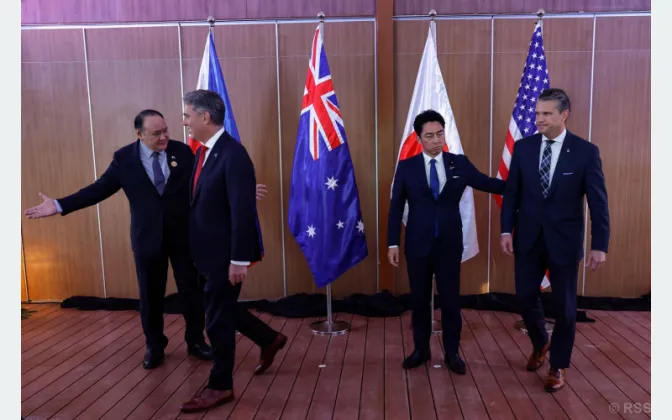
The United States and Japan have agreed to establish a facility in Japan to jointly produce advanced medium-range air-to-air missiles, in a move aimed at strengthening regional security cooperation and bolstering the defense capabilities of both allies. Japanese Defense Minister Shinjiro Koizumi announced the agreement on Wednesday after meeting US Defense Secretary Pete Hegseth in Cebu, the Philippines, where the two held talks on the sidelines of a regional event. The announcement comes amid growing security concerns across the region and marks a notable step in defense industrial cooperation between Washington and Tokyo.
Agreement announced in Cebu
The deal was confirmed by Koizumi following his bilateral meeting with Hegseth in Cebu, a city in the central Philippines. The two defense chiefs were in the country for a regional event, and their meeting served as the occasion for announcing the new cooperation, which will see the allies manufacture a key category of air-combat weaponry together on Japanese soil.
Under the agreement, the United States and Japan will set up a production facility in Japan dedicated to advanced medium-range air-to-air missiles. These weapons are launched from aircraft to engage other aircraft in the air, making them among the most essential munitions for any modern air force. Producing them jointly gives both countries a direct stake in the supply chain for a weapon central to air defense and air superiority.
The choice of venue for the announcement carried its own weight. Rather than unveiling the deal in Washington or Tokyo, the two governments used a gathering in Southeast Asia to confirm the agreement, underscoring the regional framing that both sides have attached to their defense partnership.
What the joint production agreement involves
Key elements
Based on Wednesday's announcement, the main components of the agreement are:
- The United States and Japan will jointly produce advanced medium-range air-to-air missiles.
- Manufacturing will take place at a facility to be established in Japan.
- The stated aim is to strengthen regional security cooperation and enhance the defense capabilities of both countries.
The arrangement represents a deeper form of defense industrial cooperation than a straightforward purchase. In a co-production model, both countries share the work of manufacturing a common weapon system, which can help expand a partner's defense industrial base while ensuring a steadier and more reliable supply of munitions for the alliance.
For Japan, producing such missiles domestically builds technical capacity within its own defense industry and strengthens its ability to sustain critical stockpiles. For the United States, co-production with one of its closest allies advances the goal, as stated in the announcement, of deepening security cooperation across the region.
Details such as the exact location of the planned facility, the timeline for the start of production, the number of missiles to be manufactured and the division of costs between the two governments were not disclosed in Wednesday's announcement. Those specifics had not been made public at the time the agreement was confirmed.
Cooperation against a backdrop of regional concerns
The agreement comes amid growing regional security concerns. While Wednesday's announcement did not name any specific country or threat, the move fits within the broader emphasis that both the United States and Japan have placed in recent years on deterrence, readiness and closer defense ties in the Indo-Pacific.
The setting of the talks also highlighted the increasingly regional character of the alliance's work. Holding the meeting in the Philippines, and using it to announce a concrete new defense initiative, reflected how the two governments have increasingly turned multilateral gatherings in Asia into venues for advancing their bilateral defense agenda.
The Koizumi-Hegseth meeting in Cebu adds to a series of high-level exchanges between Washington and Tokyo on defense matters. For the two sides, aligning on practical steps such as missile co-production offers a visible demonstration of the alliance's usefulness at a time when both governments have spoken of the need to reinforce stability in the region.
A deeper alliance, watched across the region
The joint production agreement is a further indication that the US-Japan partnership is extending beyond basing arrangements and joint exercises toward shared defense manufacturing. Cooperation of this kind ties the two countries' industrial capacities more closely together and anchors the alliance in long-term production commitments rather than one-off deals.
For observers in the region, the visibility of the announcement, made in Southeast Asia by Japan's top defense official alongside his American counterpart, will be read as a measure of how far the two governments are prepared to take their defense cooperation in response to an increasingly uncertain security environment.
Further details on the facility and the production program are likely to emerge as the two governments move toward implementation. In the meantime, Wednesday's announcement stands as a clear statement of intent: the United States and Japan intend to build advanced weapons together, on Japanese soil, and to present that cooperation as a contribution to security across the wider region.
Read more from the sources: