
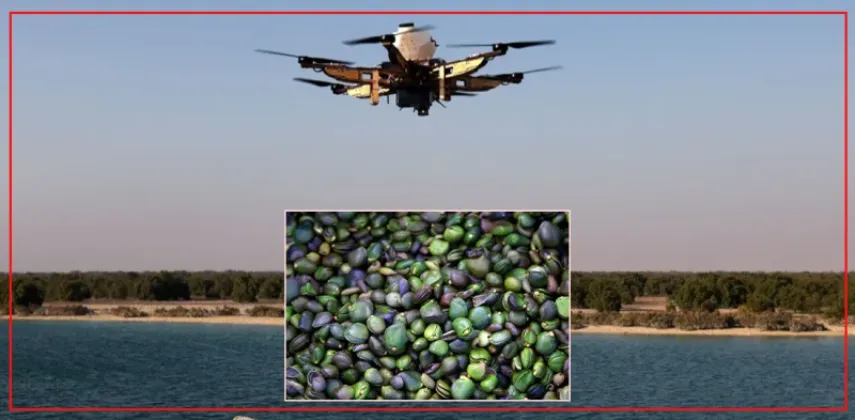
The United Arab Emirates is turning to high technology, including drones, to restore its mangrove forests, with much of the work concentrated in Abu Dhabi, according to recent reports. A story published by the Nepali news portal Ratopati and its English-language edition (English Ratopati) says the restoration drive is being carried out with advanced technology, and it comes with a clear environmental purpose: mangroves play an important role in protecting coastal ecosystems, absorbing carbon dioxide and reducing the effects of climate change.
Drones Take Over Where Planting Crews Struggle
Mangrove restoration has traditionally been slow, physically demanding work. Seeds and seedlings are often planted by hand in soft, waterlogged mud that is difficult to cross, frequently along remote stretches of coastline far from roads and settlements. The UAE's approach replaces much of this labour with flying machines that can cover wide areas quickly and reach ground that human planters cannot easily access.
Aerial systems of this kind are generally valued in restoration work for several reasons:
- Speed and scale: drones can disperse seeds across large stretches of coast far faster than manual crews, allowing degraded zones to be replanted within tight seasonal windows.
- Access to difficult terrain: intertidal mudflats and shallow lagoons, where mangroves grow best, are hard or unsafe for people to work in, but present few problems for an aerial platform.
- Precision planting: flight paths can be planned so that seeds land in the specific zones of salinity and tidal coverage where young mangroves are most likely to survive.
- Monitoring and data collection: the same or similar aerial tools can survey planted sites over time, tracking growth and flagging areas that need a second round of seeding.
From the Air to the Mudflats
Although methods differ from project to project, drone-based mangrove restoration generally follows a familiar pattern. Mature trees are first identified as sources of seeds or propagules. These are collected, processed and loaded onto drones, which then fly pre-planned routes over tidal flats and release the seeds in measured amounts. Once sown, the sites are revisited through aerial imagery and ground checks to establish how many seeds have taken root. This combination of automated planting and data-driven follow-up is what distinguishes the high-tech model from traditional hand-planting campaigns, and it is the approach now being applied in the UAE's restoration programme.
Why Mangroves Carry Such Weight
The focus on mangroves is not accidental. The trees occupy a narrow band of coastline between land and sea, yet they deliver benefits out of proportion to the area they cover.
A Storage System for Carbon
According to the reports, mangroves absorb carbon dioxide and help blunt the effects of climate change, making them one of the most valuable natural tools available to a country seeking to manage its emissions. Carbon drawn from the air by mangrove trees is stored not only in their trunks and roots but also in the deep, waterlogged soils beneath them, where low oxygen slows decay and locks the carbon away for long periods. Protecting existing mangroves and replanting lost ones is therefore treated as a form of natural climate mitigation that complements, rather than replaces, cuts in fossil fuel use.
A Buffer for Coasts and Marine Life
Mangroves also provide practical, physical protection. Their tangled root systems stabilise sediment and reduce erosion, while dense stands soften the force of waves and storm surges before they reach the shore. Beneath the waterline, the same roots create sheltered nurseries where fish, shrimp and crabs spawn and grow, supporting fisheries and the wider coastal food web. Losing mangroves removes protection, habitat and carbon storage all at once, which is why their restoration is regarded as an investment in coastal resilience as much as in biodiversity.
Abu Dhabi at the Centre of the Effort
While the restoration push concerns the Emirates as a whole, the reports indicate that the work is focused particularly on Abu Dhabi, the largest emirate. That choice makes practical sense. Abu Dhabi's coastline features shallow waters, tidal channels and mudflats of exactly the kind in which mangroves thrive, and established stands of the trees can serve as seed sources for replanting nearby areas. Concentrating drone operations there also allows teams to build experience with the technology in familiar conditions before extending it along other stretches of coast. The programme fits the UAE's broader posture of pairing environmental goals with technological ambition, applying the same appetite for advanced systems to restoration that it applies to other sectors.
A Model Other Coastlines May Follow
The significance of the UAE's experiment extends beyond its own shores. Mangrove loss is a global problem, and restoration projects in many countries have struggled with the cost and labour of planting by hand. If drones can reliably lower those barriers, the same methods could be adapted to tropical and subtropical coastlines elsewhere where mangroves once grew in abundance.
The results will unfold over years rather than months. Young mangroves need time to establish, mature and begin delivering their full benefits, and sustained monitoring will show how well drone-planted forests survive compared with those raised in nurseries and planted by hand. For now, the reports from Abu Dhabi describe a country placing its confidence in a combination of nature and engineering, wagering that the fastest way to restore a forest may be to let technology do the planting. Further details of the initiative are available from Ratopati and English Ratopati.


