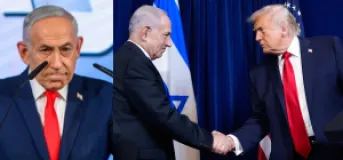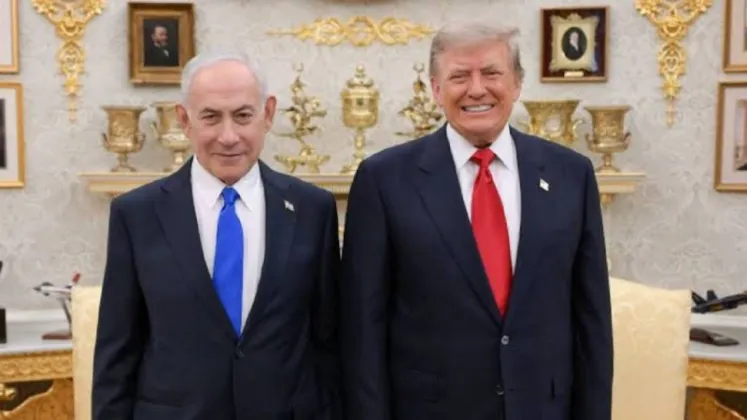
United States President Donald Trump has claimed personal credit for Israeli Prime Minister Benjamin Netanyahu's performance in Israel's closely contested general election, declaring that his public backing turned what had appeared to be a defeat into a possible tie or even a victory. In a series of posts published on Truth Social while vote counting was still underway, Trump described Netanyahu as an extraordinary fighter and said he would consider taking part in efforts to form a unity government in Israel. The comments, reported by Nepal Press, came as election authorities continued to tally ballots in a race whose final outcome remained uncertain.
"My Support Overturned Netanyahu's Defeat"
Trump's message was unambiguous: according to his own account, his intervention had changed the trajectory of the Israeli vote. Writing on Truth Social, the US president said that Netanyahu's apparent defeat had been overturned because of his support, and that the Israeli leader's position had shifted from a likely loss to a possible tie or an outright victory. Nepal Press reported that Trump framed the development as a direct consequence of his public endorsement of Netanyahu.
As reported, Trump's posts rested on three central assertions:
- That his public support had overturned what appeared to be Netanyahu's defeat
- That the result had shifted toward a possible tie or even a victory for the Israeli prime minister
- That Netanyahu deserved personal praise, with Trump calling him an extraordinary fighter
The US president did not confine himself to claiming influence over the result. His description of Netanyahu as an extraordinary fighter underscored the warmth of his language toward the Israeli leader, and the tone of the remarks was notable both for its content and for its timing, arriving while Israelis were still waiting for a definitive picture of how their country had voted.
A Vote Too Close to Call
The election itself was described as closely contested, and that characterization was reflected in the state of the count. As of the time of the reports, vote counting in Israel was still underway and no final result had been declared. Nagarik News noted that Trump's response came precisely as the counting process continued, a detail that made his confident claims about the outcome all the more striking.
Israeli elections are ultimately decided not by a single nationwide winner but by the strength of the blocs that parties are able to assemble afterward, which means that even a narrow margin can determine who is positioned to form the next government. That reality places a premium on patience. Until all votes are tallied and negotiations begin, no outside observer, however powerful, can say with certainty who has won. Trump's posts, in other words, expressed a claim rather than a confirmed result, and the final arithmetic remained open when he made them.
An Offer to Shape the Next Government
Perhaps the most consequential element of Trump's intervention was his suggestion that he could involve himself in the formation of Israel's next government. The US president said he would consider taking part in efforts to build a unity government in Israel, a statement also highlighted by Global Aawaj in its coverage of the story.
A unity government, in the Israeli context, is a cabinet that draws together rival political blocs, typically formed when no single camp is able to govern alone. For a sitting American president to float personal participation in another democracy's coalition negotiations would represent a remarkable departure from ordinary diplomatic practice. It also signaled that Trump intends to remain engaged in Israeli politics beyond election day itself, treating the aftermath of the vote as an arena in which he may play a direct role.
There was no indication in the reports of what form such participation might take, nor of how Israeli parties might respond to the offer. With counting incomplete, the shape of any future coalition, unity or otherwise, remained speculative. What was clear was Trump's willingness to advertise his influence in a process that has, historically, been the exclusive domain of Israeli politicians.
A Public Alliance in the Spotlight
The episode shone a fresh light on the alignment between Trump and Netanyahu. The US president's decision to claim credit for Netanyahu's performance, and to describe him in such emphatically complimentary terms, reinforced the image of an American leader who openly champions a foreign counterpart. His account of the vote presented the Israeli prime minister as having been rescued from defeat by American support, and it left little doubt about which outcome Trump preferred.
Whether the final count will vindicate that account remains to be seen. The state of the tally at the time suggested a contest still in the balance, with even the possibility of a tie. If the eventual outcome does place Netanyahu in a strong position, Trump can be expected to press his claim of decisive influence. If it does not, the posts will stand as a premature declaration in a race that was still being counted.
What is certain is that the statements have added an unusual international dimension to the aftermath of Israel's election. An American president has publicly inserted himself into the story of the vote, praised one of its central figures in personal terms, and floated a role in the government formation talks that will follow. As Israelis await the final numbers, attention will remain fixed not only on the ballot count but also on the commentary flowing from Washington.