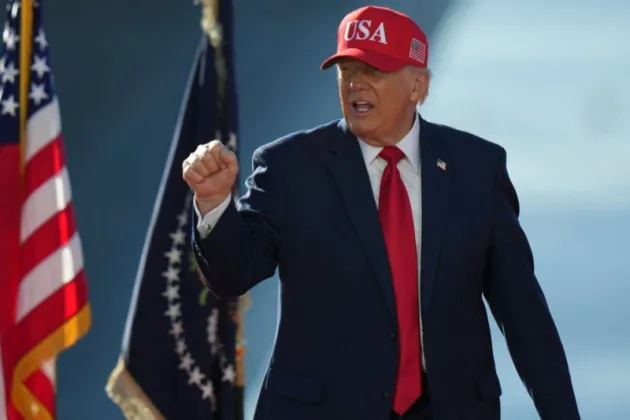
US President Donald Trump has said he will accept the results of the United States midterm elections, in which the Democratic Party has taken control of the House of Representatives, and has signalled that he is ready to work with the opposition in the period ahead. Speaking in an interview with The New York Times, Trump said he is absolutely willing to accept the outcome of the vote and that he looks forward to working with the Democrats. The two sides, he added, will probably work something out together. His comments were reported in Nepal by My Republica and Ratopati.
A Clear Message of Acceptance
Trump's remarks addressed the central question that surrounded the midterm outcome: whether the president would acknowledge a result that saw his party lose control of the House of Representatives. His answer, delivered in the interview with The New York Times, was direct. He said he is absolutely willing to accept the results of the elections, presenting the outcome as something to be acknowledged rather than contested.
The president went further than simple acceptance. He said he looks forward to working with the Democrats, the party that will now lead the chamber, and indicated that cooperation would define his approach in the period ahead. In his words, the two sides will probably work something out together, a phrasing that positions him as a negotiator at the start of a new political chapter.
Statements of this kind carry particular weight in the United States, where the peaceful acceptance of election results is a cornerstone of democratic practice. By voicing his willingness to accept the midterm outcome and to engage with the incoming House majority, Trump has set a conciliatory tone at a moment when the balance of power in Washington has shifted.
Democrats Take Control of the House
The midterm elections, held at the midpoint of a president's term, decide the full membership of the House of Representatives, the lower chamber of the US Congress. On this occasion, the Democrats have emerged with control of the House, altering the balance of power in the US capital and setting the stage for a period of divided government.
Control of the House carries substantial influence in the American system. In practical terms, the new Democratic majority will be positioned to:
- Shape the legislative agenda in the chamber and determine which bills move forward
- Take the lead on the House's influential committees
- Play a central role in matters of public spending and in oversight of the administration
For Trump, who continues to lead the executive branch, this means that any legislative proposal requiring passage through the House will need Democratic support. That reality makes the tone that both parties adopt toward one another especially significant as the new congressional term approaches.
Cooperation Ahead in a Divided Washington
Trump's remark that the two sides will probably work something out together reflects the practical arithmetic facing both parties. With the Democrats controlling the House and Trump occupying the White House, major legislation will require agreement across party lines. Under the US system, bills passed by the House must also clear the Senate and receive the president's signature, a structure that consistently pushes the rival parties toward negotiation and compromise.
The comments reported so far do not detail which specific policy issues the president and the Democrats might take up jointly. Even so, the president's expressed willingness to accept the results and to speak of working with the opposition will shape expectations for how the relationship between the White House and the new House majority develops. His framing of the outcome, as an opening for dealmaking rather than a setback, suggests an emphasis on negotiation in the months ahead.
Observers of US politics will be watching closely to see whether the cooperative language translates into concrete agreement on the issues that divide the two parties. What is already clear is that both sides will need one another: the Democrats to advance their priorities through the House, and the president to secure support for his agenda in a chamber no longer under his party's control.
For now, Trump's message, delivered through one of America's leading newspapers and picked up by news outlets around the world, is straightforward. The results of the midterm elections stand, the Democrats hold the House of Representatives, and in the president's view the two sides will probably work something out together.