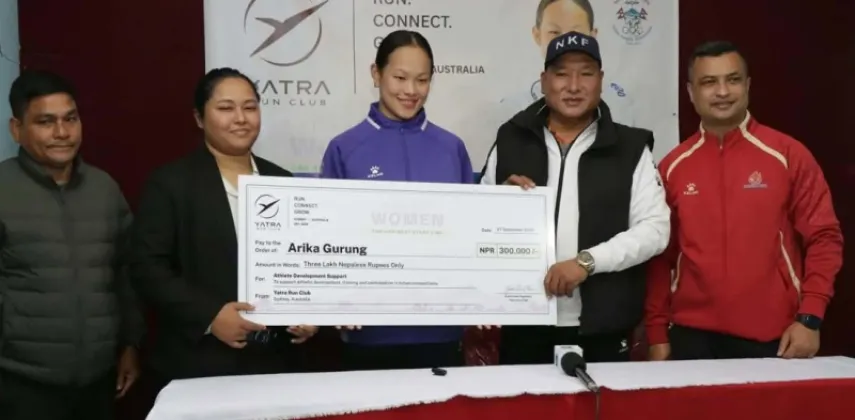
Erika Gurung, the Nepali karateka and Asian Games silver medallist, has received a significant financial boost of around Rs 300,000 to support her training and her preparation for international competitions. The amount was raised through a fundraising campaign led by the Sydney-based Yatra Run Club in Australia, which organised a special run in Sydney on 20 September as the centrepiece of the effort. According to RatoPati, the funds are earmarked for Gurung's sports development as she continues to train at the international level.
A run with a purpose
The campaign combined fitness and philanthropy, a formula that has become increasingly popular among Nepali community groups abroad. The Yatra Run Club, based in Sydney, placed a competitive athlete at the heart of its fundraising drive, mobilising support for a cause that reaches well beyond Nepal's borders. The special run held on 20 September served as the focal point of the campaign, channelling the energy of participants toward a concrete goal: backing one of Nepal's most accomplished martial artists.
Charity runs of this kind have become a familiar feature of diaspora life in Australia, where community organisations regularly use walking, jogging and running events to draw attention - and contributions - to causes back home. What sets this campaign apart is its direct, individual focus. Rather than supporting a broad programme, the roughly Rs 300,000 raised is destined for a single athlete, ensuring that the impact of every contribution can be traced to Gurung's own preparation.
For a sport like karate, where athletes often shoulder substantial costs for coaching, equipment, travel and competition fees, a dedicated fund of this size can make a tangible difference. The involvement of a running club is also fitting in spirit: both disciplines demand the same blend of discipline, endurance and long-term commitment that Gurung has displayed on the international stage.
Support for training and international preparation
The money raised will go toward Gurung's training and her preparation for international competitions, the two areas where elite athletes from smaller sporting nations most often feel the strain. Preparing for tournaments abroad involves a long list of expenses, from specialised coaching and strength and conditioning work to participation fees and travel. For athletes representing Nepal, these costs frequently fall on the individual and her supporters rather than on institutional budgets.
A fund of around Rs 300,000 will not cover every expense on the road to a major Games, but it provides meaningful breathing room. It allows an athlete to plan training blocks with greater confidence, to focus on performance rather than paperwork, and to approach upcoming international assignments with fewer financial question marks hanging over the campaign. In combat sports, where preparation margins are thin and competition is unforgiving, that stability matters.
The contribution also carries symbolic weight. It signals that Gurung's achievements have registered with the Nepali community far from home, and that her continued rise is viewed as a shared national project rather than a solitary pursuit. Support of this kind, arriving between competitions rather than after them, is exactly the form of backing that athletes consistently say is hardest to secure.
An Asian Games silver medallist
Gurung enters this new phase of support as a proven performer at the highest level of continental sport. Her silver medal at the Asian Games stands among the most significant achievements by a Nepali karateka, earned against the deep and demanding fields that the region's premier multi-sport event invariably produces. The Asian Games bring together the strongest karate nations in Asia, where the sport enjoys enormous depth, making a podium finish a genuine breakthrough rather than an expected result.
That pedigree is what makes the Sydney campaign notable. Fundraisers of this kind often rally around promising juniors or rising talents; here, the beneficiary is already an established medallist with a track record of delivering against elite opposition. The Yatra Run Club's choice of beneficiary reflects a simple calculation: investing in a proven Asian Games silver medallist offers one of the clearest returns available in Nepali sport.
Her success has also lifted the profile of karate within Nepal, a sport with a strong grassroots base in the country and a long history of producing dedicated practitioners. A visible, medal-winning role model matters enormously in that environment, giving young athletes proof that a path exists from local dojos to the Asian Games podium.
The diaspora's growing role
The campaign highlights the expanding role that Nepali communities abroad are playing in the country's sporting life. As the Nepali diaspora in Australia has grown, so too has its capacity to organise, fund and champion causes connected to the homeland. Community clubs, cultural associations and sporting groups have increasingly turned their attention to athletes and programmes that struggle for resources at home.
For Gurung, the Rs 300,000 raised in Sydney represents more than training money. It is a demonstration that her performances are being followed and valued well beyond Nepal, and that when she steps onto the tatami at her next international competition, she will do so carrying the backing of supporters on two continents. If that combination of talent and community support continues to build, the silver she already holds may well not be the last medal of her international career.