
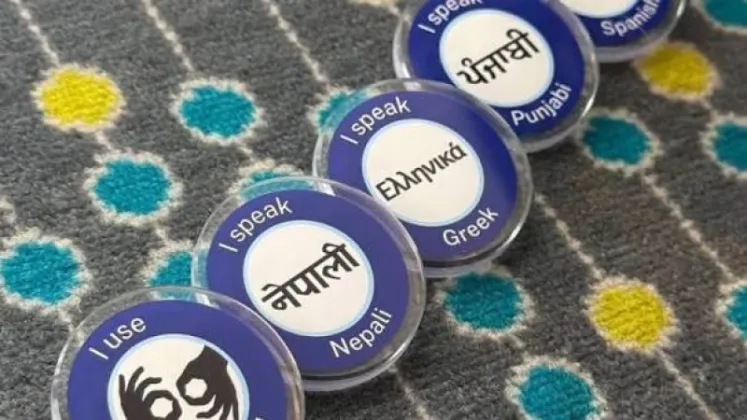
Sydney Metro staff will now be able to assist passengers in Nepali and 10 other languages, after the operator of the metro network in Australia's New South Wales state introduced a new arrangement under which employees wear badges on their uniforms showing the languages they speak. The badges cover a total of 11 languages, among them Nepali, Punjabi, Greek and Spanish. According to Sydney Metro, the measure is aimed at making it easier for passengers from different language backgrounds to get assistance, and it is expected to help passengers with hearing difficulties as well. For Nepali-speaking commuters, the change means that help at a station or on a platform can now begin in their own mother tongue rather than in a language they may struggle to explain themselves in.
How the language badge system works
The idea behind the arrangement is simple. Each staff member who takes part wears a badge on their uniform listing the languages they speak. A passenger who needs help, whether with directions, a ticket or service information, can look at the badges on the uniforms around them and go directly to someone who speaks their language.
That removes a step that many commuters from different language backgrounds know well: the need to first explain, often in English, that they need help before they can even describe what the problem is. With the badges, the introduction is made before a single word is spoken. The uniform itself becomes a signpost.
The key features of the arrangement are as follows:
- Staff wear badges on their uniforms showing the languages they speak
- A total of 11 languages are covered, with Nepali, Punjabi, Greek and Spanish among them
- The stated aim is to make it easier for passengers from different language backgrounds to get assistance
- Passengers with hearing difficulties are also among those the measure is intended to support
In day-to-day terms, the system works like this: a commuter standing at a ticket gate, unsure which platform their train leaves from, scans the uniforms nearby, spots a badge written in a language they understand, and approaches that staff member directly. The conversation, and the assistance, can start immediately.
Nepali now sits on the badge list
For Nepali-speaking readers, the headline detail is that Nepali is one of the 11 languages Sydney Metro has chosen to highlight. The report, published by Online Khabar, lists Nepali, Punjabi, Greek and Spanish among the languages covered, although the other languages on the list are not detailed.
The practical significance is easy to picture. A Nepali-speaking passenger who is unsure where to change trains, or who needs to report a lost item, no longer has to assemble the question in a second language first. They can look for a Nepali badge and ask in the language they think in. Everyday interactions, which can feel disproportionately stressful in an unfamiliar transport system, become simpler and faster.
There is also a broader point about what the inclusion signals. A public transport operator has, in effect, recognised that the people moving through its stations speak many languages, and that frontline service should reflect that reality. For the Nepali-speaking community, seeing the language named alongside Punjabi, Greek and Spanish on an Australian transport network carries a significance that goes beyond the platform.
Support for passengers with hearing difficulties
Sydney Metro has also pointed to the benefits for passengers with hearing difficulties. For these commuters, the first obstacle is often not the conversation itself but identifying the right person to approach in the first place. A visible badge reduces that uncertainty: the passenger can see, at a glance, which staff member speaks which language, and communication can begin without relying on spoken announcements or overheard information.
Why visibility matters
Public transport depends on quick, low-friction communication. Announcements are fleeting, stations are busy and staff are constantly in motion. A permanent, worn form of identification gives passengers a stable reference point in that environment. By making language ability visible, Sydney Metro has turned that identification into the first stage of assistance, for hearing passengers and those with hearing difficulties alike.
A small badge with a wider message
On its own, a badge is a modest piece of plastic. Combined across a workforce, it amounts to a statement about who the network expects to serve and how. The arrangement acknowledges, in the operator's own framing, that passengers arrive with different language backgrounds and different communication needs, and that assistance should be available in the language the passenger is most comfortable with.
For the Nepali-speaking community in Australia, the change is likely to register in two ways at once. Practically, it means station staff who speak Nepali are now findable rather than invisible. Symbolically, it places Nepali on a list of languages an Australian public transport network considers worth advertising on its uniforms.
For now, the takeaway for commuters is simple. If you are travelling on the Sydney Metro network and Nepali is the language you are most at home in, the badge you are looking for exists. Nepali is on the list.


