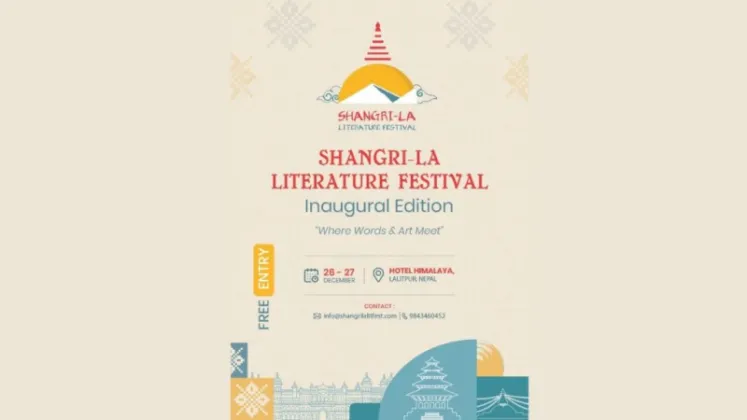
The inaugural Shangri-La Literature Festival is set to take place on December 26 and 27 at Hotel Himalaya in Lalitpur, introducing a new two-day celebration of literature, arts and performance to Nepal's cultural calendar. Organised by the Kathmandu Shangrila Foundation, the debut event is designed as a platform for creativity, ideas and cultural exchange, promising to bring writers, artists and audiences together under one roof.
News of the festival arrives shortly after a separate two-day Indigenous Literature Festival was held in Saptari, where participants issued a strong call for the promotion of indigenous languages and culture. Taken together, the two gatherings highlight how literary events, large and small, are increasingly serving as spaces for public conversation about creativity, identity and heritage in Nepal.
A New Festival on Nepal's Cultural Map
According to organisers, as reported by OnlineKhabar, the Shangri-La Literature Festival aims to bring together literature, arts and performance in a single, integrated programme spread across two days. The Kathmandu Shangrila Foundation, the body behind the initiative, has positioned the event as more than a conventional book festival, describing it as a meeting point for creativity, ideas and cultural exchange.
As the first edition of the festival, the December gathering carries particular significance. Inaugural events are often where an organiser's vision is tested against audience expectations, and where the tone for future editions is set. For the Kathmandu Shangrila Foundation, the two-day programme at Hotel Himalaya represents an opportunity to establish the festival's identity: a space where the written word shares the stage with the arts rather than standing apart from them.
Key Details at a Glance
- Event: Shangri-La Literature Festival (inaugural edition)
- Dates: December 26-27
- Venue: Hotel Himalaya, Lalitpur
- Organiser: Kathmandu Shangrila Foundation
- Focus: Literature, arts, performance, creativity, ideas and cultural exchange
The choice of venue places the festival in the heart of Lalitpur, one of the three districts of the Kathmandu Valley and a city long associated with artistry, craftsmanship and cultural life. A central, accessible setting such as Hotel Himalaya offers the kind of location that organisers of public literary events typically seek, making it easier for readers, students, artists and families from across the valley to attend.
Where Literature Meets the Arts
What distinguishes the Shangri-La Literature Festival, at least on paper, is its explicit ambition to fuse literature with the broader arts. Rather than confining the programme to readings and book discussions alone, the festival's stated framework embraces arts and performance as equal partners, reflecting a wider shift in how literary events are conceived: not as quiet gatherings for writers alone, but as multidisciplinary public celebrations.
That approach carries practical appeal. Combining literature with performance and art broadens the audience a festival can attract, drawing in people who might not pick up a poetry collection on their own but who are drawn by theatre, music or artistic showcases. It also creates natural opportunities for exchange, where writers, performers and artists can respond to one another's work, and where audiences encounter ideas across disciplinary boundaries.
For a city like Lalitpur, with its deep artistic heritage, the framing is a natural fit. A festival that treats literature as part of a wider cultural conversation aligns with the spirit of a place that has, for centuries, been a centre of craftsmanship, ritual and storytelling in the Kathmandu Valley.
Indigenous Voices Ring Out in Saptari
The announcement of the Shangri-La Literature Festival comes on the heels of another significant literary gathering. A separate two-day Indigenous Literature Festival was recently held in Saptari, bringing participants together around a shared cause: the promotion and preservation of indigenous languages and culture.
Participants at the Saptari festival called for stronger efforts to promote indigenous languages, a demand that resonates in a country as linguistically and culturally diverse as Nepal. Indigenous communities across the country maintain rich oral and written traditions, and festivals dedicated to indigenous literature provide a visible platform for those voices, many of which remain under-represented in mainstream publishing and public life.
The timing of the two events, arriving in quick succession, underscores a broader moment for literature in Nepal. From the valley's upcoming Shangri-La festival to the indigenous literary gathering in Saptari, organisers across the country are demonstrating an appetite for events that do more than showcase books. They are staging conversations about who gets to tell stories, in which languages, and for which audiences.
Looking Ahead
For now, attention turns to December 26 and 27, when the Shangri-La Literature Festival makes its debut at Hotel Himalaya in Lalitpur. As an inaugural edition, the festival carries both promise and pressure: the promise of a new platform where literature, arts and performance meet, and the test of converting that vision into an experience that audiences will want to see return.
If the Kathmandu Shangrila Foundation succeeds in delivering the blend it has promised, the festival could find a lasting place in Nepal's literary calendar, adding another stage for the country's writers, artists and performers, and another venue where ideas and cultural exchange take centre stage.