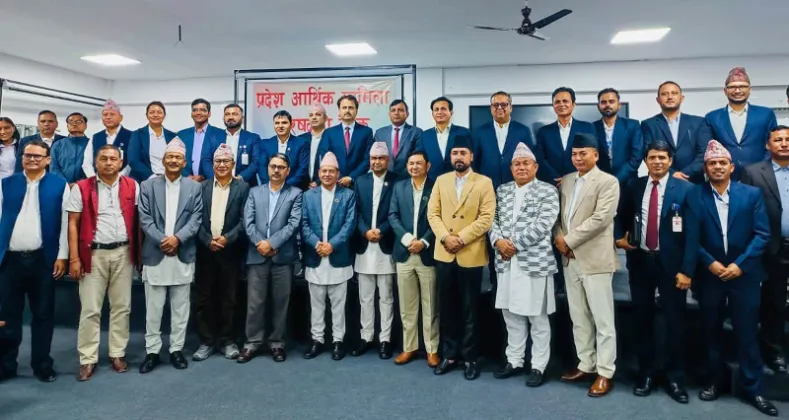
Finance ministers from all seven of Nepal's provincial governments have jointly demanded that the federal government stop cutting grants already allocated in the budget and hand over financial powers to the provinces, warning that repeated mid-year reductions were destabilising provincial planning and service delivery. The demands were formalised in a 22-point joint commitment paper released at a meeting of the Provincial Economic Affairs Council held in Birendranagar, the provincial capital of Karnali, organised by the Karnali Province Ministry of Economic Affairs and Planning. Ministers from six of the seven provinces attended the meeting, with Sudurpaschim Province absent, according to a report by Rajdhani Daily.
A united front from the provinces
The joint commitment paper stands out because it was issued collectively, in the name of all seven provincial governments, rather than as seven separate statements. By gathering in Birendranagar and backing a single document, the finance ministers presented a common position on one of the most persistent frictions in Nepal's federal system: the gap between the financial responsibilities assigned to provinces and the fiscal authority actually placed in their hands.
The key demands set out in the paper include:
- An immediate halt to mid-year cuts to grants that have already been allocated in the budget
- The handover of financial powers from the federal government to the provincial governments
- A clear message that reducing provincial grants midway through the fiscal year on the grounds of lower revenue collection must end
Six of seven at the table
Ministers from six provinces were present in Birendranagar for the council meeting. Sudurpaschim Province did not attend, making it the only provincial government without representation at the gathering. Despite the absence, the document was released as a joint commitment of all seven provinces, underscoring how widely shared the grievances are among the provincial governments.
The choice of host was also notable. The meeting was organised by the Ministry of Economic Affairs and Planning of Karnali Province, placing a province that depends heavily on federal transfers at the centre of the debate over how those transfers are managed.
The central grievance: mid-year grant cuts
The sharpest criticism in the paper was reserved for the practice of cutting grants after the budget year has already begun. According to the ministers, the federal government has reduced allocations to provinces partway through the fiscal year when its revenue collection comes in lower than anticipated. The ministers warned that this practice must end.
The consequences of such cuts fall directly on provincial governments, whose budgets are built around the grants and transfers they expect to receive. When those allocations are trimmed mid-year, provinces are left with less money than the plans and programs they have already approved, forcing them to scale back activities, delay projects and revise priorities after commitments have been made. It is this cycle, the ministers argued, that turns provincial budgets into uncertain documents rather than firm plans.
The demand also touches on the broader functioning of provincial governance. Grants are not a bonus; they support the programs and development spending that provinces commit to when their budgets are passed. Cutting them midway through the year does more than shrink the numbers on paper - it disrupts the work that provinces had already promised to deliver.
Beyond grants: the call for financial powers
While the demand to stop grant cuts addresses an immediate problem, the 22-point paper goes further, calling on the federal government to hand over financial powers to the provinces. This places the document within the longer-running debate over fiscal federalism, in which provinces operate their own budgets, ministries and assemblies, but continue to rely on the federal centre for a large share of their resources and for decisions over key fiscal instruments.
The ministers' argument, as reflected in the paper, is straightforward: without genuine financial authority, provincial governments cannot plan with confidence, budget with independence, or be fully accountable for the results of their spending. Protecting grants from mid-year cuts and transferring financial powers are presented in the document as two parts of the same reform - one stopping the immediate harm, the other addressing its underlying cause.
What the paper means going forward
The release of the joint commitment paper puts the provinces' demands on formal record. The Provincial Economic Affairs Council meeting in Birendranagar provided the platform, the Karnali ministry provided the organisation, and the finance ministers provided a unified voice. What remains is the federal government's response.
Until the practice of mid-year cuts is formally ended and questions over the transfer of financial powers are settled, the paper signals that the provinces intend to press their case together rather than individually. For now, the 22 points of the commitment paper stand as a strong collective statement from the provincial governments on the financial arrangements that govern their work, and as a direct challenge to the federal government to change how it treats the budgets of the country's provinces.