
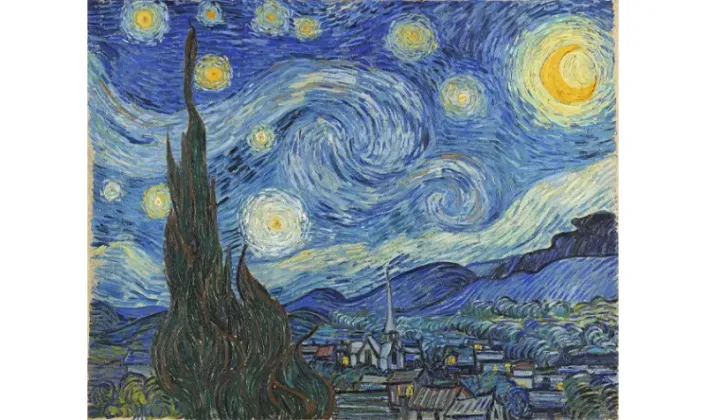
Researchers working at the crossroads of art and astronomy have concluded that Vincent van Gogh's iconic painting "The Starry Night" may have been inspired by a real celestial scene, according to research reported from Seoul. Rather than treating the 1889 masterpiece purely as a product of imagination, scientists acted as art detectives, tracing the Dutch painter's swirling composition back to an actual view of the night sky. The findings, highlighted in a report by Ratopati, connect one of the most famous images in Western art to genuine astronomical observation, adding a new layer of meaning to a canvas that has fascinated viewers for more than a century.
Scientists as Art Detectives
The research, reported from Seoul, framed the investigation in explicitly forensic terms. Scientists approached the painting the way investigators approach a case: examining the celestial details depicted in the work and asking whether they correspond to a sky that could actually have been seen and recorded.
The central suggestion of the study is striking in its simplicity. Van Gogh's night sky, long celebrated for its dreamlike energy, may not have been invented entirely in the artist's mind. Instead, the researchers indicate that the painting reflects a real astronomical vista, one that the artist could have observed and then transformed through his distinctive style.
Key points from the reported findings include:
- Scientists deliberately took on the role of art detectives to investigate the origins of the painting's sky.
- The work was traced to an actual view of the night sky rather than being dismissed as pure fantasy.
- The conclusions formally connect "The Starry Night" to the practice of astronomical observation.
- The research positions a beloved artwork as a potential record of a real celestial scene.
For the researchers, the point is not to reduce the painting to a scientific diagram, but to show how observation and imagination may have worked together in Van Gogh's process. The swirling stars and glowing orb of light remain unmistakably Van Gogh's own; what the study suggests is that the raw material for that vision may have come from the heavens above him.
The Story Behind the Canvas
"The Starry Night" is one of the most recognisable paintings in the world, and its origins are as dramatic as its brushwork. Vincent van Gogh, the Dutch post-impressionist painter, created the work in 1889 while staying at the Saint-Paul-de-Mausole asylum in Saint-Rémy-de-Provence in the south of France, where he had admitted himself following a mental health crisis.
The painting shows a night sky filled with swirling clouds of colour, a bright crescent moon, and a scattering of radiant stars above a quiet village, with a dark cypress tree rising in the foreground. Art historians have long noted that the view resembles the scene visible from the window of the artist's room at the asylum, although the canvas is widely understood to have been painted from memory and imagination rather than directly from life.
That combination, an observed setting filtered through an extraordinary artistic temperament, is precisely what has made the painting so enduring. Van Gogh, who struggled commercially during his lifetime and died in 1890 at the age of 37, sold few works while he was alive. Today, "The Starry Night" hangs at the Museum of Modern Art in New York, where it draws crowds of visitors every day and stands as a defining image of the artist's genius.
The new research adds to this well-known story by suggesting that the sky Van Gogh painted was not only emotionally real to him, but astronomically real as well.
When Science Looks at Art
The Seoul-reported study sits within a broader and growing conversation in which scientists examine artworks as potential records of the natural world. In such research, a painting is treated as evidence: the position of celestial bodies, the colour of a sky, or the shape of a landscape can all be read for clues about what an artist actually saw.
Applied to "The Starry Night," that approach reframes the canvas in a compelling way. What millions of people have admired as an expression of inner turmoil and artistic fantasy may also contain the outline of an authentic night sky. The findings suggest that Van Gogh's famous turbulence was layered on top of careful looking, and that the painter's eye for the world around him was as sharp as his gift for reinventing it.
The researchers' conclusions also underscore how much can be gained when disciplines collaborate. Art historians bring an understanding of technique, biography, and symbolism, while scientists bring instruments and methods capable of testing whether a depicted scene corresponds to reality. Together, they can recover information that neither field could uncover alone.
A Living Link Between Sky and Canvas
The suggestion that "The Starry Night" is rooted in a real celestial view is unlikely to diminish the painting's mystique. If anything, it deepens it. The idea that a man confined to an asylum in provincial France looked up at a genuine night sky and, from it, produced an image that would become one of the most beloved in human history, gives the painting an even more human story.
It also reinforces why Van Gogh's work continues to attract attention far beyond the art world. More than 130 years after his death, scientists are still studying his canvas, still asking questions about it, and still finding new reasons to be amazed. The Seoul-reported research is the latest reminder that great art rarely exists in isolation from the world: it grows out of it, star by star.
For now, the study's message is one of connection. A painting long admired for what it revealed about one man's inner life has been linked to what he saw in the sky above him, proving once again that Vincent van Gogh's "The Starry Night" belongs as much to the universe that inspired it as to the artist who painted it.


