
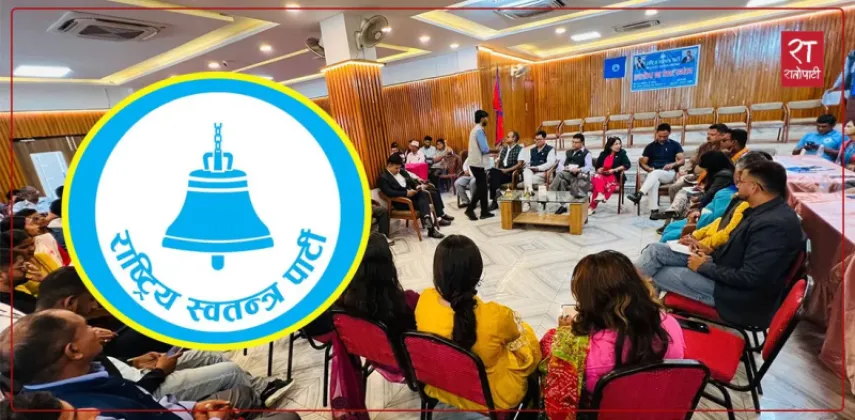
The ruling Rastriya Swatantra Party (RSP) is moving on two fronts at once, placing fresh emphasis on expanding Nepal's relations with neighboring countries while accelerating its internal preparations for the upcoming local level elections. According to a report from Kathmandu, the party has begun highlighting the expansion of ties with Nepal's neighbors, a signal of how it intends to approach foreign affairs while in government. In parallel, a report from Biratnagar in eastern Nepal confirms that the party has started organizing for local polls, and in preparation for the municipal elections more than 20,000 aspirants have already applied to the RSP for municipalities and rural municipalities alone. Taken together, the two developments indicate that the party's current focus rests squarely on foreign affairs and electoral strategy.
The Diplomatic Track: Expanding Ties With Neighbors
The report from Kathmandu is clear in its substance: the RSP has begun emphasizing the expansion of relations with neighboring countries. For Nepal, relations with its immediate neighbors, India and China, remain the most consequential dimension of foreign policy, touching trade, transit, energy and cross-border connectivity. Against that backdrop, a ruling party's public emphasis on deepening these ties points to a desire to be seen as actively engaged in managing the country's most important external relationships.
The word expansion matters here. The report does not describe a single event or a one-off meeting, but a broader direction, with the party framing closer relations with neighboring countries as an area of ongoing priority. For a party holding ruling status, this emphasis on diplomacy signals that foreign policy will remain a visible part of its political messaging alongside the routine work of government.
The Electoral Track: More Than 20,000 Aspirants
While the diplomatic messaging has come from Kathmandu, the electoral groundwork is visible in the east. A report from Biratnagar states that the RSP has started internal preparations targeting the upcoming local level elections. The most striking measure of that effort is the volume of interest it has attracted: in preparation for the municipal elections, more than 20,000 aspirants have applied to the party, with the applications covering municipalities and rural municipalities alone, according to Ratopati.
Nepal's local level elections are contested across the country's municipalities and rural municipalities, the tier of government closest to citizens and the one most directly responsible for ward-level services and municipal planning. For any party, the local level is where organizational strength is tested most directly, and the RSP's internal preparations suggest the party is treating the upcoming polls as a priority rather than an afterthought.
What the Numbers Suggest
The figure of more than 20,000 aspirants, with the reports limited to municipalities and rural municipalities alone, is significant for what it says about the state of the party's preparations:
- Scale of interest: Tens of thousands of applications indicate a wide pool of prospective candidates from which the party can draw when polls are held.
- Organizational reach: Collecting and processing applications on this scale points to party structures that are functioning at the local level.
- Early momentum: The applications form part of the party's preparations ahead of the upcoming local level elections, indicating that the RSP has begun its groundwork well in advance.
One Party, Two Fronts
The significance of the two reports lies in their combination. Both developments indicate the party's focus on foreign affairs and electoral strategy, and they arrive at the same time, describing an organization that is working on its external posture and its internal machinery simultaneously. On one side, the RSP is emphasizing the expansion of relations with neighboring countries, engaging with the most sensitive area of national policy. On the other, it is laying the groundwork for local polls, with more than 20,000 aspirants already in the pipeline for municipalities and rural municipalities.
For a ruling party, the two tracks reinforce each other. Demonstrable attention to diplomacy speaks to governing credibility, while visible electoral preparations speak to organizational seriousness. By pursuing both at once, the RSP is signaling that its ambitions extend beyond day-to-day governance to the next electoral test at the local level, where candidate selection and grassroots mobilization will ultimately decide performance.
For now, the details available remain limited to the essentials: a party emphasizing closer ties with neighboring countries as reported from Kathmandu, and a party drawing applications from more than 20,000 aspirants as reported from Biratnagar. The next stage will be converting that early interest into candidates on the ballot, and the party's dual emphasis on diplomacy and elections looks set to define its public agenda in the period ahead.


