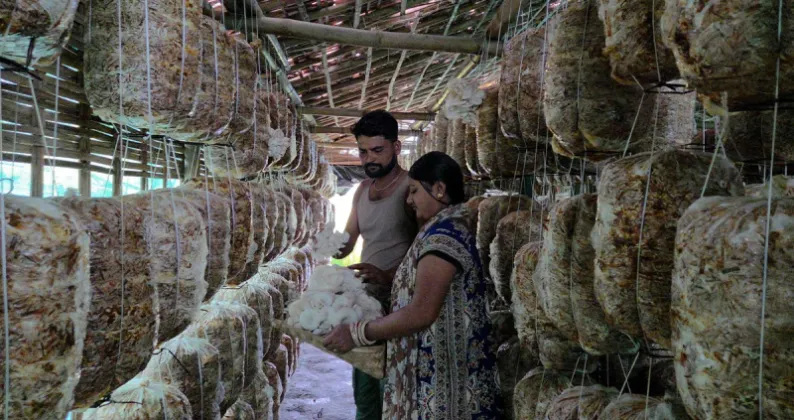
Roshan, a Nepali migrant worker who returned from foreign employment, has built a new livelihood for himself through mushroom farming, and the venture is already paying off in both income and personal satisfaction. According to recent reports published by Thahakhabar and Nepal Views, Roshan took up mushroom cultivation after coming back from abroad, treating agriculture not as a fallback but as a deliberate choice of occupation. The reports highlight his success in the trade and the satisfaction he now draws from work carried out in his own country, offering a fresh example of how returnee migrants can rebuild their lives through farming.
From overseas workplace to the mushroom farm
For hundreds of thousands of Nepali workers, foreign employment is a period of long hours, distant workplaces and postponed family life, and the return home often raises a difficult question: what comes next? In Roshan's case, the answer was mushroom farming. Rather than waiting for another opportunity abroad or drifting into uncertain daily work, he chose an enterprise he could manage himself. Reports describe him as engaged in the cultivation work and, notably, as enjoying it, with his satisfaction in the agricultural venture singled out as a defining feature of his post-return life.
The decision reflects a pattern that development workers and local governments in Nepal have long encouraged among returnee migrants: reinvesting foreign-earned savings and work discipline into productive local enterprise. Agriculture is the most common destination for such investment, and mushroom farming has emerged as a favoured option because it demands relatively little land, starts producing quickly and can be run as a small family operation.
Why mushroom cultivation appeals to returnees
Mushroom farming occupies a distinctive niche in Nepal's agricultural economy. Unlike cereal crops or livestock, mushrooms do not require large plots of land, and production can begin within a short time frame, which matters for returnees who need income soon after arriving home. Cultivation is typically carried out in sheds or simple structures, allowing farmers to manage temperature, humidity and light, and varieties such as oyster and button mushrooms are among the most widely grown in the country.
Several practical features explain why the crop suits returnee migrants like Roshan:
- Modest investment: startup costs are generally lower than for many other agricultural ventures, an important consideration for households whose savings were built through years of labour abroad.
- Quick returns: mushrooms mature within weeks rather than months, giving farmers a faster income cycle than most crops.
- Small space requirement: cultivation can be managed in a compact shed or an adapted room, so farmers without large landholdings can still participate.
- Year-round production: with basic management of indoor conditions, mushrooms can be grown continuously rather than seasonally.
- Growing market demand: urban households, restaurants and hotels have expanded the market for fresh mushrooms, giving producers a ready outlet for their harvest.
For a returnee, these characteristics turn mushroom farming into more than subsistence agriculture. It is a business that can begin on a small scale and grow as experience and confidence build, a trajectory consistent with the success that the reports attribute to Roshan.
Reintegration and the returnee economy
Roshan's story also sits within a larger national picture. Foreign employment remains one of the most significant sources of income for Nepali households, and every year a large number of workers leave the country for jobs overseas. Their return, whether temporary or permanent, presents a reintegration challenge: skills acquired abroad do not always translate into local employment, and job opportunities at home can be limited. Returnees who fail to find productive work are also more likely to migrate again, restarting a cycle that keeps them separated from their families and communities.
Successful examples like Roshan's matter in this context. They demonstrate that the experience and resources gathered overseas can be converted into self-employment at home, creating income not only for the returnee but, as an enterprise expands, often for others in the surrounding community as well. Mushroom farming, because of its low entry barriers and rapid production cycle, is widely regarded as one of the most practical avenues for such reintegration through agriculture, particularly for returnees who do not own extensive farmland.
Satisfaction beyond income
What stands out in the reporting on Roshan is not merely that he earns from mushrooms, but that he is satisfied with the life the venture has given him. The reports emphasise his success and his contentment in equal measure, portraying a returnee who has found in farming both a livelihood and a sense of purpose after his time in foreign employment.
That satisfaction carries significance beyond his own household. For every returnee weighing whether to migrate again, the visible example of a neighbour or acquaintance thriving in agriculture can help tip the decision toward staying and investing locally. In that sense, Roshan's mushroom farm is a small enterprise with a wider demonstration effect, showing that coming home from foreign employment can mark the beginning of a rewarding new chapter rather than the end of one.