
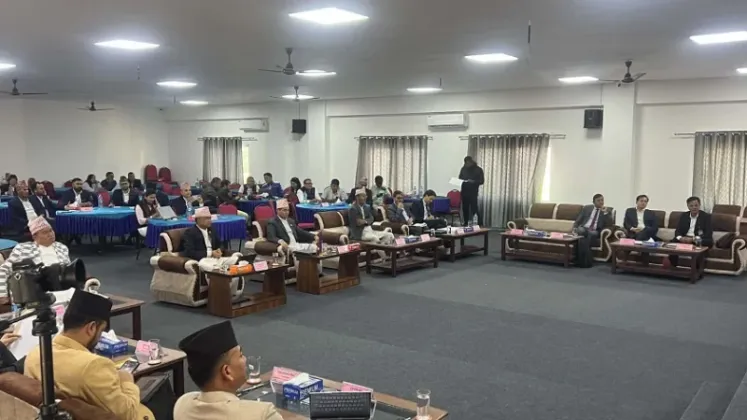
Finance ministers from six of Nepal's seven provinces gathered in Birendranagar, Surkhet, the capital of Karnali Province, for a meeting of the Provincial Economic Affairs Council, where they are debating the effective implementation of fiscal federalism, provincial financial rights and coordination between the country's tiers of government. The meeting, hosted at the Karnali Province Training Institute, was inaugurated by Karnali Chief Minister Mangal Bahadur Shahi, according to reports by RatoPati, Global Aawaj and Aaja ko Artha.
Ministers and representatives from Koshi, Madhesh, Bagmati, Gandaki, Lumbini and host province Karnali are taking part in the discussions, while Sudurpashchim was the only province not in attendance. The gathering brings the country's provincial fiscal authorities around a single table to address questions that go to the heart of Nepal's federal structure: how revenues are raised and divided, how much financial authority provinces actually hold, and how the federal, provincial and local levels work together.
A provincial forum in Karnali's capital
The Provincial Economic Affairs Council convened at the Karnali Province Training Institute in Birendranagar, the administrative centre of Surkhet district in Nepal's mid-west. Chief Minister Shahi formally inaugurated the session, welcoming the finance ministers to the city that serves as the seat of Karnali's provincial government.
The hosting role gave Karnali a visible position in a debate in which it has a direct stake. Like its counterparts, Karnali depends on the fiscal arrangements under discussion to finance its administration, services and development priorities. Holding the council in Birendranagar also underscores the body's character as a province-based platform, convening in a provincial capital rather than in Kathmandu.
The agenda for the session centres on three linked themes:
- The effective implementation of fiscal federalism across Nepal's three-tier structure
- The protection and exercise of provincial financial rights
- Inter-tier coordination among the federal, provincial and local levels
Fiscal federalism at the centre of the debate
The council's core subject, fiscal federalism, concerns the division of revenue and spending responsibilities among Nepal's federal, provincial and local governments. Under the constitution that introduced federalism in 2015, the country was reorganised into seven provinces, each with its own assembly and government and a defined share of fiscal authority, alongside revenue-sharing and transfer arrangements with the federal level. How that framework operates in practice has remained a defining question of Nepal's governance since the transition, and it is precisely this question the ministers have placed at the centre of their Surkhet meeting.
Provincial financial rights
Provincial financial rights, the second theme on the table, relate to the fiscal powers and resources available to provincial governments: the taxes and fees provinces are able to levy themselves, the grants they receive from the federal level, and their share of national revenues. The ministers in Birendranagar are debating how those rights can be made effective, an issue that shapes what provincial governments are able to fund in areas such as health, education and infrastructure within their own jurisdictions.
Inter-tier coordination
The third strand of the discussion, inter-tier coordination, addresses the working relationships between the different levels of government. Nepal's federal setup links the local units, the seven provinces and the federal government through revenue sharing and grant mechanisms, and the day-to-day delivery of services often requires plans and budgets to line up across the tiers. The Provincial Economic Affairs Council offers the provinces a common platform to examine those linkages and to develop shared positions on fiscal matters that affect all of them.
Six provinces present, one seat empty
Attendance at the Surkhet meeting covered six of the country's seven provinces. Reports indicated that all provinces except Sudurpashchim took part, although the reports did not state the reason for that province's absence. Its absence leaves one provincial voice missing from a conversation that directly concerns the fiscal powers of every province in the federation.
For the six delegations present, the meeting brings together finance ministers from across the country, from Koshi in the east to Lumbini in the west alongside host Karnali, giving the session a breadth of provincial representation that few other forums can match. That breadth matters for the agenda at hand, since questions of revenue division and intergovernmental coordination are typically shaped by the balance of views among the provinces as a group.
The deliberations in Birendranagar touch on issues that determine how much authority provinces exercise over their own finances and how smoothly the three tiers of Nepal's federal system function together. As the session proceeds, the positions taken by the six participating provinces on fiscal federalism, provincial financial rights and coordination will feed into the wider, ongoing conversation over how Nepal's federal arrangements are put into practice.


