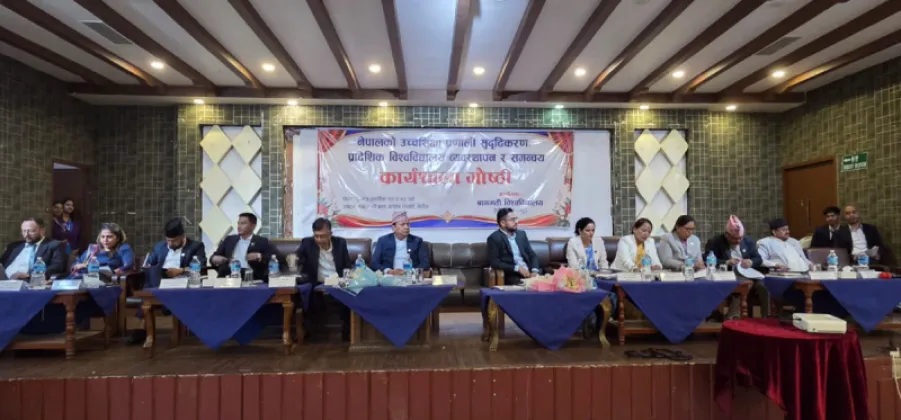
A two-day conference of provincial education and social development ministers and provincial universities began in Hetauda, the capital of Bagmati Province, on Wednesday, bringing together senior representatives from all seven provinces for talks aimed at improving education, raising higher education standards and strengthening cooperation between provinces. Education and Sports Minister Sasmit Pokharel inaugurated the conference, which is scheduled to run through Thursday, Kartik 13, according to Nagarik News.
A common platform for education priorities
The conference has been organised around three broad objectives: improving the overall state of education, raising the standard of higher education and deepening inter-provincial cooperation. By bringing provincial ministers and university leadership into the same room, the meeting is intended to create a shared platform where those who shape education policy and those who run provincial universities can discuss challenges directly rather than in isolation from one another.
According to Khabarhub, participants include ministers from all seven provinces, university officials and government authorities. The key aims of the gathering are:
- improving the quality of education delivered across the provinces,
- raising academic and institutional standards in higher education, and
- strengthening cooperation among provincial governments in education and social development.
The presence of both policymakers and university administrators is significant because provincial governments are now responsible for a substantial share of Nepal's education system, while provincial universities have become increasingly important providers of higher education outside the country's traditional academic centres.
All seven provinces at one table
The participation of ministers from all seven provinces gives the conference a national reach, even though it is being hosted by a single province. When every provincial government is represented, discussions can move beyond the concerns of one region and address questions that cut across provincial boundaries, such as how universities in different provinces can maintain comparable standards and how governments can learn from each other's experiences.
Holding the meeting in Hetauda also places Bagmati Province at the centre of the proceedings. The province provided the venue for a conference whose agenda touches every part of the country, and the Education and Sports Minister formally opened the two days of talks. The conference has also been covered by RatoPati.
Education governance in a federal Nepal
The conference takes place against the backdrop of Nepal's federal restructuring, which distributed responsibility for education among the federal government, the seven provinces and local governments. In the years since, provinces have taken on a growing role in both school education and higher education, and several provinces have established their own universities to bring degree-level study closer to students outside the major urban centres.
That distribution of responsibility has made coordination a recurring theme in Nepal's education policy. Curricula, standards, funding and administration are handled at different levels of government, and gaps between them can affect students and institutions alike. Forums where provincial ministers and universities meet together are one of the mechanisms through which such coordination can be worked out, which is precisely the format adopted in Hetauda this week.
Raising standards in higher education
Among the conference's stated goals, the push to raise higher education standards stands out for the provincial universities gathered in Hetauda. As newer institutions, many provincial universities face the task of building academic credibility, expanding their programmes and ensuring that the qualifications they award are valued by students and employers. Cooperation among the provinces, and between provincial governments and universities, is one route through which those standards can be strengthened.
The broader aim of improving education also connects to the daily concerns of the attending ministers, who hold portfolios covering education and social development in their respective provinces. Their presence in Hetauda reflects the fact that provincial governments now sit at the front line of education delivery for millions of Nepali students.
Talks continue through Thursday
The conference is due to conclude on Thursday, Kartik 13, after a second day of sessions among the participating ministers, university officials and government authorities. The two-day format suggests an effort to move beyond formal opening remarks and allow time for substantive discussion of the agenda.
For the provincial governments and universities gathered in Hetauda, the immediate task over the two days is to translate broad goals such as better education, stronger higher education institutions and closer inter-provincial cooperation into concrete areas of joint work. The discussions that wrap up on Thursday will offer an early indication of how far the seven provinces can go in aligning their education priorities.