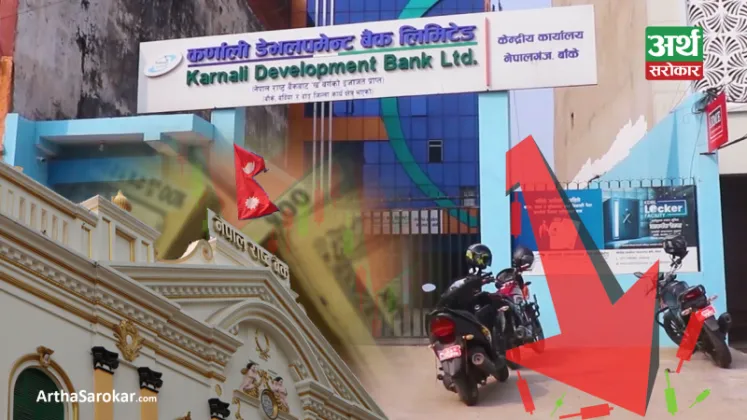
The management team appointed by the Nepal Rastra Bank (NRB) has reduced the share capital of investors in the troubled Karnali Development Bank to just 1 percent, a drastic write-down that follows an assessment finding the bank's liabilities could not be covered by its assets. According to a report by financial news outlet Artha Sarokar, the shares of 35 shareholders were cut to 1 percent after an asset-liability assessment concluded that the institution's obligations could not be met and that its capital had been paid up illegally. The decision effectively strips the bank's existing owners of nearly all of their stake, leaving them with a token holding while the NRB-appointed team runs the lender.
Why the capital was written down
At the centre of the decision is the asset-liability assessment carried out by the management appointed by the central bank. Such an assessment compares everything a bank owns, including loans and recoverable assets, against everything it owes to depositors and other creditors. According to Artha Sarokar, the review found that the liabilities of Karnali Development Bank could not be covered, meaning the bank's obligations outweighed what it could realistically recover from its assets.
The assessment also concluded that the bank's capital had been paid up illegally. Paid-up capital represents the money shareholders have actually contributed in exchange for their shares, and it forms the first cushion a bank draws on when it suffers losses. A finding that this capital was not paid up in accordance with the rules goes to the heart of the bank's financial position, because it means the equity recorded on the bank's books could not be relied upon to absorb losses or protect depositors.
Founder stakes cut from millions of shares to thousands
Business outlet Bizmandu reported that the ownership of the founding shareholders was reduced as part of the action, with 2,136,060 founder shares cut to 21,360 shares. That works out to a holding of 1 percent, meaning the founders now retain roughly one share for every hundred they previously held.
The key figures reported are as follows:
- Shareholders affected: 35
- Founder shares before the reduction: 2,136,060
- Founder shares after the reduction: 21,360
- Remaining stake: 1 percent
The scale of the cut underlines how severe the problems identified in the assessment were. In an ordinary dilution, shareholders might see their proportionate ownership fall if new shares are issued to other investors. Here, the absolute number of shares held by the founders was reduced to a hundredth of its former level, a step associated with situations where the existing capital base is judged to have failed or to have been improperly established.
Shareholders can object, with evidence
The reports note that shareholders who object to the claims against them must submit evidence. According to Bizmandu, those disputing the reduction are required to come forward with documentation to support their position. The arrangement gives the affected investors a channel to contest the findings of the NRB-appointed management, but it also places the responsibility on them to substantiate their objections rather than on the assessment to be disproved.
For the 35 shareholders, the practical effect is that their holdings now stand at a nominal level unless they can successfully challenge the findings. The requirement to submit evidence indicates that the management team is treating its asset-liability assessment and its conclusion on illegally paid-up capital as the operating record of the bank's position, with any departure from that record needing to be demonstrated by the objectors themselves.
What the reduction means for the bank and its stakeholders
The Nepal Rastra Bank, as the central bank and the regulator of banks and financial institutions in Nepal, appoints management teams to troubled institutions as a corrective measure when it judges that the existing board and management cannot safeguard the institution. Once such a team is in place, it typically re-examines the bank's books, verifies its assets and liabilities, and takes corrective action, which can include the kind of write-down now seen at Karnali Development Bank.
Under basic banking principles, shareholders' capital is the first layer to absorb losses, standing ahead of nothing but behind every depositor and creditor claim. When an assessment concludes that liabilities cannot be covered and that recorded capital was not legitimately paid, the value left for shareholders is, in principle, close to zero. Reducing the shareholders' stake to 1 percent reflects that reality: the existing owners retain a token interest while the claims of depositors and creditors are recognised first.
The action also points to how the situation at the bank is expected to develop. A bank emerging from a write-down of this nature generally needs a reconstituted capital base, whether through fresh investment, restructuring or another resolution path, before it can operate on a sound footing. For now, the immediate outcome is clear: the 35 shareholders of Karnali Development Bank have seen their capital cut to 1 percent, and their opportunity to recover anything more depends on whether they can produce evidence strong enough to overturn the findings of the central bank-appointed team.