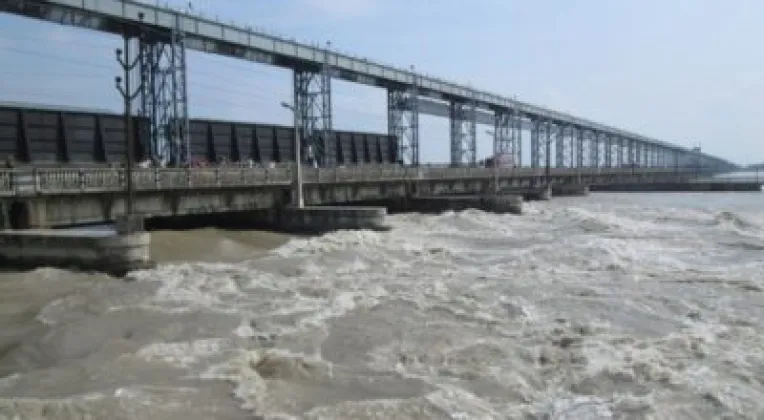
A new three-kilometer bridge is set to be constructed over the Saptakoshi River, connecting Kanchanpur in Saptari district with Rajabas in Sunsari district, in a move that will provide a long-awaited alternative to the existing Koshi Barrage Bridge. According to Chuda Raj Dhakal, Director at the Department of Roads Project Directorate, the project carries an estimated cost of Rs 43 billion and is being taken forward with financial support from the Asian Development Bank (ADB). The announcement confirms that the crossing, one of the most significant infrastructure commitments for Nepal's eastern Tarai, will proceed on the basis of a detailed project report prepared a few years ago, as reported by Khabarhub.
An Alternative Crossing Over the Saptakoshi
The Saptakoshi is one of Nepal's largest and most powerful river systems, and road travelers moving between the districts of Province 1 and Madhesh Province have long depended on the Koshi Barrage Bridge as the principal crossing point over the river. The proposed new bridge is designed to change that. Spanning approximately three kilometers, it will link Kanchanpur in Saptari district on one side of the river with Rajabas in Sunsari district on the other, creating a second dedicated road crossing where currently there is essentially one main option.
Officials describe the structure explicitly as an alternative to the existing Koshi Barrage Bridge. That framing matters for travelers, freight operators and residents of the eastern Tarai, for whom the barrage crossing has been the chokepoint on journeys along and across the eastern plains. By adding a new alignment over the river between Kanchanpur and Rajabas, the project is intended to relieve the pressure that has concentrated on the barrage route and to give traffic a second way to cross the Saptakoshi.
For the communities on both banks, the significance of the project goes beyond the physical structure. A crossing of this scale between Saptari and Sunsari ties together two districts that sit on opposite sides of one of the country's most formidable rivers, and it forms part of the broader push to strengthen road connectivity across the eastern Tarai, where river crossings have historically shaped how and where people and goods can move.
Cost, Financing and the Role of the ADB
The estimated cost of the project is Rs 43 billion, according to Director Dhakal of the Department of Roads Project Directorate. That figure places the bridge among the large-scale infrastructure undertakings in Nepal's road sector, reflecting the engineering demands of building a crossing of roughly three kilometers over the Saptakoshi.
The project is being taken forward with support from the Asian Development Bank. The ADB, a multilateral development bank that finances infrastructure projects across Asia and the Pacific, has been a longstanding partner in Nepal's development efforts, and its involvement signals that the financing for the bridge is expected to be channeled through the bank's support rather than relying solely on domestic resources. For a project of this magnitude, the backing of a multilateral lender such as the ADB is a key element in moving from planning to implementation.
The key details of the project as announced are as follows:
- Location: Over the Saptakoshi River
- Endpoints: Kanchanpur in Saptari district and Rajabas in Sunsari district
- Length: Approximately three kilometers
- Estimated cost: Rs 43 billion
- Financing: Support from the Asian Development Bank (ADB)
- Purpose: To serve as an alternative to the existing Koshi Barrage Bridge
- Planning basis: A detailed project report prepared a few years ago
Built on a Detailed Project Report Prepared Years Ago
According to Director Dhakal, the bridge will be constructed based on a detailed project report that was prepared a few years ago. In Nepal's infrastructure planning practice, a detailed project report, often abbreviated as a DPR, is the technical document that sets out a project's design, alignment, cost estimates and implementation framework. Its preparation is typically one of the final steps before a project moves toward financing and construction, and Dhakal's comments indicate that this groundwork for the Saptakoshi crossing is already in place.
The decision to proceed on the basis of the existing report rather than commissioning a fresh study suggests that the technical planning for the crossing has been awaiting the financial and administrative arrangements needed to begin implementation. With ADB support now attached to the project and the cost estimate fixed at Rs 43 billion, the Department of Roads Project Directorate is positioned to take the bridge from the drawing board toward execution.
What the New Bridge Could Mean for the Eastern Tarai
Once completed, the bridge is expected to reshape travel patterns across the Saptakoshi. As an alternative to the Koshi Barrage Bridge, it would reduce the dependence of through traffic on a single crossing, a dependency that has defined road movement in the region for decades. Travelers heading between Sunsari and Saptari, and between the wider networks of Province 1 and Madhesh Province beyond them, would gain a new route over the river at the Kanchanpur-Rajabas alignment.
The announcement will be watched closely in the eastern Tarai, where demands for improved cross-river connectivity have been a recurring feature of local infrastructure debates. For now, the confirmed elements are clear: a three-kilometer bridge, endpoints at Kanchanpur and Rajabas, an estimated cost of Rs 43 billion, ADB support and a detailed project report ready to guide construction. As the Department of Roads moves the project forward, attention will turn to how quickly those plans on paper translate into work on the banks of the Saptakoshi.
This article is based on reporting by Khabarhub.