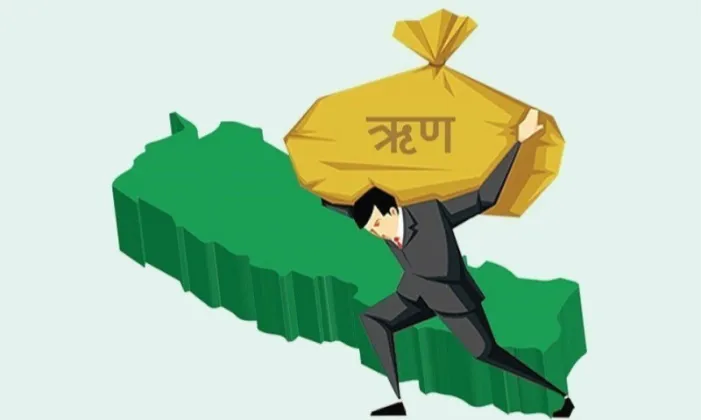
Nepal’s public debt crossed Rs 30 kharba by the end of Asoj in the first quarter of fiscal year 2083/84, reaching Rs 30 kharba 9 arba 11 crore 66 lakh, according to the Public Debt Management Office under the Ministry of Finance. That is about Rs 3.01 trillion in international numbering. The debt stood at Rs 29 kharba 81 arba 70 crore 28 lakh at the start of the fiscal year. The latest figure is equivalent to 45.59 percent of gross domestic product (GDP), while the average debt burden has exceeded Rs 100,000 per Nepali.
Debt rises in the first quarter
The government’s reported debt total was higher at the end of Asoj than at the beginning of the fiscal year. The two figures show a rise over the quarter, although the figures provided do not establish the larger increase cited in some descriptions of the change. The office’s end-of-quarter total includes the country’s public debt as reported to the Ministry of Finance.
The figures are stated in Nepal’s numbering system, in which one kharba equals 100 arba. In international terms, Rs 30 kharba is Rs 3 trillion, not Rs 30 trillion. This distinction is important when comparing the reported amount with GDP or with the government’s borrowing plan. The reported balance of Rs 30 kharba 9 arba is approximately Rs 3.009 trillion.
The rise comes as the government plans to borrow an additional Rs 6.5 kharba during the current fiscal year, equivalent to about Rs 650 billion. The plan indicates that borrowing is expected to continue beyond the first quarter. The stated target is an annual plan; it is not the amount already borrowed by the end of Asoj.
Debt-to-GDP ratio and household burden
At 45.59 percent of GDP, public debt is equivalent to nearly half of the country’s annual economic output. The ratio compares the total debt stock with GDP; it is not a measure of the amount each person must pay immediately. It provides a way to assess the scale of public debt relative to the size of the economy.
The per capita figure, meanwhile, is an average calculated by dividing the debt burden across the population. The reported amount has passed Rs 100,000 for every Nepali. It does not mean that each individual has received a bill for that sum, but it illustrates how the country’s aggregate borrowing translates into an average liability per resident.
The end-of-quarter balance and the government’s full-year borrowing plan together point to the scale of public financing being managed in fiscal year 2083/84. The debt office reported the total as of the end of Asoj, while the borrowing target covers the year as a whole. The figures therefore describe different points in the government’s financing process and should not be treated as the same amount.
What the figures show
The key measures reported by the Public Debt Management Office are the Rs 30 kharba 9 arba end-of-Asoj debt stock, a debt-to-GDP ratio of 45.59 percent, and an average per capita burden above Rs 100,000. The government’s stated plan to borrow a further Rs 6.5 kharba during the fiscal year is a separate target, not a revised debt total.
The latest figures put public borrowing in focus early in the fiscal year. They show that the debt balance increased from its opening level and that the government expects further borrowing. The figures do not, by themselves, explain the reasons for the quarter’s increase or how the planned borrowing will be allocated.