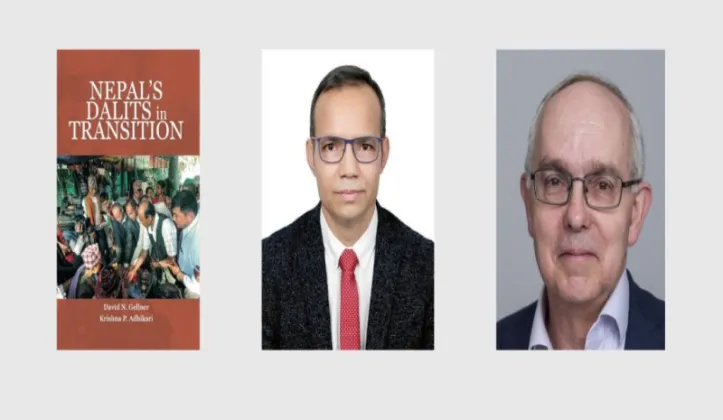
'Nepal's Dalits in Transition', a book that examines the condition of Nepal's Dalit community, has been selected for the Suvedi Prize for the Study of Nepal 2025. The Royal Asiatic Society in the United Kingdom announced the decision on Friday, in London, marking a significant moment for scholarship on caste, inequality and social change in Nepal. In a notable show of agreement, the prize's judging panel chose the winning title unanimously, and the honour carries a clear purpose: to encourage outstanding research and publication in the field of Nepal studies.
The key facts of the announcement are as follows:
- Winning book: 'Nepal's Dalits in Transition'
- Award: Suvedi Prize for the Study of Nepal 2025
- Announcing institution: The Royal Asiatic Society, United Kingdom
- Date and place of announcement: Friday, in London
- Decision: The judging panel selected the book unanimously
- Purpose of the prize: To encourage outstanding research and publication on Nepal studies
- Named in honour of: Prof Surya Suvedi
A Unanimous Verdict from the Judging Panel
Unanimity is rare enough in prize juries that its presence here carries real weight. According to the Royal Asiatic Society's announcement, the panel did not simply settle on 'Nepal's Dalits in Transition' after extended debate; it agreed on the book outright, a detail that underlines the strength of consensus around the title's contribution to the field.
The Suvedi Prize for the Study of Nepal was established in the name of Prof Surya Suvedi, and its stated aim is to encourage outstanding research and publication on Nepal studies. In practice, that means the prize functions both as an award for a single book and as a signal about the kind of scholarship the field wishes to cultivate: rigorous, original and engaged with the questions shaping Nepal today. By placing a work on the condition of the Dalit community at the centre of this year's award, the judges have indicated where they believe that attention should lie.
The Suvedi Prize and Its Purpose
Prizes of this kind do more than reward individual authors. They shape reading lists, influence library acquisitions and draw the attention of scholars, students and general readers who might otherwise miss a title. For a book focused on the condition of Nepal's Dalit community, that visibility matters.
Research on caste and social exclusion often circulates within specialist circles. A prize conferred by a United Kingdom institution, announced in London, helps carry such work to a broader international audience. The recognition also connects two scholarly worlds: the researchers, institutions and readers within Nepal who live closest to the subject, and the global academic community that studies Nepal from abroad. The Suvedi Prize, by design, sits at that junction, and this year's result ensures that a study of Nepal's most persistent social questions now carries the endorsement of one of the field's formal honours.
A Book at the Centre of Nepal's Caste Questions
At its heart, 'Nepal's Dalits in Transition' concerns the condition of the Dalit community, a subject with deep roots in Nepal's social history and an undeniable presence in its present. Caste-based discrimination and social exclusion have shaped the lives of Dalit communities across the country for generations, touching questions of dignity, livelihood, education, representation and everyday social interaction.
The word "transition" in the title points toward the other half of that story: a society in motion, in which long-standing hierarchies are being questioned and the place of Dalit communities within Nepal's political and social life continues to evolve. Scholarship that documents this condition, and the changes unfolding around it, serves a double purpose. It records experiences that have too often been pushed to the margins, and it gives policymakers, activists and general readers a grounded basis for understanding how far Nepal has come and how far it still has to go.
Recognition from London and the Road Ahead
That a United Kingdom institution has placed its endorsement on a study of Nepal's Dalit community is significant for more than ceremonial reasons. For authors and researchers working in this area, the unanimous choice sends an encouraging message: that such work belongs at the centre of Nepal studies rather than at its periphery. It also signals to publishers that books on caste and social transition in Nepal can command serious attention well beyond the country's borders, and it offers readers in Nepal and overseas a clearly signposted entry point into a body of scholarship the judges collectively judged to be the year's most outstanding.
News of the announcement was reported by Gorkhapatra Online, which noted the unanimous decision of the panel and the prize's purpose of encouraging outstanding research and publication on Nepal studies.
The Royal Asiatic Society's Friday announcement settles this year's question, but the prize's larger work continues. As 'Nepal's Dalits in Transition' takes its place among the honoured titles of the Suvedi Prize for the Study of Nepal, the book's central concern, the condition of Nepal's Dalit community, now stands where the judges evidently believe it belongs: at the very centre of the study of Nepal itself.