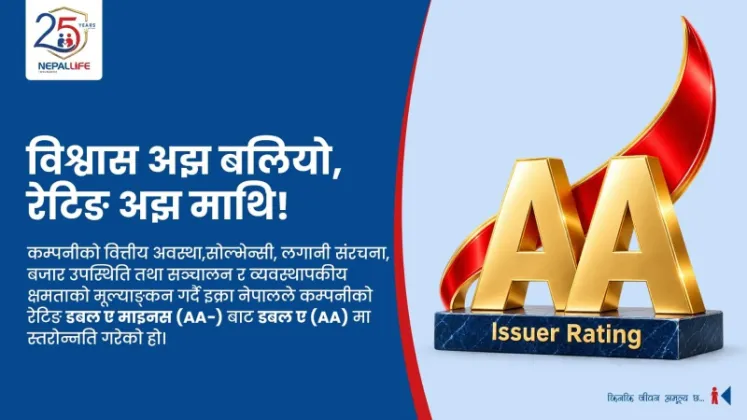
Nepal Life Insurance Company's credit rating has been upgraded to the Double A category, according to separate reports published by Nepali news outlets Nepal Views and Baahrakhari. The revision reflects a reduction in the investment risk associated with the insurer, and both publications frame the change as a positive development for the company's overall financial standing. The upgrade marks a notable moment for the life insurer, as a move into a higher rating category is an external signal that the risk attached to the company has been judged to have declined rather than grown.
What the Reports Say
According to the report published by Nepal Views, Nepal Life Insurance's rating has been upgraded to Double A, with the change attributed to a reduction in the investment risk associated with the insurer. Baahrakhari carried a similar report, likewise presenting the upgrade as good news for the company's financial position.
The key points that emerge from the two reports are straightforward:
- Nepal Life Insurance's credit rating now stands in the Double A category.
- The upgrade reflects reduced investment risk associated with the insurer.
- Both reports characterise the revision as a positive development for the company's financial standing.
In other words, the core message from both outlets is consistent: an insurer that was already operating in the market has now been assessed as carrying a lower level of risk than before, and that assessment has translated into a higher rating category.
Why Investment Risk Sits at the Heart of the Decision
The stated driver of the upgrade is a reduction in investment risk associated with Nepal Life Insurance. In broad terms, a credit rating is an external assessment of how likely an entity is to meet its financial commitments on time and in full. When the risk attached to investing in, lending to, or entering long-term arrangements with a company declines, a corresponding improvement in the rating typically follows.
This logic carries particular weight in the insurance industry. Insurers collect premiums from large numbers of policyholders and are expected to honour claims that may fall due years, or in the case of life insurance even decades, after those premiums were first paid. The ability of an insurer to manage that long horizon depends heavily on the strength and stability of its overall financial position.
Against that backdrop, a reduction in the investment risk associated with an insurer is significant. It suggests that the parties assessing the company see less likelihood of difficulty in meeting its obligations, and it is precisely this kind of improvement that rating upgrades are designed to capture. The two reports on Nepal Life Insurance present the upgrade in exactly these terms: less risk, and therefore a better rating.
How a Double A Category Is Generally Understood
While the reports do not set out the full methodology behind the decision, the Double A category is generally regarded as a high tier in most credit rating frameworks. Entities placed in this band are typically viewed as having a strong capacity to meet their financial obligations, with the perceived level of risk sitting only modestly above the very highest rating levels.
For readers who follow the insurance and financial sectors, the practical significance of such a placement can be summarised as follows:
- A Double A category rating generally signals a high degree of financial reliability on the part of the rated entity.
- An upgrade into this category indicates that the perceived risk of the insurer failing to meet its commitments has declined.
- Rating categories of this kind are widely used as a common reference point when stakeholders weigh the soundness of a financial institution.
Seen this way, the upgrade is both a description of the insurer's current standing and a benchmark that others in the market can refer to when forming their own view of the company.
A Positive Marker for Financial Standing
Both Nepal Views and Baahrakhari frame the upgrade as a positive development for Nepal Life Insurance's financial standing. In financial reporting generally, a ratings upgrade is read as independent validation that a company's risk profile has improved. Applied to Nepal Life Insurance, the reports suggest that the insurer is now viewed as a lower-risk proposition than it was under its previous assessment.
For the company's policyholders, an improved rating can be reassuring, since it points to greater confidence in the insurer's ability to pay claims and meet its policy obligations as they fall due. For counterparties, partners and observers of the insurance sector, the revised rating offers an updated picture of how the insurer's risk profile is currently judged.
It is worth noting that both reports are concise. They establish the fact of the upgrade, attribute it to a reduction in investment risk associated with the insurer, and present it as encouraging news for the company's financial position, without extending into detailed financial analysis. Readers who wish to review the original coverage can find the report from Nepal Views, with Baahrakhari having published similar coverage of the development.
Taken together, the two reports leave a clear impression: Nepal Life Insurance enters this new phase with a strengthened external rating, a reduced investment risk profile, and a positive verdict on its financial standing from the outlets covering the story.