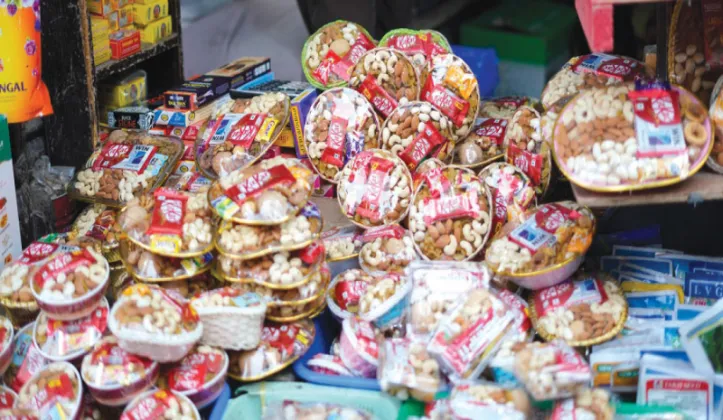
Nepal imported Bhai Masala dry fruits worth Rs 3 billion 31 crore 32 lakh between Shrawan and Ashoj of the current fiscal year, according to the Department of Customs, as the country prepared for this year’s Tihar festival. The imported items included walnuts, peanuts, cashews, raisins and pistachios, while data from the Trade and Export Promotion Centre also put the total value at around Rs 3 billion. Prices rose across all items in the Bhai Masala basket.
Imports exceed Rs 3 billion
The customs figure translates to Rs 3.3132 billion for the three-month period from Shrawan through Ashoj. The amount covers imports of the dry fruits identified as Bhai Masala, a group of items associated with Tihar. The Trade and Export Promotion Centre’s estimate was also around Rs 3 billion, placing the two reported figures in broadly similar territory.
The figures show the value of the imports, rather than the quantity of dry fruits brought into Nepal. The available data do not specify how many tonnes or individual units of walnuts, peanuts, cashews, raisins or pistachios were imported. Nor do they provide a breakdown of the total value by product. As a result, the overall figure records the scale of spending on the listed items but does not show which dry fruit accounted for the largest share.
The reporting period is also important: the customs total covers Shrawan to Ashoj of the current fiscal year, rather than imports across the full year. The figures therefore reflect trade during those months ahead of Tihar. They do not, on their own, establish how much of the imported stock was sold during the festival or how much may have been held for sale later.
Prices rise across the Bhai Masala basket
Prices increased for all the items included in the Bhai Masala basket, according to the reported information. The rise applied across walnuts, peanuts, cashews, raisins and pistachios, rather than being limited to a single product. However, the available details do not state the amount of the increase for each item or give a comparison with prices in a previous year.
Without item-by-item price figures, the reported rise cannot be used to determine which dry fruit became more expensive by the greatest amount. The import total likewise does not indicate how much of its increase, if any, came from higher prices rather than changes in import quantities. The customs and Trade and Export Promotion Centre figures provide a broad measure of the value involved, but not enough detail to separate those factors.
A snapshot of seasonal trade
The imports provide a snapshot of trade in dry fruits ahead of Tihar, when Bhai Masala is part of the festival context. The range named in the figures includes both nuts and dried fruit: walnuts, peanuts, cashews and pistachios, alongside raisins. Together, these products account for the reported customs total of more than Rs 3.3 billion during the Shrawan-to-Ashoj period.
The Department of Customs data offer the more precise reported total, while the Trade and Export Promotion Centre places the value at approximately Rs 3 billion. Both point to imports worth more than Rs 3 billion for the festival period. With no further breakdown provided, the figures do not identify the countries supplying the products, the volume imported or the share of each item in the total.
The reported increase in prices across the basket adds a cost dimension to the seasonal trade figures. Still, the information available does not quantify the effect on retail prices or on household spending. What it establishes is that Nepal brought in more than Rs 3 billion worth of the listed dry fruits between Shrawan and Ashoj, while prices for every item in the Bhai Masala group rose.